5 Questions to Ask About Your Big Data

In statistics, a hypothesis is proposed and then data samples are collected to prove or disprove the hypothesis with acceptable confidence levels. For example, let’s say that all our customers are aware of all our product lines. Basically, there are two ways of assessing our hypothesis that includes: (1) Proving our hypothesis and (2) Disproving our hypothesis.

The first way to proving our hypothesis is that we communicate with all of our customers and inquire if they know all our product lines. The second way is to communicate with as many customers as possible until we come across any customer that does not know all our product lines. From this example, we can see that if we find even one customer then that disproves our hypothesis. Thus, this is the reason why in statistics, sometimes it is easier to find an exception to disproving a hypothesis rather than proving it.

Big Data, on the other hand, inverts the generally acceptable process from hypothesis then data sample collection to data collection then a hypothesis. What this means is that Big Data emphasizes collecting data first and then coming up with a hypothesis based on patterns found in the data. Generally speaking, when we talk about Big Data, we are concerned with the 3 Vs that include:

  • Volume – Amount of data
  • Velocity – Rate of data analysis
  • Variety – Different data sources

Some have indicated that we need to go beyond just the above three Vs and should also include:

  • Viscosity – Resistance to the flow of data
  • Variability – Changes in the flow changes of data
  • Veracity – Outlier data
  • Volatility – Validity of the data
  • Virality – Speed at which data is shared

I would take the Big Data concept a bit further and introduce:

  • Vitality – General and specific importance of the data itself
  • Versatility – Applicability of data to various situations
  • Vocality – Supporters of data-driven approaches
  • Veto – The ultimate authority to accept or reject Big Data conclusions

For a metrics-driven organization, a possible way to determine the effectiveness of your Big Data initiatives is to do a weighted rating of the Vs based on your organizational priorities. These organizational priorities can range from but not limited to increasing employee retention rates, improving customer experiences, improving mergers and acquisitions activities, making better investment decisions, effectively managing the organization, increasing market share, improving citizens services, faster software development, improving the design, becoming more innovative and improving lives. What all of this means is that data is not just data but it is, in fact, an organization’s most important asset after its people. Since data is now a competitive asset, let’s explore some of the ways we can use it:

  • Monte Carlo Simulations – Determine a range of scenarios of outcomes and their probabilities.
  • Analysis of Variance (ANOVA) – Determine if our results change when we change the data
  • Regression – Determine if data is related and can be used for forecasting
  • Seasonality – Determine if data shows the same thing occurring at the same intervals
  • Optimization – Getting the best possible answer from the data
  • Satisficing – Getting a good enough answer from the data

Now that we understand what is Big Data and how it can be used, let’s ask the following questions:

Today

Tomorrow

Who is capturing data?Who should be capturing data?
What is the lifecycle of your data?What should be the lifecycle of your data?
Where is data being captured?Where should data be captured?
When is data available for analysis?When should data be available for analysis?
Why data is being analyzed?Why data should be analyzed?

Having discussed the positives of Big Data, we have to realize that it is not a panacea and has its negatives as well. Some of the negative ways data can lead to bad decisions include: (1) Data is correlated but that does not imply cause and effect, (2) Data shows you pretty pictures but that does not imply it is telling you the truth and (3) Biases can affect data anywhere from capturing to analysis to decision-making.

In conclusion, what this means is that the non-distorted quality, understanding, and usage of data is the difference between just getting on the Big Data bandwagon or truly understanding how data can fundamentally change your organization.

Big Data Vs

References:

  1. Realizing the Promise of Big Data
  2. Beyond the three Vs of Big Data
  3. 5 Factors for Business Transformation
  4. 5 Questions to Ask About Your Business Processes
  5. 5 Questions to Ask About Your Information
  6. 5 Questions to Ask About Customer Experiences
  7. 5 Observations on Being Innovative (at an organizational level)
  8. Where is my Big Data coming from and who can handle it

Processing…
Success! You're on the list.

5 Questions to Ask About Your New Year Reboot

For some organizations, December/January is that time of the year where organizations reflect on what happened during the prior year and what goals need to be accomplished for the current year. This reflection revolves around the organization’s people, processes and technologies. It also involves creating strategies, understanding the effects of internal and external politics, competing innovatively, transforming culture and polishing execution. In order to thoroughly learn and objectively plan, the right questions need to be asked. These questions open the organization to have a better understanding of what has happened and helps in determining what needs to happen. By no means, these are the only questions to be asked but rather should be used as a starting point to go beyond a mere surface-level understanding of issues. So, let’s ask them:

Today

Tomorrow

Who develops the strategy?Who should develop the strategy?
What internal and external politics affected your organization?What internal and external politics should not affect your organization?
Where did the inspiration for innovation came from?Where inspiration of innovation should come from?
When culture trumped strategy?When should culture trump strategy?
Why execution was flawed?Why execution would continue to be flawed in the future?

When you are asking the above questions, keep in mind that organizational silos have to be broken down to create a well-oiled machine where all gears interconnect with each other and understand each other’s roles and responsibilities. An organization that can consistently set goals, track them and measure them against expectations, have better data to make informed decisions.

In conclusion, take this time to understand the multidimensionality of your organization. New Years is about reboot; reboot your organization to become a disruptive force; reboot so that your employees, partners, customers, and stakeholders become your megaphone; reboot your business processes to bring products and services quickly to the market; reboot to create a learning organization; reboot to make data open your eyes to new possibilities and reboot to create an organization that positively serves people beyond perceived organizational boundaries.

newyearreboot
New Year Reboot

Processing…
Success! You're on the list.

5 Questions to Ask About Customer Experiences

According to Forrester®, “to be truly competitive your company must become customer-obsessed; you need to have deep knowledge of and engagement with your customers.” The need for the organization to be obsessed with the customer revolves around data and engagement. Data-level obsession encompasses collecting as much information as you can about the customer so that the unique needs (e.g., Amazon buying preferences, Facebook habits, and likes, etc.) of the customers can be met. This information can be gathered directly from the customer (e.g., surveys, account signups, etc.) and/or can be obtained by analyzing trends (e.g., census data, inventory depletion data, etc.) Engagement-level obsession encompasses providing services to the customer that can be person-to-person (e.g., customer service, social media, etc.) and/or can be person-to-technology (e.g., corporate website, kiosks, etc.). As technology becomes commonplace and continues to get cheaper, more and more organizations are moving towards combining their data and engagement obsessions to provide a seamless experience for the customers. Customers are becoming smarter and while at one point price was one of the major factors of customer decision-making but now the quality of products and services is becoming very important.

For organizations, customer experience revolves around maximizing the potential of its people, processes, and technologies. From this perspective, customer experience is not only about the customer but also about the organization as a whole. Thus, in order to understand the holistic nature of customer experiences, organizations need to assess the current customer experiences and determine what future customer experiences should entail. This starts by asking the following questions:

TodayTomorrow
Who serves your customers?Who should serve your customers?
What avenues are being used to make the life of customers easier?What avenues should be used to make the life of the customers easier?
Where do customers experience your organization?Where should customers experience your organization?
When do customers engage with your organization?When should you be available for the customers based on their needs?
Why customer experience matters?Why customer experience is becoming the next currency?

When you are asking the above questions, keep in mind that organizations that know how to leverage its people, processes, and technologies and who are open to exploring new paradigms of customer experience would be far ahead of the game. These organizations are not only obsessed about customer experience but create executable strategies that enhance the experience for internal and external customers.

In conclusion, customer experience is more than just external-facing activities. Customer experience is about trust; trust that you would have the most competent people for representing your organization; trust that your business processes are as efficient as they can be; trust that you would use technologies to enhance and not exploit the lives of customers; trust that you would provide the best products and services to your customers; trust that you would safeguard customer information with the utmost security and privacy; trust that you would be professional even when customers have decided to leave your organization for your competitors and trust that you would not monopolize customers’ choices even if yours is the only a handful of organizations who can serve these customers.

Holistic Customer Experiences

References:

  1. Winning in the Age of the Customer
  2. 5 Factors for Business Transformation

Processing…
Success! You're on the list.

Top 5 Articles of 2014

Thank you to the readers in 95 countries that read my articles in 2014. Following are the top 5 articles that you have been interested in:

  1. Thoughts
  2. Future Considerations for Kodak
  3. 5 Questions to Ask About Your Information
  4. 5 Factors for Business Transformation
  5. Zillow.com and the MLS CIO

Following are the top 20 countries where most readers have come from:

  1. United States
  2. India
  3. United Kingdom
  4. Canada
  5. Pakistan
  6. Australia
  7. Brazil
  8. South Africa
  9. Philippines
  10. Netherlands
  11. Germany
  12. Malaysia
  13. Italy
  14. France
  15. Indonesia
  16. Turkey
  17. Singapore
  18. Nigeria
  19. United Arab Emirates
  20. Hungary

Processing…
Success! You're on the list.

5 Questions to Ask About Gamification

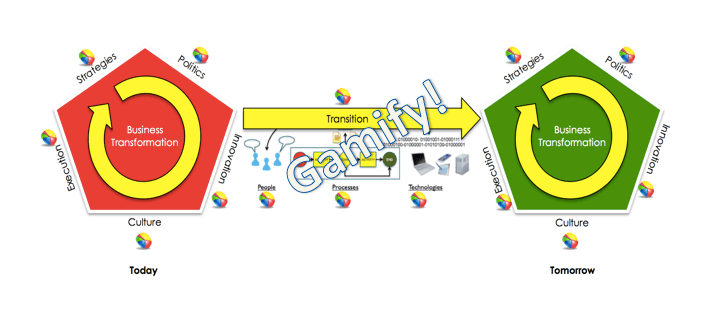
The term gamification refers to “the use of game design elements in non-game contexts.” (Deterding et al.) The non-game contexts imply that gamification is different than games and can be applied to society, business, technology, and individuals at various levels. Gartner goes a step further and defines gamification to be “the use of game mechanics and experience design to digitally engage and motivate people to achieve their goals.” Essentially what this means is that gamification is used to change the norms, attitudes, and habits of individuals and organizations from a current state to a desired future state typically through the utilization of technology. Generally speaking, the use of gamification in the organization can be categorized into external uses (e.g., customer engagement) and internal uses (e.g., employee engagement).

In order for organizations to effectively leverage gamification as a game-changer, they have to ask the following questions:

Today

Tomorrow

Who is using gamification externally and internally?Who should be using gamification externally and internally?
What is gamified?What should be gamified?
Where it is being used?Where it should be used?
When are gamified types of activities are happening?When should gamified types of activities be happening?
Why it is becoming a competitive advantage?Why you should be using it as a competitive advantage?

When you are asking the above questions across all levels of the organization, here are few things to keep in mind (1) have clearly defined goals for the players/users and the organization, (2) blindly applying gamification without thinking through organizational repercussions can be costly, (3) measure progress, get feedback and iterate, (4) create value since it is a not a one-way street but a multi-way street and (5) balance between intrinsic considerations and extrinsic rewards.

Here organizations have a choice about gamification as a (1) passing fad or (2) as a strategic lever that can help them transform. So, the real question about using gamification becomes, “Can you afford not to do it?”

Gamify SPICE
Gamify SPICE

References:

  1. Sebastian Deterding, Dan Dixon, Rilla Khaled, and Lennart Nacke. 2011. From game design elements to gamefulness: defining “gamification”. In Proceedings of the 15th International Academic MindTrek Conference: Envisioning Future Media Environments (MindTrek ’11). ACM, New York, NY, USA, 9-15. DOI=10.1145/2181037.2181040 http://doi.acm.org/10.1145/2181037.2181040
  2. “Gamification – Gartner IT Glossary.” Gartner IT Glossary. Gartner, n.d. Web. http://www.gartner.com/it-glossary/gamification-2/
  3. Werbach, Kevin. “Coursera – Gamification.” Coursera. Coursera, n.d. Web. https://www.coursera.org/course/gamification
  4. Krogue, Kevin. “5 Gamification Rules From The Grandfather Of Gamification.” Forbes. Forbes Magazine, n.d. Web. http://www.forbes.com/sites/kenkrogue/2012/09/18/5-gamification-rules-from-the-grandfather-of-gamification/
  5. Stanley, Robert. “Top 25 Best Examples of Gamification in Business.” Clickipedia. Clickipedia, 24 Mar. 2014. Web. http://blogs.clicksoftware.com/clickipedia/top-25-best-examples-of-gamification-in-business/
  6. Kleinberg, Adam. “Brands That Failed with Gamification.” – IMediaConnection.com. – IMediaConnection.com, 23 July 2012. Web. http://www.imediaconnection.com/content/32280.asp

Processing…
Success! You're on the list.