Take the free 5-minute SPICE assessment — a scored readout across Strategy, Politics, Innovation, Culture, and Execution, plus reading recommendations.
Every transformation effort runs through the same five lenses: Strategy, Politics, Innovation, Culture, and Execution. Miss one, and the whole thing stalls.
So I turned the SPICE framework into a free 15-question assessment. It takes about three minutes, and it gives you an overall readiness score, a dimension-by-dimension profile, and two priority actions to work on first.
I asked Lynn Perry Wooten, the president of Simmons University, a question that makes higher education visibly uncomfortable: “It seems like students are your customers — hence the focus on customer experience. How do you think about that?”
Watch what the question does. In a business, “the customer” is an organizing principle: the person whose experience you exist to serve, whose departure you fear, whose feedback you instrument. In a university, the same word sounds like a surrender — as if admitting students are customers means the degree becomes a product, the professor a vendor, and education a transaction with a diploma at the end.
Both reactions miss the point. The question isn’t whether students are customers. It’s what breaks when an institution refuses to decide.
Look at it through the SPICE lenses — Strategy, Politics, Innovation, Culture, Execution:
Strategy. A university that won’t name who it serves ends up serving everyone’s second priority: rankings for the board, research prestige for the faculty, amenities for the brochure. Wooten’s answer points at the strategic alternative — the student’s transformational experience as the product. That’s a harder promise than satisfaction. A customer-experience strategy for a university isn’t “give them what they want.” It’s “design, deliberately, the experience that changes who they are — and measure whether it happened.”
Politics. The customer word is a turf war in disguise. If students are customers, students get a vote — on schedules, on modality, on what a degree should contain — and every one of those votes dilutes someone else’s authority: the faculty’s over curriculum, the administration’s over tradition, the alumni’s over what the place is supposed to remain. Institutions don’t reject the customer frame because it’s inaccurate. They reject it because it’s a redistribution of power wearing a vocabulary question as a costume.
Innovation. The genuinely innovative move isn’t a chatbot for admissions. It’s importing the discipline of customer-experience design — journey mapping, friction audits, feedback loops with closing dates — into an institution that has historically run on anecdote and prestige. Where does a first-generation student actually get lost: the application, the aid letter, the first semester, the advising gap? Businesses instrument those moments because churn taught them to. Universities mostly discover them at the exit interview that never happens.
Culture. Here’s the cultural trap: in higher education, caring too visibly about the student’s experience can read as caring less about standards — as if rigor and service were opposite poles. So faculty distance themselves from the “customer” language to protect their identity as scholars, and the student’s experience becomes nobody’s identity and therefore nobody’s job. The institutions that escape this trap separate the two cleanly: the standard is non-negotiable; the experience of meeting it is a design problem, and designing it well is a form of respect, not surrender.
Execution. So here’s the machinery: pick three moments that decide whether a student stays — the aid letter, the first failed exam, the advising meeting that never gets scheduled — and assign each one a named owner, a measured outcome, and a feedback loop that closes with the student, not about the student. Publish internally, every term, where students actually fell out of the journey and what changed because of it. You don’t need to call them customers to do any of this. You just need to admit that their experience is designed — by you or by accident.
Today, universities debate the word while their students quietly judge the experience — and transfer, drop out, or never apply. Tomorrow’s winners will have stopped arguing about vocabulary and started owning the journey.
Ask yourself: if your students reviewed your institution the way they review everything else in their lives — publicly, specifically, and forever — what would the rating say about the moments you never designed?
In May 2013 I published two of the most hands-on posts this blog has ever carried: how to use AppleScript to automate job searches across Indeed, CareerBuilder, Monster, and SimplyHired. People still find them today.
Thirteen years later, the job boards have changed beyond recognition — and so have the tools. What hasn’t changed is the problem: a serious job search is 80% repetitive research and 20% judgment. So here’s the 2026 version of that post. I do the repetitive 80% with Muse now.
Two honest notes before the how-to. First, I’ve been using Muse a short time, not for years — this is what’s actually working for me right now, not a masterclass. Second, this post was drafted with Muse’s help, at my request. I’d rather tell you than have you guess.
The workflow
1. Decode the job description. Paste the job description in and ask Muse to pull out the must-haves, the nice-to-haves, and what’s implied but unsaid — then score your fit against each, using only what’s on your resume. Insist on the honest scoring. Flattery helps no one, least of all you.
2. Tailor without fabricating. “Rewrite these bullets to match the job description’s language. Do not invent experience I don’t have.” Then verify every single line yourself. Hiring managers can smell invented achievements, and AI-invented ones all smell the same.
3. Draft the cover letter around something real. Give it two or three genuine reasons — a product you admire, a problem you want to work on — and let it draft around those. Generic enthusiasm is worthless. Specific curiosity isn’t.
4. Build the tracker. “Make me an application tracker: company, role, date applied, contact, status, next follow-up.” Boring. Essential. In 2013 my AppleScript wrote results to a log file; this is the same instinct with better tooling.
5. Rehearse the hard questions. “Based on this job description and my background, give me the ten toughest questions I’ll face, then critique my answers.” Answer out loud. Muse is a patient sparring partner that never gets tired of round three.
6. Research the other side of the table. “Summarize this company’s current strategy and give me five sharp questions for the hiring manager.” Good questions beat good answers in an interview — they signal you did the work.
What it won’t do
It won’t apply for you, it doesn’t know the hiring manager, and it will confidently invent a certification you never earned if you let it. The rule from 2013 still holds: automate the repetitive work, keep the judgment.
Try Muse
If you want to try it, here’s my invite link: https://muse.ai/join — code: EZWUM8. Redeem it within 48 hours of joining and we both get 1 billion additional Muse tokens — a license for extra AI usage inside Muse (not money, not a gift card), and once credited it doesn’t expire. On iPhone/Android: the Muse app, Settings > Redeem referral code. On the web: Settings > General > Usage > Redeem invite code.
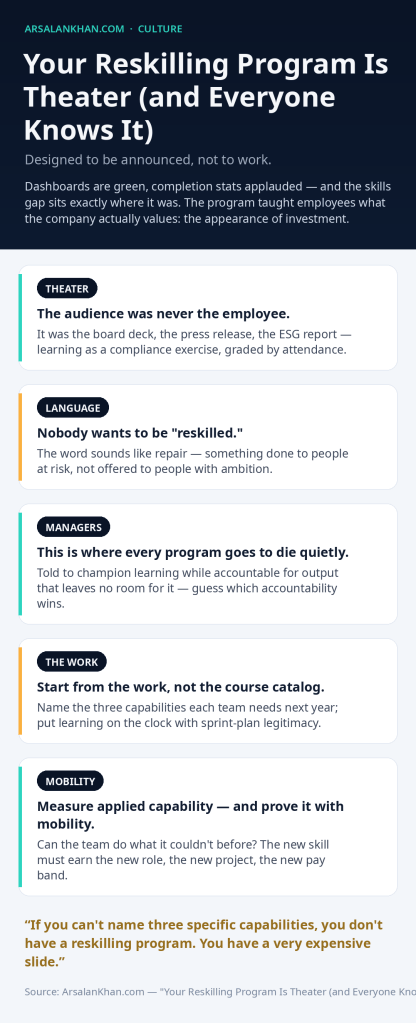
I'll say the quiet part out loud: your reskilling program is theater. And everyone — the employees clicking through modules at double speed, the managers quietly denying anyone time to learn, the executives presenting the completion stats — everyone knows.
Look at what gets measured. Course enrollments. Hours logged. Badges issued. Certificates downloaded. Every dashboard is green, every quarterly review applauds the "investment in our people" — and the skills gap sits exactly where it was last year, untouched. If the goal were new capabilities, someone would have noticed by now that nobody can do anything they couldn't do before the program started.
Theater needs an audience, and the audience was never the employee. It was the board deck, the press release, the ESG report. The program was designed to be announced, not to work.
That's the Culture problem, and it's the deeper of the two. A reskilling program teaches your people something — just not what's in the curriculum. It teaches them what the company actually values: the appearance of investment over the investment itself. It teaches them that learning is a compliance exercise, something done to you on a deadline and graded by attendance. And it teaches them the quietest lesson of all: that the organization would rather fund the illusion of growth than do the uncomfortable work of changing how work gets done.
There's a second cultural poison in the framing itself. Nobody wants to be "reskilled." The word sounds like repair — you're broken, we'll fix you, then put you back on the shelf. It's something done to people at risk, not something offered to people with ambition. So the employees who most need to grow avoid it, the ones who show up are the already-motivated, and HR reports record enrollment as if it meant engagement.
And then there's the manager layer, where every reskilling program goes to die quietly. The manager is told to champion learning while being held accountable for output that leaves no room for it. Guess which accountability wins. The employee who blocks two hours for a lab gets the look. The one who finishes the course goes back to the same job, the same metrics, the same manager who never once asked what they learned. Everyone's watching, and everyone absorbs the real lesson: growth is a hobby you're permitted on your own time.
Execution is where the theater becomes visible — because real reskilling looks nothing like a catalog.
Real starts from the work, not the course library. Name the three capabilities each team will actually need next year — the ones tied to where the business is going, not where the LMS vendor's content happens to be. Build the learning around those. Put it on the clock, in the sprint plan, with the same legitimacy as a customer deliverable. Make the manager accountable for the team's growth the way they're accountable for the team's output — same review, same weight.
Then measure the thing that matters: applied capability. Can the team now do the thing it couldn't do before? Not "did they finish the module" — can they do the work. I've never seen a completion-rate dashboard close a skills gap. And close the loop visibly: the person who builds the new skill gets the new role, the new project, the new pay band. Mobility is the proof. Right now the loop runs in reverse — learn on your own time, return to the same desk — and then leadership wonders why the ambitious ones leave for the competitor who will actually use what they learned.
None of this is complicated. It's just uncomfortable, because it moves reskilling out of HR's budget line and into the operating model — into managers' calendars, into promotion decisions, into what gets rewarded on Monday morning. Theater is cheaper. Theater doesn't require a single executive to change anything about how their organization actually runs.
So here's the honest audit, and it takes about ten minutes. Pull up your reskilling dashboard. Now answer: what can your people do today that they couldn't do before the program existed? If you can't name three specific capabilities, you don't have a reskilling program.
I asked Anupam Khare, the CIO of Oshkosh Corporation, a question that sounds like it’s about analytics and is actually about power: “When it comes to using data for decision making, how do you make sure that an executive or a business leader’s experience — which is to say their bias — doesn’t overshadow what the data is saying?”
Notice the trap inside the question. We assume the data is neutral and the executive is the problem. Sometimes that’s true. Sometimes the executive’s “bias” is twenty years of pattern recognition the dataset hasn’t lived long enough to learn, and the data is a beautifully formatted record of a world that no longer exists.
So the real question isn’t data versus experience. It’s this: in your building, when the two disagree, who wins — and was that ever a decision, or just a habit?
Look at it through the SPICE lenses — Strategy, Politics, Innovation, Culture, Execution:
Strategy. Data and experience answer different questions. Data tells you what happened at scale; experience tells you which parts of what happened actually mattered. A strategy that crowns either one permanently is a strategy with a blind spot by design. The manufacturers who get this right treat the disagreement itself as the signal — when the dashboard and the veteran diverge, that’s not noise. That’s the exact spot where the decision deserves a second hour.
Politics. Let’s be honest about why data usually loses. The person with the experience has the title, the budget, and the relationship with the CEO. The data has a PDF. “My gut says otherwise” is rarely an analytical position — it’s a veto held by someone who has never had to write down what their gut is based on. And here’s the part nobody says in the meeting: executives don’t reject data because they distrust it. They reject it because accepting it would mean a past decision — theirs — was wrong.
Innovation. The genuinely innovative move isn’t a better dashboard. It’s a decision protocol: a standing rule that says when a model and a senior leader conflict above a certain dollar threshold, both sides state their reasoning in writing before the call is made. Oshkosh’s framing — moving from data-driven to data-rich decision making — points the same way. The innovation is in enriching the decision, not automating the decider.
Culture. In most organizations, the career-safe move is to agree with the senior person’s experience and quietly let the data die in an appendix. So that’s what people do, and then leadership wonders why the analytics investment never changed a single outcome. Culture is what happens to the analyst who brings the inconvenient chart. Promote that person once — publicly — and you’ll get honesty for a decade. Bury the chart once, and you’ll get decoration forever.
Execution. So here’s the machinery: pick your ten most consequential recurring decisions. For each one, write down — in advance — what evidence would override the senior person’s judgment, and what experience would legitimately override the model. Review the disagreements quarterly: who won, and were they right? You now have something almost no company has: a track record for both your data and your executives’ instincts. Most leaders grade only one of those.
Today, the winner is decided by seniority and the loser is decided by silence. Tomorrow, the winners will be the companies that made the disagreement a governed event instead of a hallway war.
Ask yourself: in your last big decision, did the data lose an argument — or was it never actually allowed to make one?
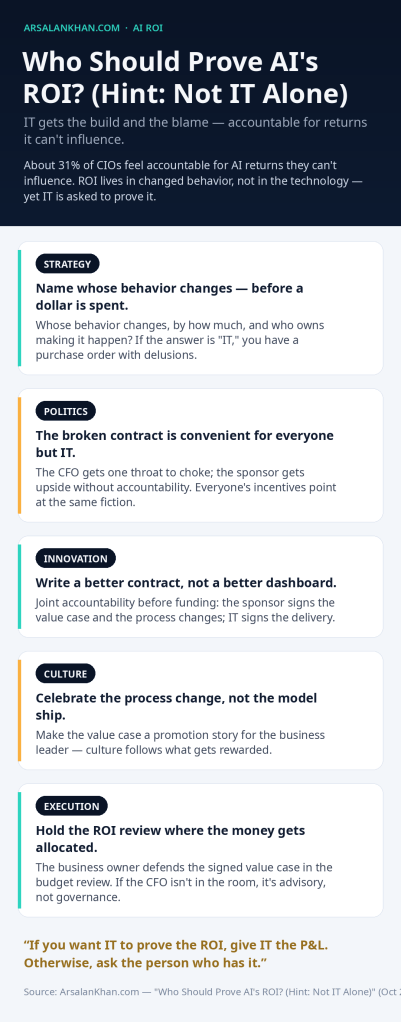
The CFO wants ROI. The business unit wants the capability. And IT gets handed both the build and the blame. About 31% of CIOs say they feel accountable for returns they can't influence — and that number should embarrass everyone who isn't in IT, because it describes a broken contract, not a failed function.
Think about what we're actually asking. IT is told to prove the financial return of a transformation it doesn't control. The business unit owns the process, the people, the incentives, and the decision rights — IT owns the model. When the process doesn't change, the model can't produce returns. And then the CIO gets the question: "Where's the ROI?" As if the algorithm were supposed to reorganize the department on its own.
Notice the asymmetry: when the transformation works, the business unit led it. When it doesn't, IT picked the wrong tool. The CIO gets accountability in both directions and authority in neither — responsible for the outcome, powerless over the inputs. No other executive would accept that deal. CIOs accept it every budget cycle.
This is accountability without authority — the oldest trap in organizational life — and we've rebuilt it around AI with a straight face.
Run it through SPICE:
Strategy. ROI doesn't live in the technology; it lives in the changed behavior the technology enables. A model that predicts churn produces zero return until someone changes how retention is worked. A document agent saves zero hours until the approval chain is actually shortened. Strategy means naming, before a dollar is spent, whose behavior changes, by how much, and who owns making that change happen. If the answer to "who owns the change" is "IT," you don't have a strategy. You have a purchase order with delusions.
Politics. Here's why the broken contract persists: it's convenient for everyone except the CIO. The CFO gets a single throat to choke — one budget line, one accountable executive, clean governance theater. The business sponsor gets the upside of the capability with none of the accountability for the outcome; if it works, they led the transformation, and if it doesn't, IT picked the wrong tool. And the CIO accepts the deal because refusing it looks like dodging accountability. Everyone's incentives point at the same fiction: that returns are a property of the technology rather than a property of the organization using it.
Innovation. The genuinely innovative move here isn't a better dashboard — it's a better contract. Joint accountability, written before funding: the business sponsor signs the value case and the specific process changes they commit to, and IT signs the capability delivery. No signed value case, no build. The signature matters more than the spreadsheet, because it converts a vague hope into a named human being with something at stake. Organizations that do this discover something uncomfortable: half their AI backlog evaporates, because nobody will sign for it. That's not a loss. That's the filter working.
Culture. Watch what gets celebrated. In most companies, IT gets praised for shipping the model and blamed for the missing returns — celebrated for the part it controls, punished for the part it doesn't. Flip it: celebrate the business leader who changed their process and can show the number. Make the value case a promotion story, not an IT metric. Culture follows what gets rewarded, and right now we're rewarding IT for building things and business units for watching.
Execution. So here's the machinery. IT measures what's technical: adoption, reliability, latency, usage. The business owner measures what's economic: cycle time, cost per transaction, revenue per head — the numbers that actually appear in the P&L. The two meet in a quarterly review where the business sponsor defends the value case they signed, not the CIO defending a model they built. One more mechanical detail: put that review on the same calendar as the budget review, with the same audience. If the ROI conversation happens in a side meeting with no CFO in the room, it's advisory. If it happens where the money gets allocated, it's governance. And the CFO? Stop accepting ROI reports from IT alone. Demand them from the business owner, and watch how quickly the numbers get honest — nothing sharpens a value case like having to sign it.
Today, we ask the people who build the capability to prove the return, then act surprised when the proof is thin. Tomorrow belongs to the organizations that put the measurement where the ownership is: with the business leader whose process, people, and P&L actually changed.
If you want IT to prove the ROI, give IT the P&L. Otherwise, ask the person who has it.


You must be logged in to post a comment.