Khan’s Oath For Technology Professionals

I swear to fulfill, to the best of my ability and judgment, this pledge:

I will respect but also appropriately challenge the hard-won technological gains of those technology professionals in whose steps I walk, and gladly share such knowledge as is mine with that diversity of people who are to follow.

I will apply, for the benefit of organizations and society, all measures which are required, avoiding those twin traps of technology-first and technology-last.

I will remember that there is art in technological implementations in addition to business and technology frameworks, and that warmth, empathy, ethics, and understanding should outweigh the manager’s bias, the analyst’s conclusion, and the system’s algorithms.

I will not be ashamed to say “I know not”, nor will I fail to call in my colleagues when the skills of another one are needed for technological improvements.

I will respect the privacy of my users, for their information is not disclosed to me that the world may know. Most especially I must tread with care in matters of using data to positively or negatively affect decisions. If it is given to me to have a positive impact, all thanks. But it may also be within my power to have a negative impact; this must never happen as I should make every effort to be aware of my own biases while being aware of the big picture. Above all, I must realize although important, technology shouldn’t be the de facto solution to everything.

I will remember that I do not just address a support ticket, a software bug, a cybersecurity threat, a network issue, a system feature, but my actions can directly and indirectly adversely affect people in organizations and societies. My responsibility includes taking into account these interconnected issues and solutions if I am to improve anything.

I will prevent misuse of technology whenever I can, for addressing issues immediately is preferable to delaying it.

I will remember that I remain a member of society, with special obligations to all my fellow human beings, those who understand the technology and those who do not.

If I do not violate this oath, may I enjoy life and art, respected while I live and remembered with inspiration thereafter? May I always act so as to preserve the finest traditions of my calling and may I long experience the joy of helping those who seek my technological expertise.

Processing…
Success! You're on the list.

How To Save Tweets Using Free Tools

Twitter is a great free tool to send, receive and share micro (small) messages (aka tweets) with other Twitter users. These tweets are limited to 280 characters (as of writing this post) and can include images and videos. Once you login to your Twitter account, it defaults to Home where you can see your timeline. This timeline shows all the tweets from the users that you follow on Twitter. These users can be people and/or organizations.

Your timeline can get long (would seem like infinite scrolling) if you follow many users and those users post at different times of the day. This means is that you have to be constantly checking Twitter to see what other users are tweeting about. For most people, this can be very time-consuming. No worries, there is a solution (a little applet) that can help.

Here is what you will need:

  1. Twitter Account (free)
  2. Google Account (free)
  3. IFTTT Account (free)

Here are the steps for IFTTT:

  1. Log in to IFTTT
  2. Click on New Applet
  3. Click on ‘+this’IFTTT 1
  4. Click on the Twitter serviceIFTTT 2
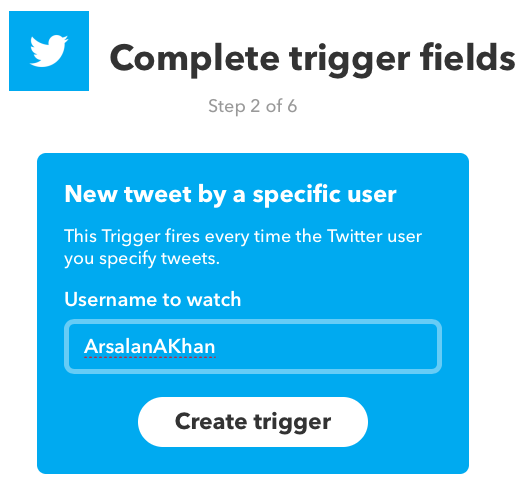
  5. Click on the trigger ‘New tweet by a specific user’IFTTT 3.png
  6. Type the Twitter user name you want follow and click on ‘Create trigger’IFTTT 4
  7. Click on ‘+that’IFTTT 5
  8. Click on Google SheetsIFTTT 6
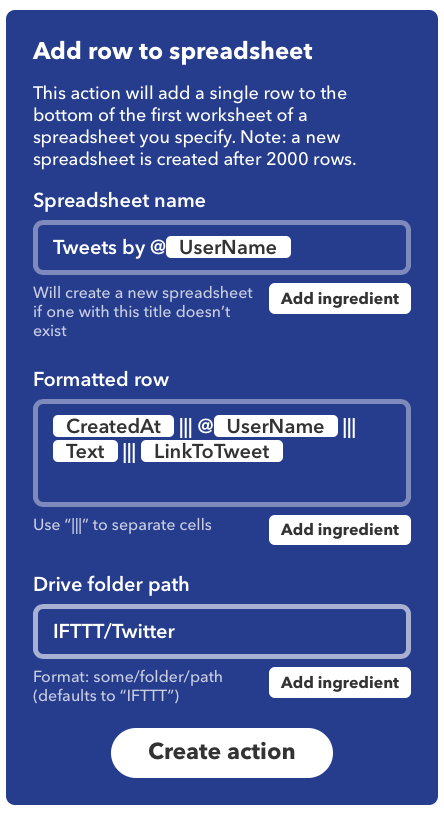
  9. Click on ‘Add row to spreadsheet’IFTTT 7
  10. Verify what information you want in the Google Spreadsheets rows, the Google Sheets location and then click ‘Create action’IFTTT 8
  11. Verify applet information and then click on Finish.
    IFTTT 9

Congratulations you have created an applet on IFTTT! Now, simply go to your Google Sheets and see the tweets being collected automatically!

But wait there is more! The tweets that you are collecting can be used to do many things such as:

  1. Easily search through the Twitter user’s tweets
  2. Determine when (day and time) the Twitter user is most active
  3. Determine the most words used by the Twitter user

Get Started on Google’s G Suite and get 20% off the first year on either G Suite Basic plan or G Suite Business plan by using thee promotion codes:

  • Basic Plan – C3VLCH3RJFVHAWU

  • Business Plan – AD4XQPHWAYFMEQW

Note:

  1. Don’t forget to link your Google account to the IFTTT account
  2. Google Sheets don’t count toward your Google account size limit
  3. Google Sheets have a limit of 2000 rows (by default) but more rows can be added
  4. Adhere to all rules and regulations pertaining to Twitter, Google, and IFTTT

Processing…
Success! You're on the list.

How to Map a Process Using Free Tools

Processes (or procedures) are a series of steps taken to accomplish a specific end. They can be standalone, interconnected or be part of something bigger (e.g., governance). They can be Business Processes, Information Technology (IT) processes, Systems Processes and Business Processes within IT. In organizations, there are many processes that happen sequentially and/or in parallel with other processes.

Basically, the idea of representing a process (or procedure) through a map (or diagram) is so that people can visually see what is happening. This visual representation also helps in identifying what can be improved within (and sometimes outside) the organization. Since the purpose of these maps is to convey what is going, you have to be cognizant that these maps should (1) be simple to understand, (2) help your audience connect with what they do daily to the big picture of the organization and (3) serve as a guide to what is (currently) happening and what would happen (tomorrow).

There are many ways and tools to depict a process but I have found that for most audiences the basic form of Business Process Model and Notation (BPMN) works best to just get the conversation started. In regards to a free tool to draw a process, draw.io can be used which saves your process maps in your google drive or any other location that you specify.

The following is just a simplified example to illustrate how a customer may interact with Amazon.com and how this customer interaction is handled. As you would see that visually representing this process can open up a door to start a discussion for improvements. If this whole process was written and not visually represented then it would require a lot of wording and the danger that the audience might get bored or would lose interest.

Amazon Customer Process

Note that the process map:

  1. Has numbered rectangular activity boxes so that your audience can easily follow
  2. Numbered rectangular activity boxed need does not need to be in sequence
  3. Is a hybrid which shows the interaction between a human (customer) and Amazon.com (online system)
  4. Uses BPMN basics to convey a story

To start the process of creating a process map, it would be prudent to ask these questions. Keep in mind that the purpose of mapping a process is not to show how talented you are in creating complex process maps but rather as a starting point and even a collaboration point where you can actually provide these maps to the audience to “fix”. Lastly, have a repository to save these process maps so that they can be used a reference of (1) what is happening, (2) what should not happen and (3) what could happen.

Processing…
Success! You're on the list.

2 Takeaways from the 2018 Spring Meetings by the International Monetary Fund (IMF) and the World Bank

Every year the IMF and the World Bank hold a conference-style event that is referred to as the Spring Meetings. These Spring Meetings bring together central bankers, ministers of finance and development, private sector executives and academics to discuss global issues such as global economy, international development, and the world’s financial markets.

This year I had the opportunity to attend the 2018 Spring Meetings where discussions were held about threats and opportunities of technological changes as it affects global economies and policies. Here are 2 takeaways from the 2018 Spring Meetings focused on technology and innovation including some of my related articles:

  1. TECHNOLOGICAL ADVANCEMENTS AND JOBS
    •  Industrialization Paradigms
      • Typical Industrialization: Agriculture → Manufacturing → Services
      • Current Industrialization: Agriculture → Services
    • Impacts of Technology
      • Technological Changes → Job loss → Re-skill → New Jobs
      • Some jobs will never be recovered
      • The flow of technology and expertise doesn’t flow easily across countries
      • Even within countries, technological impacts are uneven causing inequality
      • A good balance between data privacy and business models is needed that benefits societies at a larger scale
      • Depending upon where innovation (internal or external) to the organizations is can impact society at different levels
      • A good balance of foundations and advance education is needed
      • Specialized knowledge can negatively impact holistic societal impacts
    • Artificial Intelligence (AI)
      • Dystopian Views: AI will take over most human activities and would rule over humans
      • Middle Ground Views: AI will augment and enhance human activities but never replace humans
      • Utopian Views: AI will take over most human activities that would free up time for humans to do other things
    • The Brave New World of Data
      • Data quality issues are borderless
      • Standard data definitions of economic data has to be agreed upon and used
      • Data is being used to build economic policies
      • Data is being used to create multinational economic blocs
      • Data is being used to assess the humming of the global economy
      • Data Standardization and Harmonization àData Transparency àData Accountability
  2. PARTNERSHIPS
    • For economic prosperity, no organization, country, region is an island in of itself
    • Bridges need to be created across, public, private, academic, non-profit and shareholders
    • Regulations are slow to adapt to technological advancements and can be too heavy-handed or light-touch if not properly understood by policymakers
    • Grassroots changes are affecting how governments function and adapt
    • Technology and innovation should have executive level consideration across all branches of government and not just a ministry or a few people

Bonus: IMF’s Innovation Lab (iLab)

IMF has created the iLab whose goal seems to be to look at how technology and innovation are affecting the global economy and economic policies in various countries.

Related Articles:

  1. 5 QUESTIONS TO ASK ABOUT ARTIFICIAL INTELLIGENCE
  2. WHERE IS MY BIG DATA COMING FROM AND WHO CAN HANDLE IT
  3. 5 QUESTIONS TO ASK ABOUT YOUR INFORMATION
  4. 5 QUESTIONS TO ASK ABOUT PREDICTIVE ANALYTICS
  5. 5 QUESTIONS TO ASK ABOUT YOUR BIG DATA
  6. 5 QUESTIONS TO ASK ABOUT PRESCRIPTIVE ANALYTICS
  7. IDENTIFYING ORGANIZATIONAL MATURITY FOR DATA MANAGEMENT
  8. UNDERSTANDING AND APPLYING PREDICTIVE ANALYTICS
  9. 5 OBSERVATIONS ON BEING INNOVATIVE (AT AN ORGANIZATIONAL LEVEL)
  10. 5 OBSERVATIONS ON BEING INNOVATIVE (AT AN INDIVIDUAL LEVEL)
  11. HOW DO YOU COMMUNICATE?
  12. 5 QUESTIONS TO ASK ABOUT YOUR BUSINESS PROCESSES
  13. 75 QUESTIONABLE THOUGHTS ABOUT ORGANIZATIONAL TRANSFORMATION
  14. 35 CONCEPTS THAT AFFECT ORGANIZATIONAL TRANSFORMATION EFFORTS
  15. SPICE FOR BUSINESS TRANSFORMATION
  16. 5 QUESTIONS TO ASK ABOUT YOUR CULTURE
World Map Data

Processing…
Success! You're on the list.

How do we spark new thinking among physicians and, at the same time, how do we get physicians to think about technology beyond just being a user, but actually harness that technology?

In the video below on CxO Talk, I asked Dr. Rasu Shrestha, Chief Innovation Office at Univerity of Pittsburg Medical Center (UPMC) about technology and the medical field.

In my view, in order to get doctors interested in technology and its benefits, we have to look at three things:

  1. Education/Training – Is there adequate traning being given to doctor’s to not only use technology and but also harness its power through data?
  2. Patient’s Experience – Are we creating experiences through technology that are better than before?
  3. Doctor’s Experience – Are we properly allocating a doctor’s time and resources?

Processing…
Success! You're on the list.