35 Concepts that Affect Organizational Transformation Efforts

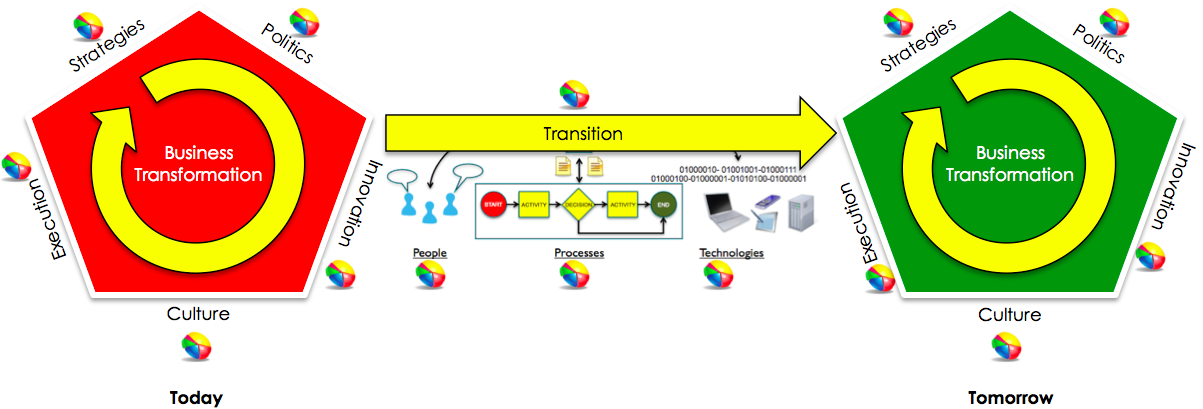
Organizational transformation entails understanding where the organization is today and where it wants to be tomorrow in terms of people, products, services, processes, and technologies. In order to accomplish this transformation, we have to determine the organization’s ‘eligibility’ by assessing its Strategy, Politics, Innovation, Culture and Execution (SPICE) factors. The SPICE factors help us determine (1) the underlying motivations of why the strategy was developed, (2) who are the power players in the organization, (3) who is really responsible for innovation, (4) who is an example of corporate culture and (5) who would help in carrying out this transformation across the organization.

As the organization begins its transformation journey, one glaring fact that is revealed is that the most crucial element to accomplishing change cannot occur without people. People are your organization’s lifeblood. People are the biggest champions of change or the biggest obstacle to it. Thus, in order to bring transformational changes in the organization, we have to understand the following concepts that affect individuals and group dynamics:

A. Inclusive Transparency

35 Concepts 1

1. Cumulative Error – Your message of transformation can be distorted along the way and could be translated into many things (e.g., layoffs, outsourcing, etc.). To address this:

2. Deep Time – People believe that the past was shorter than the future. For organizational transformation, this means that if the future does not have a due date then there is the tendency to think that transformation can happen at a later time. To address this:

  • Have transformation due dates
  • Share what happens after the transformation
  • Assess motivators that change the discussion from ‘I will do it tomorrow’ to ‘Lets create the future today’

3. Externalities – Everyone affects everyone even if they don’t know it. For organizational transformation, this means that even the most isolated action in the organization can hinder change. This could be merely someone saying that they don’t believe transformation is going to be successful without giving any constructive feedback. Essentially, by saying this what people have done is created an opinion that is the seed to create doubt in others. To understand this:

  • Determine who are the spoken and unspoken champions and obstructionists
  • Empower champions and ask the obstructionists why they are resistant
  • Actively address the concerns of the obstructionists

4. Inference to the Best Explanation – The truth behind something is often reasonable and the best explanation. For organizations transformation what this means is that while there are many truths behind the failure of a transformation activity but often times it is the simplest explanation of what happened that prevails. Of course, we have to be cognizant that this explanation is bias-free and objective. To determine this:

  • Read between the lines
  • Concentrate on what can be improved rather than who did it

5. Shifting Baseline Syndrome – Depending upon various variables, being ‘normal’ differs from one person to another. For organizational transformation, this means that the perception of what needs to be achieved can drastically vary from executive to the individual contributors. To address this:

  • Create and reiterate the objectives of the organizational transformation efforts
  • Re-inform periodically what they are doing has a role in the organizational transformation efforts

6. Subselves and Modular Minds – People have multiple versions of themselves which change and morphs based on who they interact with. For organizational transformation, this means that to get to the truth behind the truth be ready not to take things at just face value. To understand this:

  • Don’t ask what is wrong in front of the superiors
  • Create a repercussion-free zone where people can openly discuss what they think is going on anonymously

B. Bite-Sized Information35 Concepts 2

7. Cognitive Humility – People have a finite capacity of absorbing and retrieving information. Due to this finite capacity, people look for information that sits well with their own perceptions. For organizational transformation efforts, this means that if it is perceived that something similar has happened in the past with no great results then your current transformation effort would be considered just another ‘talk’. To address this:

  • Acknowledge the success and failures of the past transformation efforts
  • Discuss openly what lessons have been learned from the past transformation efforts and how those lessons are used in your current efforts
  • Create balanced specific action plans for individuals and groups, which are directly tied to their motivations (e.g., money, time-off, time to work on unique projects, competition, etc.)
  • Create measures that assess the performance of the action plans and determine various ways to measure and not measure them
  • Be transparent and share small and big success so that the transformation efforts stay top of mind
  • Don’t be afraid to add people to the transformation leading team who you didn’t consider at the beginning
  • Design your team so that they are a cross-section of every function (e.g., management, finance, accounting, marketing, operations, information technology etc.) and every level (e.g., executive, senior management, middle management, front line individual contributors etc.) within and outside (e.g., vendors, customers etc.) the organization

8. Cognitive Load – At any given moment in time, people can only handle small amounts of information to make decisions. If there is too much information then there is a high likelihood of stagnation that often results in indecisions. Perhaps that is why video game designer gives the player bare minimum information (e.g., lives remaining, mission completion status, etc.) so that they can accomplish what they need to and move on to the next task. To address this:

  • Provide the least bit of information with the most impact (e.g., # of functional units transformed, # of processes captured and verified, etc.)
  • Create anticipation (e.g.., only X time left until its time for their function to be transformed)
  • Share the right information with the right people at the right time

9. Constraint Satisfaction – With too many options we become paralyzed and thus in order to get things to get moving we have to have some constraints around them. These constraints can come from within or outside the organization for the purposes of transformation efforts. To address this:

  • Don’t try to boil the ocean but instead create ponds than lakes and then rivers
  • Have deadlines and make people work towards them
  • Allow short meetings and give power to people to cut them off when productivity declines

10. Cultural Attractor – People are attracted to ideas and thoughts that are easily digestible. Simplicity is the name of the game even in organizational transformation efforts regardless of how complex it really is. To address this:

  • Clearly define what is that you plan to accomplish
  • Create a 140-character description, a 1 pager, and a 10 pager
  • When creating process maps, eliminate complex symbols/notations and only use the basic ones to convey information
  • Setup process map meetings in a way that people become encouraged to participate since it’s so simple that anyone could do it
  • When evaluating technologies, don’t just read the systems documentation but inquire people how would they define the purpose of the information system that they use

11. Name Game – We are biologically programmed to name things and classify them but often times this can lead to not understanding what is behind that name. For organizational transformation, this means that create activities names that are easily identifiable. To use this:

  • Use acronyms that have the meaning as well (e.g., the organization needs SPICE for transformation)
  • Classify names and descriptions of activities and achievements in a way that it is clearly understood what is being attempted and what has been accomplished

12. Umwelt – People often accept reality without going into depth. For organizational transformation, this means that due to the increasing pace of businesspeople have developed certain shortcuts in their minds of how things work. To address this:

  • Challenge the thinking of everyone and everything around you
  • Show proof that their thinking might be based on outdated information
  • Document concerns to have a solid understanding of the cultures and subcultures

C. Big Picture35 Concepts 3

13. Contingent Superorganisms – After people have achieved what they want to achieve individually then they automatically become more open to helping others and larger audiences. That is why at a certain point in time, people like to give back and create a legacy of selfishness. For organizational transformation, it becomes really important to figure out who these people are. These are not necessarily those who are perceived to be accomplished (e.g. superstar executive etc.) but it could anyone from the lowest rungs of the organization to people outside the organization. To address this:

  • Find out what motivates people outside of work and use those external motivations to see if the same passion is displayed at work. If not, ask the individual how that can happen
  • Understand that status quo often means being burnt too many times
  • Keep an active lookout for those who put the group before themselves and would volunteer their own time to be a part of the transformation. Don’t just use these people but recognize them in various ways (e.g., employee recognition, bonus, paid family vacations, etc.)
  • Be cognizant of people who are getting involved because of their superiors
  • Be vigilant and recognize that sometimes the person being recommended is not the best

14. Copernican Principal – People often feel that their role is insignificant compared to the big picture. These thoughts can lead to people being tuned out and just punching the clock rather than understanding their value in the organization. To address this:

  • Visually show how their individual contributions are changing the organization for the better
  • Don’t be afraid to apply this concept for customers as well and show how their contributions (e.g., buying products/services, giving feedback, etc.) is helping create a better organization

15. Focusing Illusion – People often focus on the ‘only if’ and live in its illusion. For organizational transformation, this means that people often mistake transformation as a big bang activity while it is a slow steady approach to constantly improving organizations. To address this:

  • Share the plan of organizational transformation would across various organizational functional units
  • Constantly remind and show that organizational transformation is about the ‘here and now’

16. Holism – The idea here is that in the big picture, the little details do count as well. For organizational transformation, this means that no information is minuscule enough that it has no effect of transformation. In fact, even the minuscule information if not understood and addressed can lead to a snowball effect that can come from the left-field when it comes to the transformation journey. To understand this:

  • Recognize that due to education, work, and life experiences some people prefer to stay within their own silos without knowing how others actions affect them and how their actions affect others beyond their functional responsibilities
  • Create a ‘one-view’ map that shows the major connections between all the silos and how indirectly they are helping and hindering each other
  • Create a forum where interdependencies can be understood and improved and go beyond functional boundaries and few peoples
  • Help people connect the dots and display it everyone can see it

17. Positive Sum Game – Everyone wins. For organizational transformation, this means that transformation objectives should be balanced in a way that all teams that are involved get benefits out of it. For some, this benefit would be having a better idea of how the business works, for some this benefit, would be doing more with less, for some this benefit would be transitioning to another career. To create a positive-sum game:

  • Listen to all parties to come with positive sum solutions
  • Act in the interest of all parties and show this at the begin, middle, end and after the organizational transformation efforts

18. Powers of Ten – By understanding scaling laws you can have a better idea of where anything sits in the bigger scheme of things. For organizational transformation, this means that you should ask and assess and assign actual values in terms of the magnitude of transformational activities. To do this:

  • Ask various functional areas to represent the importance of their work for the organization. Then ask another functional area to assess what has been reported. After this brings the functional areas together to discuss the difference which is oftentimes based on known and unknown biases (e.g., IT are an only order taker, accountants are just bean counters, etc.)

19. Self-Serving Bias – People perceive themselves to be better than others. For organizational transformation, this means that for successful people would take credit but for failure, they would blame others. To address this:

  • Create surveys to reveal people’s biases towards themselves, others, their functional unit, and other functional units
  • Emphasize that successfully transformation efforts benefit them individually and the organization as a whole
  • Document any concerns that are revealed to get a sense of the idea of culture in the people’s minds

D. Patterns Matters

35 Concepts 4

20. Cycles – Everything is cyclical. For organizational transformation efforts, this is a disaster repeating itself in terms of hiring the same kind of people, redundant processes and outdated technologies. To address this:

  • Determining candidate cultural fit does not mean to hire or rehire from the same pool (e.g., age, gender, geographical location, race, birthplace, language pronunciations, how they look, etc.) of people
  • Identify processes that have a black hole meaning that they are being carried out without any regard to their usefulness
  • Recognize patterns in organizational transformation efforts
  • Understand that technologies that are being used are not necessarily the best to get the job done but are those that people are just comfortable with and hence continue to use them

21. Double-Blind Control Experiments – This method is used to identify the underlying biases people have without even recognizing them. In organizational transformation, this can mean the difference between onboard or just being an observer to see what happens. Use this method to:

  • Determine how do people actually feel about transformation efforts anonymously
  • Determine if there are varying tendencies (e.g., preference to work with younger folks rather than older folks, the difference between 9-5 versus getting the job done, text versus visual display of information, etc.)

22. Fixed-Action Patterns – Certain behaviors and attitudes displayed by people are not necessarily biases but have been learned and reinforced over time so it becomes a habit. To leverage this:

  • Observe what people do and then ask why they did it. Get to the underlying factors of their actions
  • Train people so that transformation is not a one-time event but a continuous improvement initiative

23. Hidden Layers – As time progresses people develop layers between what is the reality and what is perception. These layers help develop habits that can be restarted even after practice years later. For organizational transformation, this means that success and failures are learned over time and can be used to affect the organization. To figure this out:

  • Find out who has been involved in any kind of transformation even it was outside the current organization
  • Assess what habits led to success or failure keeping in mind biases

24. Predictive Coding – People are a product of what happens to them and over time this becomes a pattern recognition system to engage or avoid. For organizational transformation, this means that people’s thoughts and eventual actions are based on what has happened to them. To leverage this:

  • Positively reinforce the benefits of transformation not only through talk but through action
  • Get to the root of people’s behavior and actions to turn them into a positive
  • Understand that you cannot turn everyone into a champion but as long as they are not an obstacle then you have come closer to a positive result

E. Team Creation

35 Concepts 5

25. Effective Theory – If you can’t measure it then you can’t improve it. For organizational transformation, what this means is that while it is useful to have plans and work towards achieving the objectives of those plans but they are meaningless if it is not being measured. To assess this:

  • Properly define what successes and failures looks like
  • Know what to do when successes and failures are encountered
  • Don’t measure for the sake of measuring

26. Expanding In-Group – The world is a global village and there is more interconnectedness than anytime else in our history. This interconnectedness can lead to looking at solving problems from different angles. For organizational transformation, this means that the more diverse and cross-over that you have in your teams, the better it would be able to solve problems on a bigger scale. To leverage this:

  • Create hybrid teams from various parts of the organization
  • Inform team members that they are all equal in the team and everyone has a veto
  • Give the same problems to different teams and see what solutions they come up with. Combine these teams to create solutions that have a holistic view of the organization and understand the internal and external values of creating such solutions

27. Fear of the Unknown – People’s known and unknown biases can make them inaccurately determine their risks and benefits. For organizational transformation, this can mean the difference between making a big gain versus remaining in the status quo. To accomplish this, do:

  • Create metrics on how to conduct risks and benefits analysis individually and for the organization
  • Train people in making sound judgments without rhetoric and biases

28. Rational Unconsciousness – People make conscious and unconscious decisions despite their awareness of their weaknesses. For organizational transformation, this means that despite people’s knowledge of what is the right thing to do people unconsciously continue to do the opposite. To address this:

  • Ask people what they want from this transformation and then observe it what the want is consistent with their actions
  • Enlighten these people by discussing what you have observed
  • Create opportunities for people to grow and adjust to the new reality

29. Structured Serendipity – Luck is found through a concerted effort in achieving objectives. For organizational transformation, this means that a structure should be put in place with the ability to be flexible and adapt if necessary. To do this:

  • Create specific milestones and their relevance to individuals and organizations
  • Show that through structure they are able to achieve their objectives efficiently and effectively (e.g., faster innovation, removal of redundant processes

F. Experimental Boundaries

35 Concepts 6

30. Failure Liberates Success – Encourage failure and experimentation. For organizational transformation, give your teams the ability to refine, reiterate and rethink problems to solutions. To influence this:

  • Task your teams to think of as many problems as they can about a solution. Ask the other teams to create solutions to those problems and then make these teams sit together to figure things out
  • Create ways for teams to rinse and repeat SPICE factors
  • Measure the various ways to find optimum solutions
  • Don’t just go for the lowest hanging fruit. Go after big things and challenge the foundations to make it stronger

31. Kaleidoscopic Discovery Engine – When it comes to insights and innovation, people are always learning from each other. For organizational transformation, this means that there is constant learning activity going on within and outside the organization. Sometimes these activities can excel in the transformation journey if they are given enough thought. To leverage this:

  • Get innovative ideas at an individual level. These range from (1) direct circle of influence, (2) extended circle of influence, (3) areas that people are interested in, (4) unrelated ideas and (5) stitching, applicability and combination
  • Get innovative ideas at an organizational level. These range from (1) internal customers, (2) external customers, (3) within the industry, (4) outside the industry and (5) integration, customization and combination.
  • Build and refine what has been learned
  • Document what was learned and what was the result

32. Pessimism Meta-Induction – Every theory is up for debate and discussion in light of new evidence. For organizational transformation, what this means is that the organization has to be constantly challenged to question the status quo not only periodically but also ad hoc to check if stated objectives are being achieved. To accomplish this:

  • Create open discussions forums where all topics related to organizational transformation should be discussed in a transparent manner
  • Follow-up on issues and concerns with corrective action plans

33. Randomness – There are certain things that we cannot control. For organizational transformation, this means that regardless of how pristine and well-thought-out your plan for transformation is it is bound to run into unanticipated obstacles. To plan for this:

  • Have time and money set aside for contingency purposes
  • Accept failure as an option and have a way to document and measure it so learn from it
  • Welcome wrenches in discussions so that you can address them before it is too late to address them

34. Skeptical Empiricism – Don’t believe by merely observing but by careful thought. For organizational transformation, this means that most people get easily swayed by what they observe and thus mechanisms should be put into place where they are free to challenge the status quo with evidence and deep thoughts. To remedy this:

  • Show proof of what you are trying to accomplish and how it would have a positive effect on them
  • Document what is going on to get a feel of the underlying culture activities
  • Create action plans to address these different observations when they happen

35. Uncalculated Risks – People often worry about the big stuff but don’t take into account the little stuff that can affect their risk-taking. For organizational transformation, this means that being less precautious on the little stuff can slowly thwart efforts. To address this:

  • Create a risk matrix for big and small items
  • Create a mechanism for measuring all risk tolerances

Now that we have understood the varying concepts that affect organizational transformation efforts, let’s ask the following questions:

Currently

In the Future

Who is involved in organizational transformation activities within and outside the organization?Who should be involved in organizational transformation activities within and outside the organization?
What outcomes the organizational transformation activities are revealing?What results are expected for organizational transformation?
Where does organizational transformation begin?Where should organizational transformation begin?
When does organizational transformation become important?When should organizational transformation become important?
Why people work on organizational transformation?Why people should and shouldn’t work on organizational transformation?

When you are asking the above questions, keep in mind that organizational transformation entails all aspects of the organization. Without people transformation, without process transformation, without product/service transformation and without technological transformation, there is no transformation at all but just another illusion of transformation.

References:

  1. 5 Questions to Ask About Business Transformation
  2. 35 Scientific Concepts That Will Help You Understand The World
  3. 5 Questions to Ask About Your Information
  4. 5 Questions to Ask About Your Business Processes
  5. 5 Questions to Ask About Your Information Supply Chain
  6. 5 Observations on Being Innovative (at an individual level)
  7. 5 Observations on Being Innovative (at an organizational level)

Processing…
Success! You're on the list.

What is the future of data analytics gone beyond user experience?

Processing…
Success! You're on the list.

What Is The Future Of Data Analytics Going Beyond User Experience?

In the video below on CxO Talk, I asked Giorgos Zacharia, CTO of Kayak, about what comes next after data-based user experience improvements.

In my view, as organizations continue to collect data to improve user experiences, we have think beyond what is possible just to improve a product. Here are few suggestions:

  1. Collect data from your supply chain(s) to improve operations
  2. Collect data from your employees to improve employee experiences
  3. Collect data outside of your organization to see how it can improve you

5 Questions to Ask About Prescriptive Analytics

Prescriptive analytics is used for performance optimization. This optimization is accomplished by using a variety of statistical and analytical techniques to identify the decisions that need to be taken in order to achieve the desired outcomes. The data sources used for the determination of outcomes can range from structured data (e.g., numbers, price points, etc.), semi-structured data (e.g., email, XML, etc.) and unstructured data (e.g., images, videos, texts, etc.).

If done correctly, Prescriptive Analytics is the Holy Grail of analytics. However, if done incorrectly, it can result in misinformed decisions that can be outright dangerous. Individuals and organizations have to understand that even if the data is correlated that does not mean that there is some sort of causation. A general example of this is when in a news report, the host(s) says that the survey has shown that x is correlated with y but then they go on how y was caused due to x. This is simply what I call “jumping the data gun” and organizations that are not aware of this can fall into this trap.

Another thing to be aware of is that after the Prescriptive Analytics gives you certain courses of action and you apply those actions, keep track of how well your Prescriptive Analytics is performing as well. In other words, you have to measure the performance of your performance optimization ways. The reason to do this is that over time you can see if the models presented by your Prescriptive Analytics engine are worth following, re-doing or dumping.

To get you started, here are a few questions to ask:

Today

Tomorrow

Who uses prescriptive analytics within, across and outside your organization?Who should be using prescriptive analytics within, across and outside your organization?
What outcomes do prescriptive analytics tell you?What outcomes prescriptive analytics should tell you?
Where is the data coming from for prescriptive analytics?Where should the data become from for prescriptive analytics?
When prescriptive analytics is used?When prescriptive analytics should be used?
Why prescriptive analytics matter?Why prescriptive analytics should matter?

When you are asking the above questions, keep in mind that Prescriptive Analytics uses data to create a model (aka a data version of the world) that is used by individuals and organizations to make real-world decisions. But if the model itself is flawed then you are bound to get answers that although might look visually appealing are completely wrong. It is not all doom and gloom though. In fact, Prescriptive Analytics is used in determining price points, expediting drug development and even finding the best locations for your physical stores. Companies like Starbucks have been using Prescriptive Analytics in the last few years to determine the best locations for their next coffee stores. Interestingly, some have claimed that wherever Starbucks goes, the real-estate prices also increase. While there is some correlation between a Starbucks coffee store opening with increased real-estate prices but this does not mean that because of Starbucks coffee stores the real-estate prices increase.

Analytics Trophies

References:

  1. 5 Questions to Ask About Business Transformation
  2. 5 Questions to Ask About Your Information
  3. Starbucks Tries New Location Analytics Brew

Processing…
Success! You're on the list.

5 Questions to Ask About Your Big Data

In statistics, a hypothesis is proposed and then data samples are collected to prove or disprove the hypothesis with acceptable confidence levels. For example, let’s say that all our customers are aware of all our product lines. Basically, there are two ways of assessing our hypothesis that includes: (1) Proving our hypothesis and (2) Disproving our hypothesis.

The first way to proving our hypothesis is that we communicate with all of our customers and inquire if they know all our product lines. The second way is to communicate with as many customers as possible until we come across any customer that does not know all our product lines. From this example, we can see that if we find even one customer then that disproves our hypothesis. Thus, this is the reason why in statistics, sometimes it is easier to find an exception to disproving a hypothesis rather than proving it.

Big Data, on the other hand, inverts the generally acceptable process from hypothesis then data sample collection to data collection then a hypothesis. What this means is that Big Data emphasizes collecting data first and then coming up with a hypothesis based on patterns found in the data. Generally speaking, when we talk about Big Data, we are concerned with the 3 Vs that include:

  • Volume – Amount of data
  • Velocity – Rate of data analysis
  • Variety – Different data sources

Some have indicated that we need to go beyond just the above three Vs and should also include:

  • Viscosity – Resistance to the flow of data
  • Variability – Changes in the flow changes of data
  • Veracity – Outlier data
  • Volatility – Validity of the data
  • Virality – Speed at which data is shared

I would take the Big Data concept a bit further and introduce:

  • Vitality – General and specific importance of the data itself
  • Versatility – Applicability of data to various situations
  • Vocality – Supporters of data-driven approaches
  • Veto – The ultimate authority to accept or reject Big Data conclusions

For a metrics-driven organization, a possible way to determine the effectiveness of your Big Data initiatives is to do a weighted rating of the Vs based on your organizational priorities. These organizational priorities can range from but not limited to increasing employee retention rates, improving customer experiences, improving mergers and acquisitions activities, making better investment decisions, effectively managing the organization, increasing market share, improving citizens services, faster software development, improving the design, becoming more innovative and improving lives. What all of this means is that data is not just data but it is, in fact, an organization’s most important asset after its people. Since data is now a competitive asset, let’s explore some of the ways we can use it:

  • Monte Carlo Simulations – Determine a range of scenarios of outcomes and their probabilities.
  • Analysis of Variance (ANOVA) – Determine if our results change when we change the data
  • Regression – Determine if data is related and can be used for forecasting
  • Seasonality – Determine if data shows the same thing occurring at the same intervals
  • Optimization – Getting the best possible answer from the data
  • Satisficing – Getting a good enough answer from the data

Now that we understand what is Big Data and how it can be used, let’s ask the following questions:

Today

Tomorrow

Who is capturing data?Who should be capturing data?
What is the lifecycle of your data?What should be the lifecycle of your data?
Where is data being captured?Where should data be captured?
When is data available for analysis?When should data be available for analysis?
Why data is being analyzed?Why data should be analyzed?

Having discussed the positives of Big Data, we have to realize that it is not a panacea and has its negatives as well. Some of the negative ways data can lead to bad decisions include: (1) Data is correlated but that does not imply cause and effect, (2) Data shows you pretty pictures but that does not imply it is telling you the truth and (3) Biases can affect data anywhere from capturing to analysis to decision-making.

In conclusion, what this means is that the non-distorted quality, understanding, and usage of data is the difference between just getting on the Big Data bandwagon or truly understanding how data can fundamentally change your organization.

Big Data Vs

References:

  1. Realizing the Promise of Big Data
  2. Beyond the three Vs of Big Data
  3. 5 Factors for Business Transformation
  4. 5 Questions to Ask About Your Business Processes
  5. 5 Questions to Ask About Your Information
  6. 5 Questions to Ask About Customer Experiences
  7. 5 Observations on Being Innovative (at an organizational level)
  8. Where is my Big Data coming from and who can handle it

Processing…
Success! You're on the list.