The maturity of an organization is determined by how that organization can collect, manage and exploit data. This is a continuous improvement process where data is used to make strategic decisions and strategic decisions are made to collect data that creates competitive advantages. But in order to create strategic advantages through data, an organization needs to have data management and related processes in place to discover, integrate, bring insight and disseminate data within the entire organization. In terms of data, organizations need to understand where they are currently and where they want to be in the future and thus they need to ask the following questions:
Currently
In the Future
Who receives the data?
Who should receive the data?
What happens to data?
What should happen to the data?
Where does data come from?
Where should data come from?
When is the data being shared?
When should data be shared?
Why data is collected?
Why should data be collected?
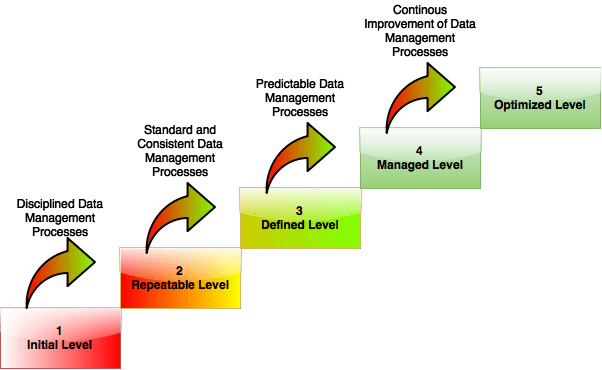
After an organization understands and documents the above then they need to develop metrics to measure the relevance of their data as it pertains to the entire organization. Since being a data-driven organization is a continuous improvement journey, organizations can use the following adaptation of the Capability Maturity Model (CMM) to determine their maturity of data management and related processes:
Data Management Maturity Levels
Additionally, organizations can have governance and processes that can help them assemble, deploy, manage and model data at each level of CMM as shown below:
According to the publication from Mitre, Cloud Computing and Service Orientated Architecture (SOA), cloud computing has many services that can be viewed as a stack of service categories. These service categories include Infrastructure-as-a-Service (IaaS, Platform-as-a-Service (PaaS), Storage-as-a-Service, Components-as-a-Service, Software-as-a-Service (SaaS) and Cloud Clients. The following figure shows the service categories stack as depicted in the Mitre publication:
Mitre’s Cloud Stack
SOA is a framework that allows business processes to be highlighted to deliver interoperability and rapid delivery of functionality. It helps system-to-system integration by creating loosely coupled services that can be reused for multiple purposes. The concept of SOA is similar to Object-Orientated Programming where objects are generalized so that they can be reused for multiple purposes.
Now that we have an understanding of the various types of Cloud Computing services and SOA, let’s explore how Cloud Computing and SOA are similar and different.
Similarities between Cloud Computing and SOA:
Reuse – Conceptually speaking, the idea of reuse is inherent both in Cloud Computing and SOA.
As needed basis – In Cloud Computing, the services are provided to the users on-demand and as needed. SOA is similar to this since the system-to-system services are on-demand and as needed as well.
Network Dependency – Cloud Computing and SOA both require an available and reliable network. If a network does not exist then the cloud services provided over the Internet would not be possible. Similarly, if a network does not exist then the communications between systems would not be possible. Thus, both Cloud Computing and SOA are dependent on a network.
Cloud Contracts – In Cloud Computing, contracts entail the mutual agreement between an organization and cloud service providers. In cloud contracts, there is a cloud service provider and a cloud service consumer (the organization). In the case of SOA, contracts are important and can be either external (e.g., Yahoo! Pipes) and/or internal (e.g., organizational system integration). In SOA contracts, there are service producer(s) and service consumer(s) that are conceptually similar to cloud contracts.
Differences between Cloud Computing and SOA:
Despite the similarities between Cloud Computing and SOA, they are not the same. Following are some of the differences between them:
Outcome vs. Technology – In Cloud Computing, we are paying for the outcome but in SOA we are paying for technology.
External vs. External and/or Internal Point-of-View – In Cloud Computing, the services that organizations get are from external organization but in SOA these services can be either from external organizations (e.g., Yahoo! Pipes) and/or internally (e.g., system-to-system integration between two or more systems).
IaaS, PaaS, SaaS vs. Software Components – In Cloud Computing, the services provided can go up and down the stack but in SOA the services are software components.
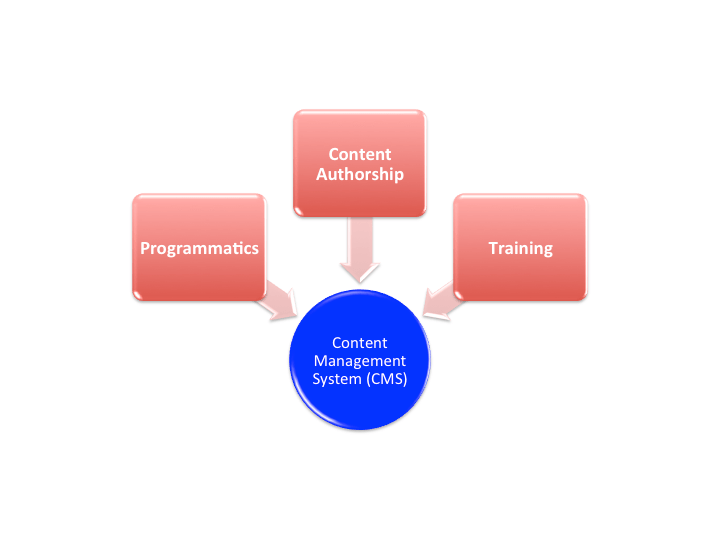
Content Management System (CMS) is a software system that helps to organize and facilitate the collaboration of content. Some of the benefits and challenges that could arise from/during implementation and use of CMS are discussed below:
CMS Programmatic – In a CMS, content, display of content, content revisions, canned functionality, integration with other systems and security mechanisms can be manipulated programmatically. This means that organizations can set content display schedules, allow only a revision from certain people and even set the level of security for those who have access to the content. However, these benefits come with the following challenges:
Due to this programming aspect of CMS, technical experts are required to develop, update and maintain the CMS. Depending upon the complexity of the organization, this type of programming can prove to be costly to the organization.
CMS is susceptible to hackers who can programmatically manipulate content and content displays that can result in loss of organizational reputation and perhaps even customers.
Content Authorship – One of the benefits of a CMS is that users don’t have to worry about display of content since it is already predefined through templates and thus there is no knowledge or use of HTML required. However, content authorship can result in the following challenges:
Users are stuck with the presentation templates that have been created and do not have any flexibility in changing them easily.
If content authorship is centralized and it has to go through an approval process then this can create bottlenecks if approvals are not done in time.
If content authorship is distributed then how does the organization make sure that the content being created complies with organizational policies?
Training on CMS – The other benefit of CMS is that once it is created, people have to be potentially trained in only one system that is being used for content creation, distribution, and collaboration. However, CMS has challenges when it comes to training especially when it is first being rolled out. These challenges include:
Since CMS is a system users have to be trained on how to create content that complies with the policies and procedures being used in the system. Depending upon the user base, this training can prove to be difficult if people are not willing to change their habits.
Ineffective and complex training can lead to a CMS no one is willing to use.
This article provides in detail the elements of an Enterprise Architecture (EA) framework that would be selected and deployed at a fictional United States (US) Federal Government contractor called FedCon. FedCon is divided into 3 Business Units (BUs) that are focused on providing Management Consulting, Information Technology (IT) Consulting and Systems Integration (SI) Services in Healthcare, Environment, and Finance.
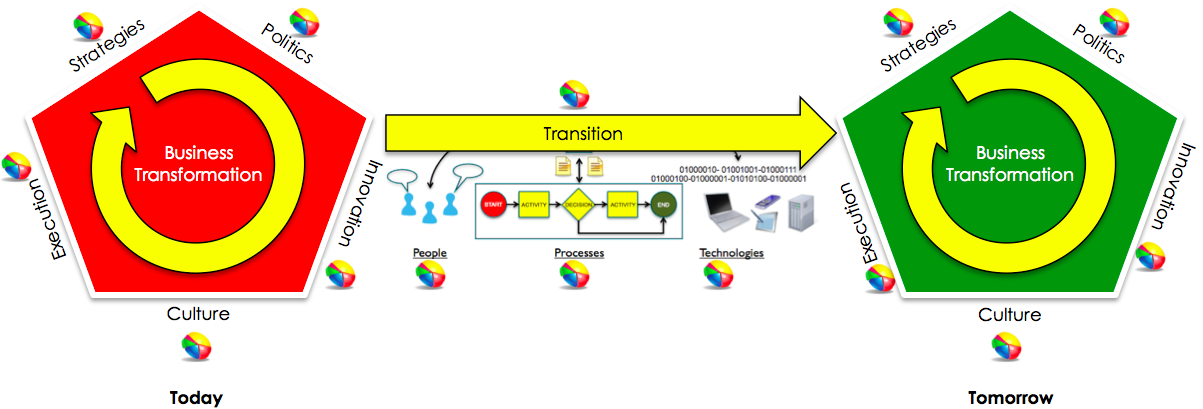
This article analyzes FedCon in terms of Strategies, Politics, Innovation, Culture and Execution (SPICE) as shown below:
Stakeholders
Domains
Strategies
CEO, COO, and CIO
Business-IT alignment
Politics
BU SVPs, PMO and program/project managers
Technology products and services
Innovation
Employees directly interfacing with customers
Technology products and services
Culture
PMO, HR and Accounting/Finance
Leverage the massive intellectual property
Execution
All employees
Organizational performance
Based on the above, it is determined that The Open Group Architecture Framework (TOGAF) would be the appropriate EA framework at FedCon since (1) it is supported by multiple vendor tools (2) it is constantly being improved upon and (3) it has an Architecture Development Methodology (ADM) which can be used as a guide.
ABOUT FEDCON:
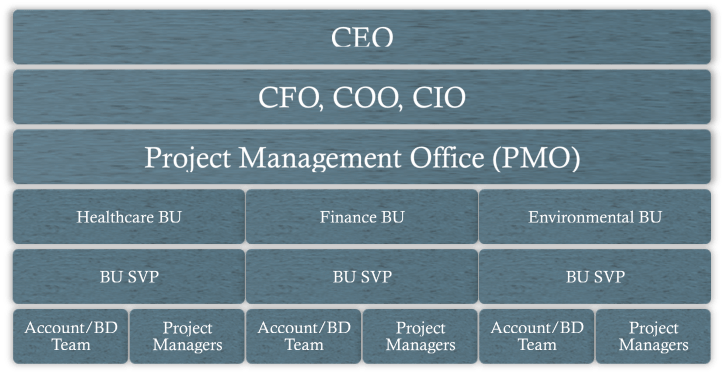
FedCon is a fictional 30-year-old large publically traded US Federal Government contractor that provides Management Consulting, IT Consulting, and SI services to civilian agencies. It has over 5,000 employees nationwide and it is structured into three Business Units (BUs). Each BU has domain expertise in Healthcare, Finance or Environmental information systems. This structure allows the BUs to work directly with the civilian agencies based on their missions. Each BU has its own account/business development (BD) team that reports to the BU Senior Vice President (SVP). The Program/Project Managers report to the BU SVP and provide status updates on programs/projects to the corporate Program Management Office (PMO). The PMO conducts weekly meetings to provide guidance on corporate standards, compliance, and general project templates.
Organizational Structure
PROBLEM STATEMENT:
Over the past couple of years, FedCon has lost 20% of its business. The CEO has been under pressure by the shareholders to turn the company around. Thus, the CEO hired a management consulting firm to determine what were the pain points within FedCon that were preventing it from staying competitive in the marketplace. The management consulting firm’s report revealed that due to inefficient business processes and outdated technologies FedCon’s BUs were not able to collaborate efficiently to manage business and technology changes. Based on these findings in the report, the CEO mandated the Chief Operation Officer (COO) and Chief Information Officer (CIO) to work together to find areas that they can improve in the next 12 months.
ANALYSIS:
In order to address the CEO’s concerns, the COO and CIO came to the conclusion that in order to help FedCon create a disciplined approach to managing strategic intent and its execution they had to look into the field of Enterprise Architecture. Thus, the COO and CIO decided to standup an Enterprise Architecture Program Management Office (EAPMO) that would report directly to the CIO. Initially, the EAPMO is tasked with determining the high-level criterions to select a framework. This task includes providing elements of the framework to be used and how the framework would be applied within FedCon..
In this article, we assess the feasibility of an EA framework that can be used in FedCon by making observations about Strategies, Politics, Innovation, Culture and Execution (SPICE) factors. These factors would focus on understanding the people, processes, and technologies at FedCon to create an effective EAPMO.
SPICE Factors
Strategies at FedCon:
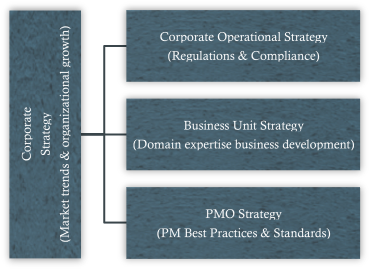
At FedCon, there are multiple levels of strategies that are developed. These strategies include: (1) the corporate strategy determined by the CEO, (2) the operational strategy determined by the CFO, COO, and CIO, (3) the BU strategy determined by the BU SVPs and (4) the PMO strategy determined by the PMO office. This is shown below.
Multiple Corporate Strategies
As we can see from the above figure, each strategy layer addresses different domains for the various stakeholders. Even though these strategies are developed to increase the bottom line and decrease costs, they are created in isolation. Additionally, since each BU is somewhat autonomous it can create technology products and solutions for the civilian agencies that overlap with corporate products and solutions. This is a problem since not leveraging the corporate assets where applicable for client delivery can result in program/project delays and duplicative systems.
The primary strategic concerns in choosing an EA framework are:
Stakeholders – CEO, COO and CIO are the strategic stakeholders and the executive sponsors of the EAPMO.
Domain – Strategically, FedCon is interested in the alignment of business and IT operations and efficient processes.
FedCon has never stood up an EA practice and thus it would be wise to select an EA framework that could guide them in what to do and that it has been proven in the industry to be useful for organizations that are just starting out their EA journey. These high-level strategic criterions are fulfilled by The Open Group Architecture Framework (TOGAF) that provides an Architecture Development Methodology (ADM) as a step-by-step guide and includes how to do stakeholder management.
Politics at FedCon:
Generally, when we talk about politics in an organization we are referring to the negative connotations attached to it. But for our purposes, we will define politics to mean the formal power or informal power of an individual or group within an organization. The power exhibited by these individuals and groups can turn into obstacles or support to bring about organization-wide changes. In this sense, here we refer to formal power as the reporting structures while informal power refers to the influence yielded based upon the size of the BU, revenue generated by BU, the headcount of BU and close relationships of BU leadership with the executives.
At FedCon, even though the BU SVPs have the same title, they don’t have the same power. Taking this into account and the emphasis by the US Federal Government Executive Branch to focus on healthcare issues, the largest and most profitable among the FedCon’s BUs in the healthcare BU. Due to this reason, healthcare BU SVP has more informal power among its peers. This means that if the healthcare BU can be convinced of the merits of the EA practice then we can come one step closer to a FedCon-wide EA practice.
The primary political concerns in choosing an EA framework are:
Stakeholders – BU SVPs, PMO and program/project managers are the political stakeholders. The BU SVPs have the formal power to bring change within their respective BUs. The PMO is a well-established office and it has visibility into the various kinds of projects and has informal power by pushing down changes to the project level within different BUs. Lastly, the program/project managers within BUs are stakeholders as well since they have to indoctrinate their teams on how EA can be used as leverage when developing client technology products and services.
Domain – Politically, agreement, collaboration, and coordination across BUs and the corporate team seems to be the area of focus to rapidly bring technology products and services.
Due to the “friendly” competition among BUs to become bigger and yield more influence in FedCon, politics has to be carefully considered. Sometimes BUs are not willing to share if there are possible overlaps with what they are developing and what is already available in a different BU or at the corporate level. Convincing BUs to work together could be hard and caution has to be taken in which players to involve in the development of the EA practice. Additionally, there has to be some sort of collaboration between the EAPMO and PMO for lessons learned and organizational improvements. These high-level political criterions are also fulfilled by TOGAF where it recommends how Architecture Governance and Architecture Boards should be set up.
Innovation at FedCon:
Broadly speaking, innovation in organizations is disruptive, incremental or a combination of both. Disruptive innovation as described by the world-renowned management theorist Clay M. Christensen’s institute is such that it “transforms an existing market or sector by introducing simplicity, convenience, accessibility, and affordability where complication and high costs are the status quo.” This disruption can come in the form of unique business models, products and/or services that can give rise to new industries and improve existing industries. On the other end of the innovation spectrum, incremental innovation is where small changes are made to existing business models, products and services to improve existing industries.
Being a US Federal Government contractor, innovation at FedCon is mostly incremental since it tries to improve upon its existing products and services that are provided to the civilian agencies. FedCon accomplishes incremental innovation by obtaining customer feedback and assessing the competitive landscape. However, since BUs only focus on their own expertise, there are fewer opportunities for collaboration across BUs, which means technology products and services, are being developed without leveraging what already exists in the organization.
The primary innovation concerns in choosing an EA framework are:
Stakeholders – FedCon employees that work directly with customers are the stakeholders that need to be considered since the improvement of existing technology products and services are highly dependent upon customer feedback and conveying of the feedback to FedCon.
Domain – In terms of innovation, FedCon is interested in creating technology products and services that meet customer expectations and exceed what the competition can offer.
EA is a disciplined approach to accomplishing enterprise objectives through alignment between business and IT. This disciplined approach can also be leveraged to make FedCon more competitive, which can result in bringing technology products and services quicker to the marketplace. This high-level innovation criterion also points towards using TOGAF since it is constantly being improved upon based on the feedback from technology vendors and solution providers.
The culture at FedCon:
The “father of modern management” Dr. Peter Drucker once said that “Culture eats strategy for breakfast.” Culture can affect the ability of any organization to adopt or resist changes to the organization. While culture is typically considered a fuzzy attribute of an organization but there are tangible things that we can observe to decipher corporate culture which includes (1) corporate values, (2) employee recognition and risk-taking, (3) salaries, commission and hourly rates, (4) location, (5) clothes and (6) domain expertise and product/service subcultures.
At FedCon, the culture is such that change is welcomed as long everyone who is affected by it understands its purpose and there is no disruption to normal business processes. This is a two-pronged issue for the selection of an EA framework since even if the value of EA is understood by senior leadership but it is not understood at the BU, program/project and individual levels then it becomes just another information collection exercise.
The primary cultural concerns in choosing an EA framework are:
Stakeholders – FedCon has a process-driven and metrics-monitoring culture. This is one of the reasons that the Program Management Office (PMO) is an important part of FedCon since it provides a consistent process by which programs/projects can be evaluated. In order to incentivize employees to change their behavior for the organizational transformation, human resources and accounting/finance offices are also stakeholders in EA success.
Domain – Culturally, FedCon is interested in creating an atmosphere that encourages employees to take risks and leverage the massive intellectual property it has developed over the years to stay competitive.
One of the reasons for the success of the PMO within FedCon is its process-driven culture. So for the selection of an EA framework, we have to consider what plays into strengths of FedCon. This high-level cultural criterion leads us to TOGAF that provides a methodological approach for EA within an organization. The EAPMO would make use of lessons learned from the PMO to create a successful EA practice.
Execution at FedCon:
Intention without execution is simply thoughts without results. An organization can have great intentions but if it does not operationalize those intentions then all the strategy discussions and documentation it did just an exercise in futility.
At FedCon, execution has two views. One view is the execution based on winning a government contract to deliver technology products and services. The second view is the execution of the corporate strategy that looks into entering new markets, mergers and acquisitions and creating superior technology products and services.
The primary execution concerns in choosing an EA framework are:
Stakeholders – All employees of FedCon at every level are stakeholders in the successful execution of EA.
Domain – In terms of execution, best practices have to be applied/created for all of FedCon and metrics developed that assess organizational performance.
STANDING UP AN EAPMO:
After assessing the business environment of FedCon to determine an appropriate EA framework, next we have to determine people, processes and technologies needed to standup the EAPMO. These needs are discussed below:
People:
In order to assess the skill sets needed to run the EAPMO, we have to look at the current skillsets available, skillsets that people need to be trained on and hiring people with the necessary skillsets at FedCon. The hard skills needed to join the EAPMO require the knowledge of the chosen EA framework (i.e., TOGAF) and the ability to find common themes to enhance collaboration. The soft skills needed to join the EAPMO require (1) being politically aware, (2) ability to create bridges/connections and (3) high emotional intelligence. Additionally, metrics will be created to evaluate EAPMO team members based on their hard and soft skills.
Processes:
The business processes followed by EAPMO would be determined by TOGAF best practices and what has worked within FedCon. At a high level, this would be the architecture governance process and at the lower level, this would the cross-functional team’s processes for being advocates and collectors of information across FedCon. The various processes would be tested in the first 6 months to work out any wrinkles and get a baseline understanding of what needs to be done.
Technologies:
Now that we have selected the FedCon’s EA framework to be TOGAF, we have to select a tool that supports this framework. This tool can be selected by looking at Gartner’s Magic Quadrant for Enterprise Architecture Tools.
CONCLUSION:
Due to FedCon’s expertise as a technology company and for all the reasons stated in the analysis section, TOGAF is the right EA framework since it provides a roadmap of what needs to be done. One thing to keep in mind is that a framework needs to be flexible enough so it can adapt to changing organizational needs rather than the organization becoming a slave to the framework.
Schekkerman, Jaap. Enterprise Architecture Good Practices Guide: How to Manage the Enterprise Architecture Practice. Victoria, BC: Trafford Pub., 2008. Print.
People who have not heard the term “gamification” before perceiving it to be about games but this is inaccurate. In order to address this misperception, Deterding and his team researched the various uses of gamification and came up with a definition that states gamification as “the use of game design elements in non-game contexts.” (Deterding et al.) We can see from this definition that gamification distinguishes itself from games by implying that while games are for fun without real-world implications but gamification has implications in the real world. Broadly speaking, gamification continues to be applied to various areas of business, technology, and society.
For this research paper, the focus is on the business and technology aspects of gamification. This leads to the definition by Gartner that states gamification as “the use ofgame mechanics and experience design to digitally engage and motivate people to achieve their goals.” In this definition, game mechanics refers to the points, badges, and leaderboards that are applied to computers, smartphones and wearables and experience design refers to gameplay, play space and storyline(s) to motivate people to change behavior. What this means is that gamification is used to change the norms, attitudes, and habits of people and organizations from a current state to a future state through today’s technologies.
For organizations, gamification is looked at from a strategic perspective in the following ways:
External Purposes: Organizations use gamification externally for customer engagement. The idea is that if customers are more engaged then this can create customer loyalty. This customer loyalty can lead to brand awareness and consequently more products and services being sold. In this sense, organizations use gamification as a sales and marketing tool that is often applied using websites, online communities, mobile devices, and other digital devices.
Internal Purposes: Organizations use gamification internally for employee engagement. The idea is that if employees are more engaged then this can help achieve various organizational objectives. Thus, in this sense, organizations use gamification in hiring, training, product enhancements, innovation, performance improvement and change management that is often applied through technologies in the organizations.
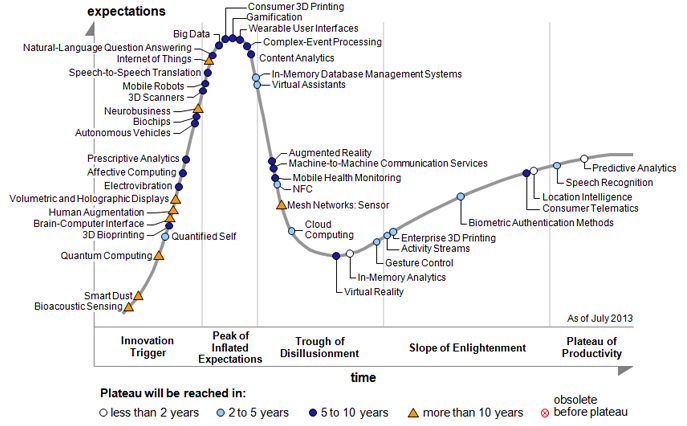
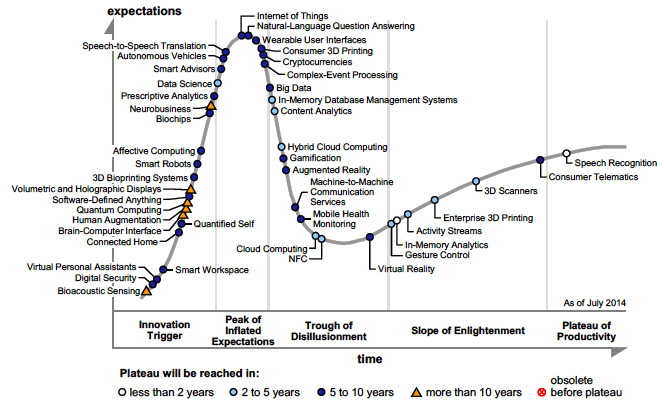
Initially, when gamification started to pick up steam in 2010, organizations were only interested in its external uses up until 2013. However, Gartner states that this started to change in 2014 where now organizations are interested in using gamification for external and internal purposes. This change is using gamification is reflected in Gartner’s Emerging Technologies Hype Cycle wherein 2014 gamification moved to Trough of Disillusionment from 2013’s Peak of Inflated Expectations. By simply looking at the 2013 and 2014 Hype Cycles one might think that gamification’s days are numbered. But a closer look reveals that organizations are beginning to understand how gamification can be used to not only increase the bottom line but also how it can help them transform themselves.
Thus, in a nutshell for our purposes, gamification for organizations is the use of game design thinking to change behaviors internally and externally through technology.
Figure1: 2013 Emerging Technologies Hype Cycle
Figure 2: 2014 Emerging Technologies Hype Cycle
BACKGROUND:
The idea of using gamification for external and internal purposes is not new. One of the earlier applications of gamification can be attributed to the Cracker Jack company who more than 100 years ago introduced the idea of having a toy prize in its boxes. While basic but it worked and soon other organizations started to follow the same route. However, currently, gamification implies making real-world activities more game-like through the use of technological advancements. In order to understand the current view on gamification, we have to look at a few significant events that have occurred over the last 40 years. These include:
In the 1970s, the invention of the microprocessor that led to the PC revolution
In the 1980s, the development of the first massive multiuser computer game called Multi-User Dungeon (MUD) created by Richard Bartle at the University of Essex in England
In 1984, Charles Coonradt explored why people were more engaged at sports and recreation activities that at work which led to the following 5 principles of making work more game-like:
Clearly defined goals
Better scorekeeping and scorecards
Frequent feedback
A higher degree of personal choice of methods
Constant coaching
In 2002, the Serious Games Initiative was launched that brought together the private sectors, academia, and military to develop battlefield simulations for training
In 2010, Jesse Schell’s presentation goes viral and starts to resonate with the business community.
Today, the video games industry is a $70 billion industry. Over these last 40 years, it has figured out how to keep people engaged and motivated for longer periods on time. During this time we have seen the explosion of computer devices being used and the creation of the Internet that has given rise to video games that can be played simultaneously online with many users. From a business perspective, some of Coonradt’s principles have been used for creating performance reviews and loyalty programs. As time passes we will see technology and business fields coming together for gamification purposes.
EXAMPLES OF GAMIFICATION IN ORGANIZATIONS:
The Good Examples:
Gamification can be beneficial for organizations that know how to correctly and thoughtfully use it for internal and external purposes. Following are some examples of where gamification was used to produce positive results for organizations:
Increasing System Usage and Engagement: Salesforce sells Software-as-a-Service (SaaS) subscription services to organizations. One of these subscription services is the Customer Relationship Management (CRM) service in the cloud that is mostly used by the customer’s sales staff. In order to increase the adoption of the CRM services with the customer’s sales staff, Salesforce turned to gamification by creating a game called Salesforce’s User Hunt for Chicken. In this game, game mechanics such as status changes were used to motivate sales staff to use more of the CRM services features. In one case, the customer’s sales staff compliance in using the CRM service increased by 40%. This example shows how gamification was used to create a win-win-win scenario where (1) the customers’ sales staff wins since they become more aware of how to utilize the CRM service to its full potential by using its features, (2) the customer wins since their sales staff is using the features that they have already paid for and (3) Salesforce wins since it creates opportunities for itself to stay competitive by keeping the customer’s sales staff reliant on their CRM services.
Increasing Customer Interaction: Dodgeball was the predecessor to Foursquare that used check-ins for events. It was sold to Google in 2005 but after four years of getting a very little traction, Google decided to shut it down. Foursquare, on the other hand, took the check-in concept and used gamification to gain traction. They did this by using game mechanics such as badges and perks to incentivize users to check-in. Today, Foursquare is one of the most popular applications in the world. It has 50 million registered users, 1.9 million listed businesses and it has crossed 6 billion check-ins. This example shows how gamification was used to enter and dominate a market by creating value for the users in the forms of perks.
Bad Examples:
Gamification can be detrimental for organizations that don’t know how to correctly and thoughtfully use it for internal and external purposes. Following are some examples of where gamification produced negative results for organizations:
No Value for Users: Google’s social network is called Google+. Google+ has 300 million users who spend an average of 7 minutes per month on the social network. In order to increase the time spent on Google+, Google decided to use gamification. Thus, Google decided to use game mechanics such as badges to give to Google+ users who read Google News. The problem with this approach was that it was not clear what value these badges provided to the users since they were private and added no value to the search being conducted. This example shows how a half-baked attempt at gamification resulted in creating something that users did not find appealing.
Lack of Proper Cost-Benefit Analysis: Marriot was interested in recruiting and training associates for its management program. In order to do this, they turned to gamification by creating a game called My Marriot Hotel. While the initial idea was not bad but as Kevin Kleinberg states in his article, the amount of money spent in creating this game versus the number of people who would actually become managers at Marriot seems to be miscalculated. This example shows gamification is not a remedy for management’s lack of foresight into the actual user base versus the amount of money spent on gamification.
RISKS AND CHALLENGES:
Gamification as an emerging technology has its risks and challenges as any new technology would have but since it is heavily dependent upon people either as players/users or game designers, it needs to consider areas of human psychology and motivation as well. Following are some of the risks and challenges of gamification:
Points Obsession by Players:The competitive nature of gamification in organizations can result in players being too obsessed with the points, badges, statuses rather than understanding why the game is being played in the first place (e.g., training, change management, innovation, etc.). The main question to ask here is, “How do you prevent players from becoming obsessed with just collecting points?”
Manipulation: Gamification has elements of manipulation in it either by the game designers and/or by the players themselves. These are discussed below:
Game Design: A game with a predefined agenda to change behaviors can be considered by some to be manipulation by the game designers. The main question to ask here is, “How do you avoid manipulation baked into gamification that is based on the game designer(s) biases?”
Players: The competitive nature of players can result in them creating the system that is supposed to be equal for everyone. The main question to ask here is, “How do you prevent players gaming the system?”
Regulatory and Legal Issues: Depending upon the nature of gamification in the organization, there might be laws and regulations that the organization needs to abide by. If careful attention is not paid, this can result in fees and fines. The two main questions to ask here is, “What are the federal, state and local regulatory concerns that need to be considered?” and “Are there any laws/rules that are applicable nationally and internationally?”
While the above questions are not a comprehensive list but it is a starting point when organizations are thinking about how gamification can be used externally and internally.
RECOMMENDATIONS:
Based on research done on gamification, its examples, its risks, and challenges, I recommend the following:
General Recommendations: Following are some general recommendations that should be considered for both external and internal uses of gamification:
Clearly defined goals: For organizations and players, it should be clearly stated what the gamification initiative is intended to accomplish.
Not a Panacea: While there is great promise in gamification for organizations but it should not be considered an answer for everything. Blindly applying gamification without thinking through organizational repercussions can be a recipe for disaster.
Measure, Measure, Measure: Gamification is used for organizational improvements whether it is used for external purposes or internal purposes. Since it is about organizational improvements, its progress needs to be measured, feedback should be obtained from its users and should be updated as needed.
External Use Recommendations:
It is about Values: When using gamification, organizations need to understand that it is not a one-way street but a multi-way street where value needs to be created for everyone involved.
Internal Use Recommendations: When using gamification, organizations need to create a balanced approach between intrinsic considerations and extrinsic rewards. This balanced approach should include understanding the organization in terms of Strategies, Politics, Innovation, Culture and Execution (SPICE) factors as shown below:
SPICE Factors
CONCLUSION:
As we have seen throughout this research paper, gamification has implications across many different aspects of an organization whether it is applied externally and/or internally. Due to the continuous improvements in technology and our desire to be better, there will always be new business models where gamification can prove to be useful. Here organizations have a choice of ignoring it as a passing fad or getting ahead of it to understand how it can help them transform themselves. Thus, gamification will continue to be an emerging technology regardless of where it stands in Gartner’s Hype Cycle.
References:
Sebastian Deterding, Dan Dixon, Rilla Khaled, and Lennart Nacke. 2011. From game design elements to gamefulness: defining “gamification”. In Proceedings of the 15th International Academic MindTrek Conference: Envisioning Future Media Environments (MindTrek ’11). ACM, New York, NY, USA, 9-15. DOI=10.1145/2181037.2181040 http://doi.acm.org/10.1145/2181037.2181040
“Gartner’s 2013 Hype Cycle for Emerging Technologies Maps Out Evolving Relationship Between Humans and Machines.” Gartner’s 2013 Hype Cycle for Emerging Technologies Maps Out Evolving Relationship Between Humans and Machines. Gartner, 19 Aug. 2013. Web. http://www.gartner.com/newsroom/id/2575515
“Gartner’s 2014 Hype Cycle for Emerging Technologies Maps the Journey to Digital Business.” Gartner’s 2014 Hype Cycle for Emerging Technologies Maps the Journey to Digital Business. Gartner, 11 Aug. 2014. Web. http://www.gartner.com/newsroom/id/2819918





 Welcome to Khan's Blog
You must be logged in to post a comment.