Chief Executive Officer (CEO) and Service Orientated Architecture (SOA)

EXECUTIVE SUMMARY

This article discusses what is Service Orientated Architecture (SOA), how it is used, what are its benefits and what are the challenges when adopting it for your organization. It explores the business and technology perspectives of where SOA can be applied internally and externally by showing the following benefits of SOA to your organization:

  • Enhanced Operational Insights
  • Increased Business Agility
  • Better Customer Experience
  • Reduced Technology Costs
  • Creation of New Business Models

Keeping the benefits in mind, your organization has to also assess the following challenges that SOA brings for your organization:

In a nutshell, SOA is a framework that allows business processes to be highlighted to deliver Information Technology (IT) interoperability and rapid delivery of application functionality. Successful adoption of SOA would result in enhanced alignment between Business and IT. So, while there are challenges to overcome by your organization but overcoming these challenges would make your organization aligned from top to bottom and across people, processes and technologies.

1. WHAT IS SOA?

1.1. What is a Service?

In order to understand SOA, lets first explore the concept of a ‘service’. Depending upon the context, Merriam-Webster defines service in 11 different ways. These include a service being “the occupation or function of serving”, “the work performed by one that serves” to many other religious, military, public utilities and organizational definitions (“Service.” Merriam-Webster. Merriam-Webster, n.d. Web.). In economics and marketing, a service is the exchange of non-material equivalent of a good.

In organizations, a service can have business contexts and technological contexts. From a business context, a service can be activities that are performed inside the organization (e.g., Accounts Receivables), outsourced to another organization (e.g., Payroll Processing) and performed for the internal or external customers (e.g., Helpdesk Support). From a technological context, a service can be provided within an operating system (e.g., Windows EventLog), for software (e.g., log service) and where a user exchanges messages with a program to interact with it.

1.2. What is Service-Orientation and Service-Orientated Architecture?

Now that you have an understanding of what a service is, let’s define what is service-orientation and what is service-orientated architecture. Microsoft defines SOA to be “a design philosophy independent of any vendor, product, technology or industry trend” (Linthicum, David. “Chapter 1: Service-Oriented Architecture (SOA).” Chapter 1: Service-Oriented Architecture (SOA). Microsoft, n.d. Web.). Oracle, on the other hand, says SOA “provides a unified approach with a single interface for all of your current and future integration requirements” (“Oracle SOA – Service-Oriented Architecture.” Service-Oriented Architecture. Oracle, n.d. Web.)

In light of the varying definitions from vendors and practitioners, a working group was established in 2009 to remove the confusion. This working group had a mix of practitioners and vendors and came up with the SOA Manifesto that states “service-orientation is a paradigm that frames what you do” and that “SOA is a type of architecture that results from applying service-orientation” This group also prioritized SOA as a business initiative rather than a technological initiative and thus states the importance of (1) business value over technical strategy, (2) strategic goals over project-specific benefits, (3) intrinsic interoperability over custom integration, (4) shared services over specific-purpose implementations, (5) flexibility over-optimization and (6) evolutionary refinement over pursuit of initial refinement. (Erl, Thomas et al. “SOA Manifesto.” SOA Manifesto. N.p., Oct. 2009. Web.)

As you can see, SOA is an organizational journey that spans across business and technology. From a business perspective, business objectives drive the integration of applications within the organization and between business partners. From a technological perspective, integration of applications is modeled using loosely coupled services that can be combined and orchestrated to achieve business objectives. Thus, you can say that SOA is a framework that allows business processes to be highlighted to deliver interoperability and rapid delivery of functionality.

1.3. How does SOA work?

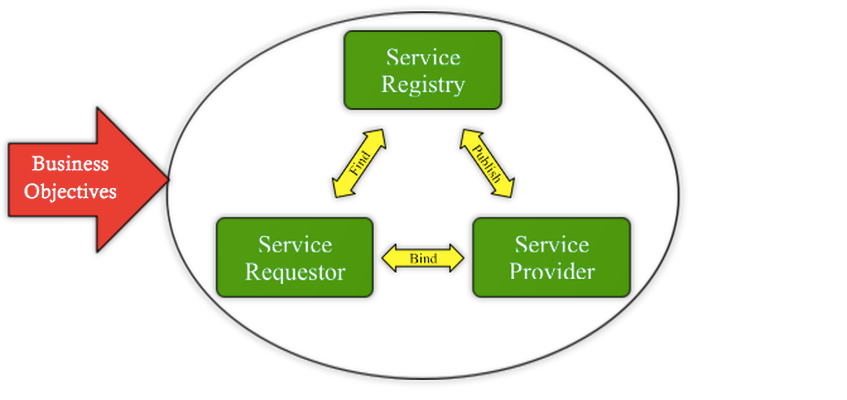
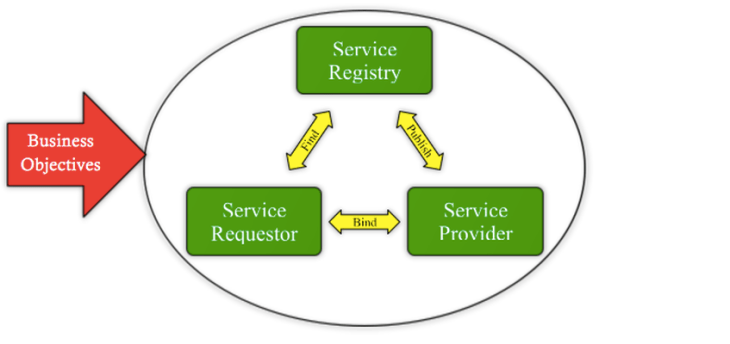
In SOA, you have three roles that include the Service Provider, the Service Requester, and the Service Registry. The Service Provider role (1) describes what the service does, (2) deploys the service over the network and (3) publishes service in a service registry. The Service Requester role (1) finds service in a service registry and (2) uses the service description to invoke the service. The Service Registry advertises the availability of a service that is published by the Service Provider. The interaction between Service Provider, Service Requester and Service Registry is shown below:

Business Objectives and SOA

From the above figure, you can see that business objectives are the drivers for SOA within an organization. While the main idea behind SOA is the reuse of generalized software components modeled as services, but due to its ability to encourage collaboration between business and IT, it can create alignment and can help the organization respond to the rapidly changing business environments.

2. WHAT ARE THE BENEFITS OF SOA?

In order to understand how SOA can help your organization, you have to explore some of its benefits and how other organizations were able to use SOA for their strategic advantage. Following are some of the benefits of SOA:

2.1 Enhanced Operational Insights:

It is often observed in organizations that the left hand is unaware of what the right hand is doing. This type of disconnects causes organizational silos where the approach to developing business processes and the technologies that support it have a very narrow focus. Due to this, the business processes and technologies are tightly coupled with the functional needs at the time when they were created. While this gets the job done for a particular functional need but now if you multiple this scenario across the entire organization and its various functions then you start to see a spaghetti of business processes and its enabling technologies (“Why Enterprise Architecture?” YouTube. Mastering ArchiMate, 19 Apr. 2013.)

The ‘spaghetti architecture’ can result in duplicative business processes and technologies across different organizational divisions. These business processes and enabling technologies are rarely documented which increases the risk of costly mistakes when these business processes change and when the underlying technologies that support these business processes become outdated. In spaghetti architecture, there is also rarely any thought put into the future needs of the organization as a whole, this can also result in using technologies that might become obsolete for future needs.

SOA addresses the spaghetti architecture head-on by creating operational insights into the different organizational processes of the organization. Since the main driver of SOA is business objectives that encompass business processes, your organization can start to view the various unique, duplicative and interdependent business processes holistically across the entire company. This holistic view gives your organization the ability to see which business processes can be completely eliminated, which ones can be combined and which ones can be used to make rapid decisions. An example of an organization that used SOA to address its spaghetti architecture is FedEx, a $32 billion multinational organization. By overhauling FedEx’s entire spaghetti architecture to SOA, within 3 years it was able to better manage acquisitions and process changes (Ganesan, Suresh et al. “What Business Executives Must Know About SOA.” Cognizant White Paper (2007): n. pag. Bloom Group, 2007. b.)

2.2 Increased Business Agility:

In today’s competitive business environment, business agility is the ‘holy grail’ that organizations strive to achieve. This business agility can entail many things and can range from bringing a product/solution quicker to the market to providing efficient troubleshooting support for customers. This also implies that business agility is a moving target and can be achieved partially and holistically depending upon the business objectives. The underlying thought behind business agility is the idea of continuous improvement to get better and better at what the organization does.

As your organization looks to be agile, SOA provides the foundation to do this. Due to operational insights and an understanding of the shared services within your organization, SOA can help accelerate what you are trying to achieve. An example of an organization that used SOA to become agile was Wachovia Bank. Using SOA, Wachovia was able to promote a product engineering mentality and make IT an advisor to the business (Ganesan, Suresh et al. “What Business Executives Must Know About SOA.” Cognizant White Paper (2007): n. pag. Bloom Group, 2007. Web.). In 2008, Wells Fargo bought Wachovia for $15.4 billion and when in 2014 Wells Fargo became the highest-earning bank in the United States, its CEO gave credit to their smooth acquisition of Wachovia due their cultural similarities (Raice, Shayndi. “As Wells Fargo Hits Profit Milestone, CEO Gives Credit to Wachovia.” MoneyBeat RSS. The Wall Street Journal, 14 Jan. 2014. Web.). You can extrapolate that Wachovia’s SOA might also have been a factor in the smooth acquisition since most acquisitions fail due to cultural and technological differences.

2.3 Better Customer Experience:

If the customer is king, then customer experience must be the only priority. Traditionally, organizations have considered customer experience to be the point of the transaction when a purchase is made. But a more holistic view of customer experience entails the pre-sales and post-sale processes as well. Due to the many touchpoints (e.g., physical, website, mobile, social media, etc.) of the customers with business; customer experience is not a point of transaction anymore. Forrester® goes on to say that in today’s era of empowered and always-connected customers, organizations need customers more than the customers need organizations. [9] Forrester® goes on and talks about creating a “customer experience ecosystem” that entails the people, processes, policies, and technologies. (Fenwick, Nigel. “Nigel Fenwick’s Blog.” Why Customer Experience Will Become The #1 CIO Priority. Forrester Research, 27 June 2013. Web.)

When you talk about customers, you have to take into account both the internal customers and external customers. The ease by which internal customers can provide customized and quick services to external customers can increase productivity and improve the bottom line for your organization. An example of an organization where SOA was used to improve customer experience was The Hartfort Group, a $26 billion organization. By implementing SOA, The Hartfort Group was able to enable its agents to create, assemble and complete transactions with the external customers (Ganesan, Suresh et al., “What Business Executives Must Know About SOA”).

2.4 Reduced Technology Costs:

As discussed earlier, “spaghetti architecture” can prove to be costly to the organization due to duplicative business processes and the underlying technologies. These costs can quickly add up and start to affect the bottom line of your organization. On the flip side, since SOA allows reuse of services across many functional domains, this can free up money for other endeavors that your organization might be interested in pursuing. An example of this would be Starwood Hotels who are on their way to saving $20 million per year simply by moving from tightly coupled mainframe applications to loosely-coupled SOA services (Ganesan, Suresh et al. “What Business Executives Must Know About SOA.” Cognizant White Paper (2007): n. pag. Bloom Group, 2007. Web.).

2.5 Creation of New Business Models:

In today’s competitive business landscape, organizations are continuously looking for ways to differentiate themselves from their competitors. This differentiation can also come in the form of determining new business models enabled by SOA services that would not have been possible in the past. Due to SOA, your organization can look across the various services and make intelligent decisions on what services can be combined to create additional value for the customer that in turn can increase the bottom line. An example of where SOA is best used and enforced is that of Amazon, a $74 billion online retailer (“Amazon Booms in 2013 With $74.45 Billion in Revenue.” Digital Book World. Digital Book World, 30 Jan. 2013. Web.). In 2002, Jeff Bezos of Amazon issued a mandate that stated, “All teams will henceforth expose their data and functionality through service interfaces” and “anyone who doesn’t do this will be fired” “The Secret to Amazons Success Internal APIs.” The Secret to Amazons Success Internal APIs. API Evangelist, 12 Jan. 2012. Web.). Bezos’s commitment to SOA and betting the entire future of the company speaks volumes about what SOA can do for an organization.

3. WHAT ARE THE CHALLENGES OF SOA?

So, while SOA provides great promise for your organization, it is by no means a panacea. Thus, you have to also carefully assess the following challenges that SOA brings to your organization:

3.1. Governance & Organizational Maturity:

Governance in a way is the policy of how things ought to be done. It provides a framework in which business processes can operate under regulatory, time and other constraints. Thus, governance is an organizational responsibility even for SOA and not only an IT activity. In order to accomplish this, your organization should set up a governance board that consists of a cross-functional team from both business and IT. Additionally, governance should not only include the overall organization and management of SOA activities but also the creation of success and failure measurements. These measurements should be used to actually determine the state of SOA within your organization instead of people doing vaporware measurements that have no grounds in reality.

3.2 Not Only an IT thing:

If the burden of implementing SOA across your entire organization is on IT then it takes away the business side’s responsibility and involvement. While IT is responsible for creating SOA services but the business has to work collaboratively with IT to define what those services are. Additionally, the business-side has to understand how did the current state of misalignment between business and IT came into being and how this can be avoided in the future. Thus, SOA is not an IT issue but an organizational endeavor that affects all parts of your organization.

3.3. Organizational Processes Need Reevaluation:

While the presence of too many point-to-point integrations in your organization can reduce your ability to be agile but there is a bigger perspective that you also have to consider. This perspective revolves around your organizational processes that led to misalignment in the first place. These organizational processes not only entail IT but also the business side. Typically, IT does what business asks but then there has to be some mutual understanding that the requests for services have to be understood holistically. Even after SOA migrations, if your organizational processes are not optimized they might still result in ad-hoc requests from the business leading back to point-to-point tightly couple services that you try to avoid in SOA.

3.4. Long-Term View of Legacy Systems is Needed:

In the short term, it may seem like a good idea to not replace your organizational legacy systems but in the long term, there are issues when you do this. These issues entail the constant “patching” to upgrade underlying hardware and software in addition to overburdening legacy systems where new services are being added on top of systems that should be replaced rather than being continued to extend their life. While it may not be possible to replace legacy systems altogether but you should have a plan to retire these systems with new systems eventually.

3.5. No Measurement Means No ROI:

If your organization does not measure pre-SOA activities then how would you know if what SOA promised for your organization is what you really wanted to achieve. So, since SOA often requires a long-term commitment from both business and IT, you have to develop performance metrics upfront before you embark on your journey towards SOA-fication.

4. CONCLUSION

Due to your organization’s desire to compete in today’s competitive business landscape, you have to carefully weigh the benefits of SOA’s value in terms of operational efficiencies and organizational improvements. Based on the information provided above, using SOA will help your organization have enhanced operational insights which can increase your organization’s agility to provide better customer experiences, reduce technology costs and explore new business models. Also, you need to keep in mind that SOA presents the challenges of honestly looking at yourselves in terms of maturity and business-IT collaboration by having a long-term view of what you want your systems to accomplish and how you measure what success looks like. Consequently, if you lack foresight into how SOA can be used as a business transformation effort then your desire to be the best would just be a pipedream.

References:

  1. “Service.” Merriam-Webster. Merriam-Webster, n.d. Web. <http://www.merriam-webster.com/dictionary/service&gt;.
  2. Linthicum, David. “Chapter 1: Service Oriented Architecture (SOA).” Chapter 1: Service Oriented Architecture (SOA). Microsoft, n.d. Web. <http://msdn.microsoft.com/en-us/library/bb833022.aspx&gt;.
  3. “Oracle SOA – Service-Oriented Architecture.” Service Oriented Architecture. Oracle, n.d. Web. <http://www.oracle.com/ca-en/products/middleware/soa/overview/index.html&gt;.
  4. Erl, Thomas et al. “SOA Manifesto.” SOA Manifesto. N.p., Oct. 2009. Web. <http://www.soa-manifesto.org/&gt;.
  5. “Why Enterprise Architecture?” YouTube. Mastering ArchiMate, 19 Apr. 2013. Web. <http://www.youtube.com/watch?v=qDI2oF1bASk&gt;.
  6. Ganesan, Suresh et al. “What Business Executives Must Know About SOA.” Cognizant White Paper (2007): n. pag. Bloom Group, 2007. Web. <http://bloomgroup.com/sites/all/files/Cognizant%20SOA%20paper.pdf&gt;.
  7. Raice, Shayndi. “As Wells Fargo Hits Profit Milestone, CEO Gives Credit to Wachovia.” MoneyBeat RSS. The Wall Street Journal, 14 Jan. 2014. Web. <http://blogs.wsj.com/moneybeat/2014/01/14/as-wells-fargo-hits-profit-milestone-ceo-gives-credit-to-wachovia/&gt;.
  8. Fenwick, Nigel. “Nigel Fenwick’s Blog.” Why Customer Experience Will Become The #1 CIO Priority. Forrester Research, 27 June 2013. Web. <http://blogs.forrester.com/nigel_fenwick/13-06-27-why_customer_experience_will_become_the_1_cio_priority&gt;.
  9. “Amazon Booms in 2013 With $74.45 Billion in Revenue.” Digital Book World. Digital Book World, 30 Jan. 2013. Web. <http://www.digitalbookworld.com/2014/amazon-booms-in-2013-with-74-45-billion-in-revenue/&gt;.
  10. “The Secret to Amazon’s Success Internal APIs.” The Secret to Amazon’s Success Internal APIs. API Evangelist, 12 Jan. 2012. Web. <http://apievangelist.com/2012/01/12/the-secret-to-amazons-success-internal-apis/&gt;.

Processing…
Success! You're on the list.

Understanding and Applying Predictive Analytics

Executive Summary

This article proposes looking at Predictive Analytics from a conceptual standpoint before jumping into the technical execution considerations. For the implementation aspect, organizations need to assess the following keeping in mind the contextual variances:

Strategies

Tactics

Operations

  • Top Down
  • Bottom-Up
  • Hybrid
  • Organizational Maturity
  • Change Management
  • Training
  • Practical Implications
  • Pros and Cons of Technology Infrastructure
  • Providing Enabling Tools to Users
  • Best Practices

Describing Predictive Analytics

Predictive Analytics is a branch of data mining that helps predict probabilities and trends. It is a broad term describing a variety of statistical and analytical techniques used to develop models that predict future events or behaviors. The form of these predictive models varies, depending on the behavior or event that they are predicting. Due to the massive amount of data organizations are collecting, they are turning towards Predictive Analytics to find patterns in this data that could be used to predict future trends. While no data is perfect in predicting what the future may hold there are certain areas where organizations are utilizing statistical techniques supported by information systems at strategic, tactical and operational levels to change their organizations. Some examples of where Predictive Analytics is leveraged include customer attrition, recruitment and supply chain management.

Gartner describes Predictive Analytics as any approach to data mining with four attributes:

  1. Emphasis on prediction (rather than description, classification or clustering)
  2. The rapid analysis measured in hours or days (rather than stereotypical months of traditional data mining)
  3. An emphasis on the business relevance of the resulting insights (no ivory tower analyses)
  4. An (increasing) emphasis on ease of use, thus making tools accessible to business users

The above description highlights some important aspects for organizations to consider namely:

  1. More focus on prediction rather than just information collection and organization. Sometimes in organizations, it is observed that information collection becomes the end goal rather than using that information to make decisions.
  2. Timeliness is important otherwise organizations might be making decisions on information that is already obsolete.
  3. Understanding of the end goal is crucial by asking why Predictive Analytics is being pursued and what value it brings to the organization.
  4. Keeping in mind that if the tools are more accessible to business users then they would have a higher degree of appreciation of what Predictive Analytics could help them achieve.

Relationship of Predictive Analytics with Decision Support Systems or Business Intelligence

The University of Pittsburg describes Decision Support Systems as interactive, computer-based systems that aid users in judgment and choice activities. They provide data storage and retrieval but enhance the traditional information access and retrieval functions with support for model building and model-based reasoning. They support framing, modeling and problem-solving. While Business Intelligence according to Gartner is an umbrella term that includes the applications, infrastructure and tools, and best practices that enable access to and analysis of information to improve and optimize decisions and performance. These descriptions point to the fact that Decision Support Systems or Business Intelligence are used for decision making within the organization.

Interestingly, it seems like Predictive Analytics is the underlying engine for Decision Support Systems or Business Intelligence. What this means is the predictive models that result in Predictive Analytics could be under the hood of Decision Support Systems or Business Intelligence. It should be noted that organizations should proceed with caution with regards to the Decision Support Systems or Business Intelligence since if the underlying assumption is incorrect in making the predictive models then the decision-making tools would be more harmful then helpful. A balanced approach would be to create expert systems where Decision Support Systems or Business Intelligence is augmented by human judgment and the underlying models are checked and verified periodically.

Implementation Considerations for Predictive Analytics

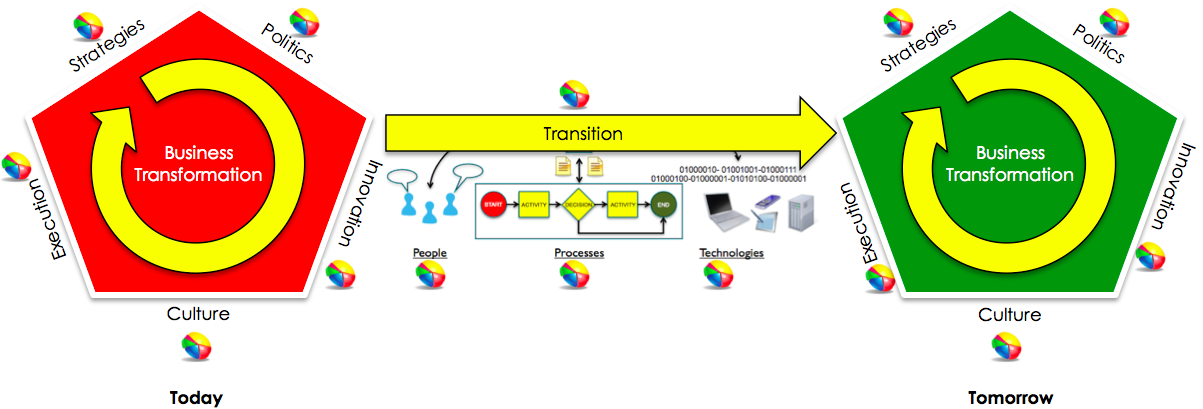
As the descriptions above have indicated that the aim of Predictive Analytics is to recognize patterns and trends that can be utilized to transform the organization. This requires organizations to first educate themselves on what value they want and what can be derived from Predictive Analytics. Predictive Analytics is about business transformation and it needs to show what value it brings to the organization. In this regard, we have to assess people, processes and technologies of the organization in terms of the current state (where the organization is right now) and future state (where the organization wants to be). Typically, this revolves around Strategies, Politics, Innovation, Culture and Execution (SPICE) as shown below.

SPICE Factors
SPICE Factors

The assessment of people for Predictive Analytics means understanding what users will be leveraging Predictive Analytics and if they understand that simply relying on Predictive Analytics is not enough but in order to have an effective system, they need to be part of the system. This means that analytics insights need to be augmented by human expertise to make intelligent decisions. The assessment of processes for Predictive Analytics entails looking at how organizations make decisions right now and how future decisions would be made if Predictive Analytics is put into place. This includes having appropriate governance structures in place. The assessment of technology entails looking at what technologies exist within the organization and if they could be leveraged for Predictive Analytics. If not then looking at what Predictive Analytics products are in the market that would work for the organization and are they flexible enough in case the underlying assumptions for the predictive models change and when predictive models become obsolete.

The advanced techniques mentioned in the book, Seven Methods for Transforming Corporate Data into Business Intelligence would be applicable to Predictive Analytics. These methods are:

  1. Data-driven decision support
  2. Genetic Algorithms
  3. Neural Networks
  4. Rule-Based Systems
  5. Fuzzy Logic
  6. Case-Based Reasoning
  7. Machine Learning

Technologies Used for Predictive Analytics

Gartner has been publishing its Magic Quadrant on Business Intelligence and Analytics Platforms since 2006. Due to the increased importance of Predictive Analytics in the marketplace, Gartner decided to create a separate Magic Quadrant for Advanced Analytics Platforms which focuses on Predictive Analytics and published its first version in February 2014. Since it is the first version of the Magic Quadrant, all vendors listed are new and no vendors were dropped.

Gartner's Magic Quadrant for Advanced Analytics Platforms
Gartner’s Magic Quadrant for Advanced Analytics Platforms

As we can see from this Magic Quadrant that it includes well-known vendors but also vendors that are not as big or as well-known. It is interesting to note that open-source vendors such as RapidMiner (a Chicago company) and Knime (a European company) are in the same Leaders Quadrant as well-established vendors such as SAS and IBM. While there are some issues with these open-source vendors as stated in the report but perhaps this Magic Quadrant is also an indication of where the next generation of analytics would come from. Due to the very nature of open-source, there are more opportunities for cheaper customization which would give the organizations the flexibility to be as granular as they want to be. Of course code stability and lack of proper documentation are issues that organizations need to be cognizant about. Organizations may also want to “try-out” these open source tools before they make a big commitment to proprietary software to see if Predictive Analytics is something they want to invest heavily in.

Using Predictive Analytics in Specific Industries

There are many industries that utilize Predictive Analytics. The organizations in these industries either use Predictive Analytics to transform their business and/or to address certain areas that they would like to improve upon. Following is a list of some of the industries that utilize Predictive Analytics:

Industry How is Predictive Analytics used?
Retail
  • Customer Retention
  • Inventory Optimization
  • Low-Cost Promotions
Oil and Gas
  • Well and Field Asset Surveillance
  • Production Optimization
  • Equipment Reliability and Maintenance
Automotive
  • Adjust production schedules
  • Tweak marketing campaigns
  • Minimize Inventory
Food
  • Human Resources Allocation
  • Supply Chain Optimization
Healthcare
  • Electronic Health Records
Government
  • Nation-wide Blood Levels
Social Media
  • New Business Models

While there are many examples of industries that have embraced Predictive Analytics but there are other industries that have not fully accepted it as a new reality. These industries have many excuses for not considering Predictive Analytics but typically revolve around scope, quality, cost, and fear of the known. However, the tide might be changing for these industries as well since industry bloggers are beginning to insist on how Predictive Analytics could be leveraged for competitive advantages.

My Opinion

Predictive Analytics can come in handy in making organizations analytical and becoming a better version of themselves. However, Predictive Analytics can be a deal-breaker if organizations have attempted and failed in the past and for this very reason, Predictive Analytics should start as a discussion first. This discussion should revolve around asking which areas need improvements and among other things determine if Predictive Analytics could be something that could help. After a successful Predictive Analytics initiative, other areas could be potential candidates as well.

An important thing to note is that Predictive Analytics is an organization-wide initiative that has touchpoints across the organization and thus the maturity of the organization has to be seriously considered prior to go on a Predictive Analytics journey. No matter how good Predictive Analytics can be for the organization but if the organization is not mature enough and it does not have the right governance, processes and feedback mechanisms in place then it might turn out to be another attempt at glory but nothing to show for it.

References:

    1. Predictive Analytics for Dummies
    2. Seven Methods for Transforming Corporate Data Into Business Intelligence
    3. IBM Journal Paper on A Business Intelligence System by H.P. Luhn
    4. Gartner report (G00258011) Magic Quadrant for Advanced Analytics
    5. Gartner IT Glossary on Predictive Analytics
    6. Gartner IT Glossary on Business Intelligence
    7. SAP Predictive Analytics
    8. Decision Support Systems by Marek J. Druzdzel and Roger R. Flynn
    9. 5 Questions to Ask About Predictive Analytics
    10. 5 Factors for Business Transformation

Processing…
Success! You're on the list.

2 Management Challenges with Really Simple Syndication (RSS)

According to the Interactive Advertising Bureau (IAB) and PricewaterhouseCoopers (PwC) US, in the first quarter of 2014 Internet advertising revenues reached USD $11.6 billion. The President of IAB indicated that “Digital screens are a critical part…” of why these numbers are so high. Typically, these advertisements are done through images and/or text ads displayed with online articles and websites.

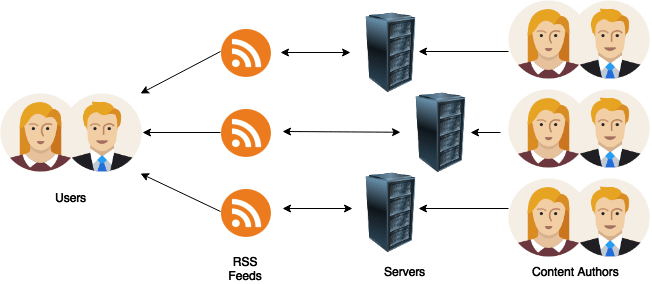
Really Simply Syndication (RSS) and other types of syndicated Internet sharing protocols strip away the images and/or text ads and only display content such as title, first sentence, summary or a complete article. This content is read typically through third party feed readers. In addition to content ownership issues, the other two management challenges include tracking subscribers and higher traffic demands.

Tracking of Subscribers 

In order to address the tracking of subscribers, organizations should request that the RSS readers provide this information to them. In order to get this information, organizations should incentivize the owners of the RSS feed readers and also the content subscribers to provide tracking information. One of the other ways to track and direct subscribers to their website would be to create some sort of paywalls that either ask subscribers to pay for content and/or ask them to create free login accounts to access more content.

Higher Traffic Demands 

One of the other issues that RSS feeds create is higher traffic demands on the servers that house the content. These feed readers access to content on websites more frequently than if a person was reading the information. In order to address this, a possible solution is to integrate desktop applications into a P2P network that would distribute the load among hundreds of clients.

RSS Management Challenges

As we can see from the above management challenges, beyond ownership issues there are issues of maintenance (e.g., optimize server capacities for repeated requests) and standardization (e.g., creating standard ways of tracking subscribes from multiple feed readers).

References:

  1. “Pros and Cons for RSS.” Pros and Cons for RSS. FeedforAll.com, n.d. Web. 05 July 2014. http://www.feedforall.com/pros-and-cons-of-rss-feeds.htm
  2. Singel, Ryan. “Will RSS Readers Clog the Web?” WIRED. WIRED, 30 Apr. 2004. Web. 05 July 2014. http://archive.wired.com/techbiz/it/news/2004/04/63264?currentPage=2

Processing…
Success! You're on the list.

How to select an Enterprise Architecture Framework?

EXECUTIVE SUMMARY:

This article provides in detail the elements of an Enterprise Architecture (EA) framework that would be selected and deployed at a fictional United States (US) Federal Government contractor called FedCon. FedCon is divided into 3 Business Units (BUs) that are focused on providing Management Consulting, Information Technology (IT) Consulting and Systems Integration (SI) Services in Healthcare, Environment, and Finance.

This article analyzes FedCon in terms of Strategies, Politics, Innovation, Culture and Execution (SPICE) as shown below:

 StakeholdersDomains
StrategiesCEO, COO, and CIOBusiness-IT alignment
PoliticsBU SVPs, PMO and program/project managersTechnology products and services
InnovationEmployees directly interfacing with customersTechnology products and services
Culture PMO, HR and Accounting/FinanceLeverage the massive intellectual property
ExecutionAll employeesOrganizational performance

Based on the above, it is determined that The Open Group Architecture Framework (TOGAF) would be the appropriate EA framework at FedCon since (1) it is supported by multiple vendor tools (2) it is constantly being improved upon and (3) it has an Architecture Development Methodology (ADM) which can be used as a guide.

ABOUT FEDCON:

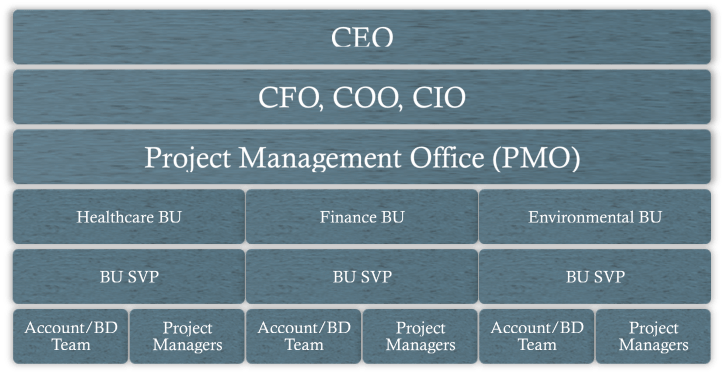
FedCon is a fictional 30-year-old large publically traded US Federal Government contractor that provides Management Consulting, IT Consulting, and SI services to civilian agencies. It has over 5,000 employees nationwide and it is structured into three Business Units (BUs). Each BU has domain expertise in Healthcare, Finance or Environmental information systems. This structure allows the BUs to work directly with the civilian agencies based on their missions. Each BU has its own account/business development (BD) team that reports to the BU Senior Vice President (SVP). The Program/Project Managers report to the BU SVP and provide status updates on programs/projects to the corporate Program Management Office (PMO). The PMO conducts weekly meetings to provide guidance on corporate standards, compliance, and general project templates.

Organizational Structure

PROBLEM STATEMENT:

Over the past couple of years, FedCon has lost 20% of its business. The CEO has been under pressure by the shareholders to turn the company around. Thus, the CEO hired a management consulting firm to determine what were the pain points within FedCon that were preventing it from staying competitive in the marketplace. The management consulting firm’s report revealed that due to inefficient business processes and outdated technologies FedCon’s BUs were not able to collaborate efficiently to manage business and technology changes. Based on these findings in the report, the CEO mandated the Chief Operation Officer (COO) and Chief Information Officer (CIO) to work together to find areas that they can improve in the next 12 months.

ANALYSIS:

In order to address the CEO’s concerns, the COO and CIO came to the conclusion that in order to help FedCon create a disciplined approach to managing strategic intent and its execution they had to look into the field of Enterprise Architecture. Thus, the COO and CIO decided to standup an Enterprise Architecture Program Management Office (EAPMO) that would report directly to the CIO. Initially, the EAPMO is tasked with determining the high-level criterions to select a framework. This task includes providing elements of the framework to be used and how the framework would be applied within FedCon..

In this article, we assess the feasibility of an EA framework that can be used in FedCon by making observations about Strategies, Politics, Innovation, Culture and Execution (SPICE) factors. These factors would focus on understanding the people, processes, and technologies at FedCon to create an effective EAPMO.

SPICE Factors
SPICE Factors

Strategies at FedCon:

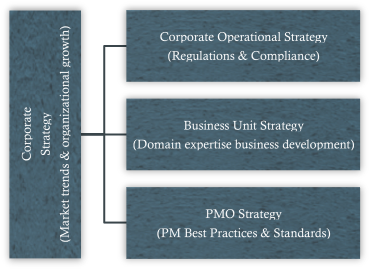
At FedCon, there are multiple levels of strategies that are developed. These strategies include: (1) the corporate strategy determined by the CEO, (2) the operational strategy determined by the CFO, COO, and CIO, (3) the BU strategy determined by the BU SVPs and (4) the PMO strategy determined by the PMO office. This is shown below.

Multiple Corporate Strategies

As we can see from the above figure, each strategy layer addresses different domains for the various stakeholders. Even though these strategies are developed to increase the bottom line and decrease costs, they are created in isolation. Additionally, since each BU is somewhat autonomous it can create technology products and solutions for the civilian agencies that overlap with corporate products and solutions. This is a problem since not leveraging the corporate assets where applicable for client delivery can result in program/project delays and duplicative systems.

The primary strategic concerns in choosing an EA framework are:

  1. Stakeholders – CEO, COO and CIO are the strategic stakeholders and the executive sponsors of the EAPMO.
  2. Domain – Strategically, FedCon is interested in the alignment of business and IT operations and efficient processes.

FedCon has never stood up an EA practice and thus it would be wise to select an EA framework that could guide them in what to do and that it has been proven in the industry to be useful for organizations that are just starting out their EA journey. These high-level strategic criterions are fulfilled by The Open Group Architecture Framework (TOGAF) that provides an Architecture Development Methodology (ADM) as a step-by-step guide and includes how to do stakeholder management.

Politics at FedCon:

Generally, when we talk about politics in an organization we are referring to the negative connotations attached to it. But for our purposes, we will define politics to mean the formal power or informal power of an individual or group within an organization. The power exhibited by these individuals and groups can turn into obstacles or support to bring about organization-wide changes. In this sense, here we refer to formal power as the reporting structures while informal power refers to the influence yielded based upon the size of the BU, revenue generated by BU, the headcount of BU and close relationships of BU leadership with the executives.

At FedCon, even though the BU SVPs have the same title, they don’t have the same power. Taking this into account and the emphasis by the US Federal Government Executive Branch to focus on healthcare issues, the largest and most profitable among the FedCon’s BUs in the healthcare BU. Due to this reason, healthcare BU SVP has more informal power among its peers. This means that if the healthcare BU can be convinced of the merits of the EA practice then we can come one step closer to a FedCon-wide EA practice.

The primary political concerns in choosing an EA framework are:

  1. Stakeholders – BU SVPs, PMO and program/project managers are the political stakeholders. The BU SVPs have the formal power to bring change within their respective BUs. The PMO is a well-established office and it has visibility into the various kinds of projects and has informal power by pushing down changes to the project level within different BUs. Lastly, the program/project managers within BUs are stakeholders as well since they have to indoctrinate their teams on how EA can be used as leverage when developing client technology products and services.
  2. Domain – Politically, agreement, collaboration, and coordination across BUs and the corporate team seems to be the area of focus to rapidly bring technology products and services.

Due to the “friendly” competition among BUs to become bigger and yield more influence in FedCon, politics has to be carefully considered. Sometimes BUs are not willing to share if there are possible overlaps with what they are developing and what is already available in a different BU or at the corporate level. Convincing BUs to work together could be hard and caution has to be taken in which players to involve in the development of the EA practice. Additionally, there has to be some sort of collaboration between the EAPMO and PMO for lessons learned and organizational improvements. These high-level political criterions are also fulfilled by TOGAF where it recommends how Architecture Governance and Architecture Boards should be set up.

Innovation at FedCon:

Broadly speaking, innovation in organizations is disruptive, incremental or a combination of both. Disruptive innovation as described by the world-renowned management theorist Clay M. Christensen’s institute is such that it “transforms an existing market or sector by introducing simplicity, convenience, accessibility, and affordability where complication and high costs are the status quo.” This disruption can come in the form of unique business models, products and/or services that can give rise to new industries and improve existing industries. On the other end of the innovation spectrum, incremental innovation is where small changes are made to existing business models, products and services to improve existing industries.

Being a US Federal Government contractor, innovation at FedCon is mostly incremental since it tries to improve upon its existing products and services that are provided to the civilian agencies. FedCon accomplishes incremental innovation by obtaining customer feedback and assessing the competitive landscape. However, since BUs only focus on their own expertise, there are fewer opportunities for collaboration across BUs, which means technology products and services, are being developed without leveraging what already exists in the organization.

The primary innovation concerns in choosing an EA framework are:

  1. Stakeholders – FedCon employees that work directly with customers are the stakeholders that need to be considered since the improvement of existing technology products and services are highly dependent upon customer feedback and conveying of the feedback to FedCon.
  2. Domain – In terms of innovation, FedCon is interested in creating technology products and services that meet customer expectations and exceed what the competition can offer.

EA is a disciplined approach to accomplishing enterprise objectives through alignment between business and IT. This disciplined approach can also be leveraged to make FedCon more competitive, which can result in bringing technology products and services quicker to the marketplace. This high-level innovation criterion also points towards using TOGAF since it is constantly being improved upon based on the feedback from technology vendors and solution providers.

The culture at FedCon:

The “father of modern management” Dr. Peter Drucker once said that “Culture eats strategy for breakfast.” Culture can affect the ability of any organization to adopt or resist changes to the organization. While culture is typically considered a fuzzy attribute of an organization but there are tangible things that we can observe to decipher corporate culture which includes (1) corporate values, (2) employee recognition and risk-taking, (3) salaries, commission and hourly rates, (4) location, (5) clothes and (6) domain expertise and product/service subcultures.

At FedCon, the culture is such that change is welcomed as long everyone who is affected by it understands its purpose and there is no disruption to normal business processes. This is a two-pronged issue for the selection of an EA framework since even if the value of EA is understood by senior leadership but it is not understood at the BU, program/project and individual levels then it becomes just another information collection exercise.

The primary cultural concerns in choosing an EA framework are:

  1. Stakeholders – FedCon has a process-driven and metrics-monitoring culture. This is one of the reasons that the Program Management Office (PMO) is an important part of FedCon since it provides a consistent process by which programs/projects can be evaluated. In order to incentivize employees to change their behavior for the organizational transformation, human resources and accounting/finance offices are also stakeholders in EA success.
  2. Domain – Culturally, FedCon is interested in creating an atmosphere that encourages employees to take risks and leverage the massive intellectual property it has developed over the years to stay competitive.

One of the reasons for the success of the PMO within FedCon is its process-driven culture. So for the selection of an EA framework, we have to consider what plays into strengths of FedCon. This high-level cultural criterion leads us to TOGAF that provides a methodological approach for EA within an organization. The EAPMO would make use of lessons learned from the PMO to create a successful EA practice.

Execution at FedCon:

Intention without execution is simply thoughts without results. An organization can have great intentions but if it does not operationalize those intentions then all the strategy discussions and documentation it did just an exercise in futility.

At FedCon, execution has two views. One view is the execution based on winning a government contract to deliver technology products and services. The second view is the execution of the corporate strategy that looks into entering new markets, mergers and acquisitions and creating superior technology products and services.

The primary execution concerns in choosing an EA framework are:

  1. Stakeholders – All employees of FedCon at every level are stakeholders in the successful execution of EA.
  2. Domain – In terms of execution, best practices have to be applied/created for all of FedCon and metrics developed that assess organizational performance.

STANDING UP AN EAPMO:

After assessing the business environment of FedCon to determine an appropriate EA framework, next we have to determine people, processes and technologies needed to standup the EAPMO. These needs are discussed below:

People:

In order to assess the skill sets needed to run the EAPMO, we have to look at the current skillsets available, skillsets that people need to be trained on and hiring people with the necessary skillsets at FedCon. The hard skills needed to join the EAPMO require the knowledge of the chosen EA framework (i.e., TOGAF) and the ability to find common themes to enhance collaboration. The soft skills needed to join the EAPMO require (1) being politically aware, (2) ability to create bridges/connections and (3) high emotional intelligence. Additionally, metrics will be created to evaluate EAPMO team members based on their hard and soft skills.

Processes:

The business processes followed by EAPMO would be determined by TOGAF best practices and what has worked within FedCon. At a high level, this would be the architecture governance process and at the lower level, this would the cross-functional team’s processes for being advocates and collectors of information across FedCon. The various processes would be tested in the first 6 months to work out any wrinkles and get a baseline understanding of what needs to be done.

Technologies: 

Now that we have selected the FedCon’s EA framework to be TOGAF, we have to select a tool that supports this framework. This tool can be selected by looking at Gartner’s Magic Quadrant for Enterprise Architecture Tools.

CONCLUSION:

Due to FedCon’s expertise as a technology company and for all the reasons stated in the analysis section, TOGAF is the right EA framework since it provides a roadmap of what needs to be done. One thing to keep in mind is that a framework needs to be flexible enough so it can adapt to changing organizational needs rather than the organization becoming a slave to the framework.

References:

  1. Khan, Arsalan. “5 Factors for Business Transformation.” Arsalan Khan. WordPress.com, n.d. Web. https://arsalanakhan.wordpress.com/2013/07/16/5-factors-for-business-transformation/
  2. “Stakeholder Management.” ADM Guidelines and Techniques – Stakeholder Management. TOGAF, n.d. Web. http://pubs.opengroup.org/architecture/togaf9-doc/arch/chap24.html
  3. Schekkerman, Jaap. Enterprise Architecture Good Practices Guide: How to Manage the Enterprise Architecture Practice. Victoria, BC: Trafford Pub., 2008. Print.
  4. “Architecture Governance.” Architecture Governance. TOGAF, n.d. Web. http://pubs.opengroup.org/architecture/togaf8-doc/arch/chap26.html
  5. Christensen, Clay M. “Christensen Institute.” Christensen Institute Disruptive Innovation Comments. Christensen Institute, n.d. Web. http://www.christenseninstitute.org/key-concepts/disruptive-innovation-2/
  6. “The Business Executive’s Guide to IT Architecture.” The Open Group Architectural Framework (TOGAF) Executive Overview. TOGAF, n.d. Web. http://www.opengroup.org/public/arch/p1/oview/
  7. Caldbeck, Ryan. “Why Execution Is Everything In Business.” Forbes. Forbes Magazine, 16 Sept. 2014. Web. http://www.forbes.com/sites/ryancaldbeck/2014/09/16/why-execution-is-everything/
  8. “Organisational Culture Eats Strategy for Breakfast and Dinner.” ORGANISATIONAL CULTURE EATS STRATEGY FOR BREAKFAST, LUNCH AND DINNER. Meliorate, n.d. Web. http://www.torbenrick.eu/blog/culture/organisational-culture-eats-strategy-for-breakfast-lunch-and-dinner/
  9. Lapkin and Weiss. “Ten Criteria for Selecting an Enterprise Architecture Framework”. Gartner report G00163673. Gartner http://my.gartner.com/portal/server.pt?open=512&objID=260&mode=2&PageID=3460702&resId=838915&ref=QuickSearch&sthkw=G00163673
  10. Brand, Saul. “Magic Quadrant for Enterprise Architecture Tools.” Gartner report G00263193 http://my.gartner.com/portal/server.pt?open=512&objID=260&mode=2&PageID=3460702&resId=2859721&ref=QuickSearch&sthkw=ea+tools+magic+quadrant

Processing…
Success! You're on the list.

Is the Internet a Distributed System?

Tanenbaum and Steen describe a distributed system as “a collection of independent computers that appears to its users as a coherent system.” This means that even if there are multiple heterogeneous components within the distributed system communicating with each other, but from a user’s point of view it is a single system. An example of a distributed system would be the World Wide Web (WWW) where there are multiple components under the hood that help browsers display content but from a user’s point of view, all they are doing is accessing the web via a medium (i.e., browsers). The following figure from Tanenbaum and Steen below helps visualize their definition of a distributed system.

Distributed Systems Organized as Middleware

From the above figure, we can observe that the distributed systems layer sits in-between the various computer applications and the independent computer operating systems. What the authors are trying to show here is that distributed systems are at a software layer level that acts as the “glue” which helps in sharing of resources across various independent components (i.e., computers) but at the same time seems like a single system to the end-users. The authors call this type of distributed system middleware. Additionally, we notice that these components are connected via a network. While it is not clear what kind of network this is but we can extrapolate that these independent computers are on the same network.

As we can see that the importance of the network cannot be minimized. For if there is no network then it becomes difficult for independent components to talk to each other and share resources hence there is no distributed system. The importance of the network is such that when we look at the 8 fallacies formulated by Peter Deutsch 8 out of the 8 fallacies when developing distributed applications are about the network. Following are these 8 fallacies:

  1. The network is reliable
  2. The network is secure
  3. The network is homogenous
  4. The topology does not change
  5. Latency is zero
  6. Bandwidth is infinite
  7. Transport cost is zero
  8. There is one administrator

Despite the importance of the network for distributed systems, can we truly claim that the Internet, which is a network of networks, is really a distributed system? I would say no since while a network provides the essential connectivity and communication channels for a distributed system but the network itself is not a distributed system. From an end-user perspective, the Internet might appear to be a single system (e.g., email) but in reality, email is not the Internet but a service provided on top of the Internet utilizing existing Internet infrastructure. Vera-Ssmio and Rodrigues agree with the claim that there is a distinction between a network and a distributed system. They emphatically say that “a computer network is not a distributed system.” 

Beyond the technological aspects though, should we be looking at distributed systems from a broader lens. Should we be looking at distributed systems from security and privacy perspectives? The answer is of course yes. The reason is that by definition within a distributed system components share resources. Some examples of sharing resources would include memory allocation and computing power optimization to name a few. But the sharing of resources opens up a Pandora’s box of issues related to security and privacy. This is due to the fact that when sharing resources, certain information (e.g., computer IP addresses, open ports, etc.) needs to be shared as well. The exposure of this information can result in unintentional consequences on one end or deliberate attacks on the other end. We need to ask ourselves: How much information sharing is too much? What happens when information is compromised? Should the Internet become a Distributed System? What happens if one computer is exposed and an intruder has gotten onto the network? How do you safeguard other computers on the same network that share resources?

In conclusion, in the 21st century, the Internet has become a necessary tool for businesses and individuals to interact with each other and share information. Some examples of this information sharing include emails, browsing the World Wide Web, conducting a financial transaction, sharing photos, etc. As time progresses, the importance of the Internet will only increase which would result in improvements and the creation of new services and business models. Thus, in order for businesses and individuals who are interested in leveraging the power of the Internet, it is useful to understand what the Internet is and what it is not. So, when we hear that if the Internet is a distributed system, the immediate reaction for some people is of course it is. But if we dig a little deeper, we would realize that the answer is not as simple. The reason is that the Internet itself is a network of networks and does not necessarily fall under the classic definition of a distributed system. Thus, in this paper, we have made the argument about the Internet not being a distributed system and raised some issues that go beyond the technological realm.

References:

  1. Tanenbaum, Andrew S., and Maarten Van. Steen. Distributed Systems: Principles and Paradigms. Harlow: Prentice Hall, 2006. Print.
  2. Veríssimo, Paulo, and Luís Rodrigues. Distributed Systems for System Architects. Boston: Kluwer Academic, 2001. Print.

Processing…
Success! You're on the list.