5 Questions to Ask About Your New Year Reboot

For some organizations, December/January is that time of the year where organizations reflect on what happened during the prior year and what goals need to be accomplished for the current year. This reflection revolves around the organization’s people, processes and technologies. It also involves creating strategies, understanding the effects of internal and external politics, competing innovatively, transforming culture and polishing execution. In order to thoroughly learn and objectively plan, the right questions need to be asked. These questions open the organization to have a better understanding of what has happened and helps in determining what needs to happen. By no means, these are the only questions to be asked but rather should be used as a starting point to go beyond a mere surface-level understanding of issues. So, let’s ask them:

Today

Tomorrow

Who develops the strategy?Who should develop the strategy?
What internal and external politics affected your organization?What internal and external politics should not affect your organization?
Where did the inspiration for innovation came from?Where inspiration of innovation should come from?
When culture trumped strategy?When should culture trump strategy?
Why execution was flawed?Why execution would continue to be flawed in the future?

When you are asking the above questions, keep in mind that organizational silos have to be broken down to create a well-oiled machine where all gears interconnect with each other and understand each other’s roles and responsibilities. An organization that can consistently set goals, track them and measure them against expectations, have better data to make informed decisions.

In conclusion, take this time to understand the multidimensionality of your organization. New Years is about reboot; reboot your organization to become a disruptive force; reboot so that your employees, partners, customers, and stakeholders become your megaphone; reboot your business processes to bring products and services quickly to the market; reboot to create a learning organization; reboot to make data open your eyes to new possibilities and reboot to create an organization that positively serves people beyond perceived organizational boundaries.

newyearreboot
New Year Reboot

Processing…
Success! You're on the list.

5 Questions to Ask About Customer Experiences

According to Forrester®, “to be truly competitive your company must become customer-obsessed; you need to have deep knowledge of and engagement with your customers.” The need for the organization to be obsessed with the customer revolves around data and engagement. Data-level obsession encompasses collecting as much information as you can about the customer so that the unique needs (e.g., Amazon buying preferences, Facebook habits, and likes, etc.) of the customers can be met. This information can be gathered directly from the customer (e.g., surveys, account signups, etc.) and/or can be obtained by analyzing trends (e.g., census data, inventory depletion data, etc.) Engagement-level obsession encompasses providing services to the customer that can be person-to-person (e.g., customer service, social media, etc.) and/or can be person-to-technology (e.g., corporate website, kiosks, etc.). As technology becomes commonplace and continues to get cheaper, more and more organizations are moving towards combining their data and engagement obsessions to provide a seamless experience for the customers. Customers are becoming smarter and while at one point price was one of the major factors of customer decision-making but now the quality of products and services is becoming very important.

For organizations, customer experience revolves around maximizing the potential of its people, processes, and technologies. From this perspective, customer experience is not only about the customer but also about the organization as a whole. Thus, in order to understand the holistic nature of customer experiences, organizations need to assess the current customer experiences and determine what future customer experiences should entail. This starts by asking the following questions:

TodayTomorrow
Who serves your customers?Who should serve your customers?
What avenues are being used to make the life of customers easier?What avenues should be used to make the life of the customers easier?
Where do customers experience your organization?Where should customers experience your organization?
When do customers engage with your organization?When should you be available for the customers based on their needs?
Why customer experience matters?Why customer experience is becoming the next currency?

When you are asking the above questions, keep in mind that organizations that know how to leverage its people, processes, and technologies and who are open to exploring new paradigms of customer experience would be far ahead of the game. These organizations are not only obsessed about customer experience but create executable strategies that enhance the experience for internal and external customers.

In conclusion, customer experience is more than just external-facing activities. Customer experience is about trust; trust that you would have the most competent people for representing your organization; trust that your business processes are as efficient as they can be; trust that you would use technologies to enhance and not exploit the lives of customers; trust that you would provide the best products and services to your customers; trust that you would safeguard customer information with the utmost security and privacy; trust that you would be professional even when customers have decided to leave your organization for your competitors and trust that you would not monopolize customers’ choices even if yours is the only a handful of organizations who can serve these customers.

Holistic Customer Experiences

References:

  1. Winning in the Age of the Customer
  2. 5 Factors for Business Transformation

Processing…
Success! You're on the list.

Top 5 Articles of 2014

Thank you to the readers in 95 countries that read my articles in 2014. Following are the top 5 articles that you have been interested in:

  1. Thoughts
  2. Future Considerations for Kodak
  3. 5 Questions to Ask About Your Information
  4. 5 Factors for Business Transformation
  5. Zillow.com and the MLS CIO

Following are the top 20 countries where most readers have come from:

  1. United States
  2. India
  3. United Kingdom
  4. Canada
  5. Pakistan
  6. Australia
  7. Brazil
  8. South Africa
  9. Philippines
  10. Netherlands
  11. Germany
  12. Malaysia
  13. Italy
  14. France
  15. Indonesia
  16. Turkey
  17. Singapore
  18. Nigeria
  19. United Arab Emirates
  20. Hungary

Processing…
Success! You're on the list.

5 Questions to Ask About Gamification

The term gamification refers to “the use of game design elements in non-game contexts.” (Deterding et al.) The non-game contexts imply that gamification is different than games and can be applied to society, business, technology, and individuals at various levels. Gartner goes a step further and defines gamification to be “the use of game mechanics and experience design to digitally engage and motivate people to achieve their goals.” Essentially what this means is that gamification is used to change the norms, attitudes, and habits of individuals and organizations from a current state to a desired future state typically through the utilization of technology. Generally speaking, the use of gamification in the organization can be categorized into external uses (e.g., customer engagement) and internal uses (e.g., employee engagement).

In order for organizations to effectively leverage gamification as a game-changer, they have to ask the following questions:

Today

Tomorrow

Who is using gamification externally and internally?Who should be using gamification externally and internally?
What is gamified?What should be gamified?
Where it is being used?Where it should be used?
When are gamified types of activities are happening?When should gamified types of activities be happening?
Why it is becoming a competitive advantage?Why you should be using it as a competitive advantage?

When you are asking the above questions across all levels of the organization, here are few things to keep in mind (1) have clearly defined goals for the players/users and the organization, (2) blindly applying gamification without thinking through organizational repercussions can be costly, (3) measure progress, get feedback and iterate, (4) create value since it is a not a one-way street but a multi-way street and (5) balance between intrinsic considerations and extrinsic rewards.

Here organizations have a choice about gamification as a (1) passing fad or (2) as a strategic lever that can help them transform. So, the real question about using gamification becomes, “Can you afford not to do it?”

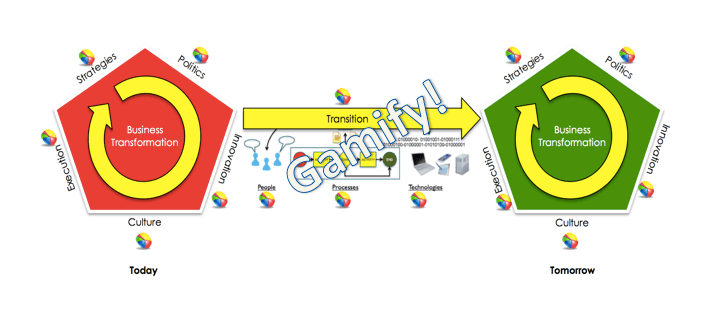
Gamify SPICE
Gamify SPICE

References:

  1. Sebastian Deterding, Dan Dixon, Rilla Khaled, and Lennart Nacke. 2011. From game design elements to gamefulness: defining “gamification”. In Proceedings of the 15th International Academic MindTrek Conference: Envisioning Future Media Environments (MindTrek ’11). ACM, New York, NY, USA, 9-15. DOI=10.1145/2181037.2181040 http://doi.acm.org/10.1145/2181037.2181040
  2. “Gamification – Gartner IT Glossary.” Gartner IT Glossary. Gartner, n.d. Web. http://www.gartner.com/it-glossary/gamification-2/
  3. Werbach, Kevin. “Coursera – Gamification.” Coursera. Coursera, n.d. Web. https://www.coursera.org/course/gamification
  4. Krogue, Kevin. “5 Gamification Rules From The Grandfather Of Gamification.” Forbes. Forbes Magazine, n.d. Web. http://www.forbes.com/sites/kenkrogue/2012/09/18/5-gamification-rules-from-the-grandfather-of-gamification/
  5. Stanley, Robert. “Top 25 Best Examples of Gamification in Business.” Clickipedia. Clickipedia, 24 Mar. 2014. Web. http://blogs.clicksoftware.com/clickipedia/top-25-best-examples-of-gamification-in-business/
  6. Kleinberg, Adam. “Brands That Failed with Gamification.” – IMediaConnection.com. – IMediaConnection.com, 23 July 2012. Web. http://www.imediaconnection.com/content/32280.asp

Processing…
Success! You're on the list.

5 Questions to Ask About Three Dimensional (3D) Printing

Three dimensions (3D) printing refers to using a 3D printer to create objects. These objects are created layer-by-layer by using raw materials. Think of 3D printing as a “miniature version” of a machine in a manufacturing plant that creates objects. While in a manufacturing plant, the machine might be dedicated to creating only a few types of objects but a 3D printer can practically create any type of 3D objects as long as it has the specifications for that object.

3D printing is pushing the idea of giving power to consumers to create objects that are readily available and customizable in their own homes. The prices of 3D printers are declining quickly and soon they would become as common as mobile phones. From these advancements, we observe that 3D printing is shaking the manufacturing industry to its core and thus some organizations will scoff at it, some organizations will be ignorant of it and some organizations will not know how to leverage it but there are only a few organizations that will try to get ahead of it. For the organizations that are trying to get ahead of 3D printing and having competitive advantages, they would need to think about 3D printing as not only giving power to the consumer to print their own objects but the opportunity to create new business models, new services and new sources of revenue. For these forward-looking organizations, here are a few things to consider:

  1. Strategic Perspective – As the ability of printing objects shifts to consumers, they would spend less time going to shops that sell those objects and would spend more time in shops that provide the raw material used for 3D printers. This shift in consumer power would result in organizations reevaluating their supply chains and vendor relationships. These reevaluations should also be observed by governments to explore what education and training programs need to be developed for the jobs of the future.
  2. Tactical Perspective – A vast number of consumers will change their habits quickly when: (1) cost of manufacturing objects at home significantly decreases, (2) the quality of objects printed is equal or greater than objects bought from organizations and (3) the amount of time saved in printing at home is much greater than going to shops. This consumer behavior change is closer than we think and it will be accelerated by the need for consumers to spend more time with their families than running around finding stuff from various retail stores. This would, of course, raise the question if brick and mortar stores should really exist.
  3. Operational Perspective – It is all about how organizations would improve, revamp and reengineer operations to take advantage of 3D printing. To fully understand the leverage 3D printing brings, organizations would need to become more tech-savvy since in the future organizations would be mainly responsible for providing the 3D object specifications. Most importantly, organizations would need to pay close attention to how technology can become an enabler or a disabler in moving them to the next century.

Now that we understand the different organizational perspectives, it is time to consider traditional manufacturing and 3D printing by asking the following questions:

 TodayTomorrow
Who directly buys your manufactured objects?Who directly would buy your 3D object specifications?
What business processes are supported by your people and manufacturing plants?What new business processes are needed for resources and training?
Where do manufactured objects go?Where should 3D object specifications go?
When are manufactured objects delivered?When should 3D object specifications be delivered?
Why manufactured objects are still being used?Why 3D object specifications would be used?

When you ask the above questions, keep in mind that your business model will be changing from providing a physical object to providing 3D object specifications. This shift can have a dramatic effect on your costs and your ability to connect with the consumers directly. Thus, you would also need to determine (1) keeping the same level of quality even if you don’t manufacture the objects (2) sharing of 3D object specification with suppliers and vendors (3) processes that would need to be eliminated and (4) the new relationships that need to be developed.

3D Printing Considerations

Processing…
Success! You're on the list.