Is the Internet a Distributed System?

Tanenbaum and Steen describe a distributed system as “a collection of independent computers that appears to its users as a coherent system.” This means that even if there are multiple heterogeneous components within the distributed system communicating with each other, but from a user’s point of view it is a single system. An example of a distributed system would be the World Wide Web (WWW) where there are multiple components under the hood that help browsers display content but from a user’s point of view, all they are doing is accessing the web via a medium (i.e., browsers). The following figure from Tanenbaum and Steen below helps visualize their definition of a distributed system.
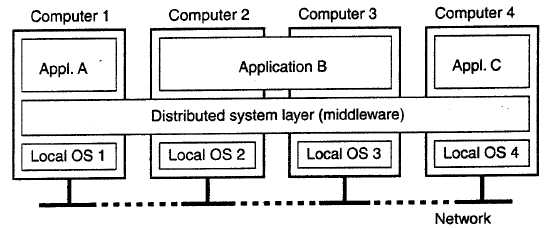
Distributed Systems Organized as Middleware

From the above figure, we can observe that the distributed systems layer sits in-between the various computer applications and the independent computer operating systems. What the authors are trying to show here is that distributed systems are at a software layer level that acts as the “glue” which helps in sharing of resources across various independent components (i.e., computers) but at the same time seems like a single system to the end-users. The authors call this type of distributed system middleware. Additionally, we notice that these components are connected via a network. While it is not clear what kind of network this is but we can extrapolate that these independent computers are on the same network.

As we can see that the importance of the network cannot be minimized. For if there is no network then it becomes difficult for independent components to talk to each other and share resources hence there is no distributed system. The importance of the network is such that when we look at the 8 fallacies formulated by Peter Deutsch 8 out of the 8 fallacies when developing distributed applications are about the network. Following are these 8 fallacies:

  1. The network is reliable
  2. The network is secure
  3. The network is homogenous
  4. The topology does not change
  5. Latency is zero
  6. Bandwidth is infinite
  7. Transport cost is zero
  8. There is one administrator

Despite the importance of the network for distributed systems, can we truly claim that the Internet, which is a network of networks, is really a distributed system? I would say no since while a network provides the essential connectivity and communication channels for a distributed system but the network itself is not a distributed system. From an end-user perspective, the Internet might appear to be a single system (e.g., email) but in reality, email is not the Internet but a service provided on top of the Internet utilizing existing Internet infrastructure. Vera-Ssmio and Rodrigues agree with the claim that there is a distinction between a network and a distributed system. They emphatically say that “a computer network is not a distributed system.” 

Beyond the technological aspects though, should we be looking at distributed systems from a broader lens. Should we be looking at distributed systems from security and privacy perspectives? The answer is of course yes. The reason is that by definition within a distributed system components share resources. Some examples of sharing resources would include memory allocation and computing power optimization to name a few. But the sharing of resources opens up a Pandora’s box of issues related to security and privacy. This is due to the fact that when sharing resources, certain information (e.g., computer IP addresses, open ports, etc.) needs to be shared as well. The exposure of this information can result in unintentional consequences on one end or deliberate attacks on the other end. We need to ask ourselves: How much information sharing is too much? What happens when information is compromised? Should the Internet become a Distributed System? What happens if one computer is exposed and an intruder has gotten onto the network? How do you safeguard other computers on the same network that share resources?

In conclusion, in the 21st century, the Internet has become a necessary tool for businesses and individuals to interact with each other and share information. Some examples of this information sharing include emails, browsing the World Wide Web, conducting a financial transaction, sharing photos, etc. As time progresses, the importance of the Internet will only increase which would result in improvements and the creation of new services and business models. Thus, in order for businesses and individuals who are interested in leveraging the power of the Internet, it is useful to understand what the Internet is and what it is not. So, when we hear that if the Internet is a distributed system, the immediate reaction for some people is of course it is. But if we dig a little deeper, we would realize that the answer is not as simple. The reason is that the Internet itself is a network of networks and does not necessarily fall under the classic definition of a distributed system. Thus, in this paper, we have made the argument about the Internet not being a distributed system and raised some issues that go beyond the technological realm.

References:

  1. Tanenbaum, Andrew S., and Maarten Van. Steen. Distributed Systems: Principles and Paradigms. Harlow: Prentice Hall, 2006. Print.
  2. Veríssimo, Paulo, and Luís Rodrigues. Distributed Systems for System Architects. Boston: Kluwer Academic, 2001. Print.

Processing…
Success! You're on the list.

5 Questions to Ask About Prescriptive Analytics

Prescriptive analytics is used for performance optimization. This optimization is accomplished by using a variety of statistical and analytical techniques to identify the decisions that need to be taken in order to achieve the desired outcomes. The data sources used for the determination of outcomes can range from structured data (e.g., numbers, price points, etc.), semi-structured data (e.g., email, XML, etc.) and unstructured data (e.g., images, videos, texts, etc.).

If done correctly, Prescriptive Analytics is the Holy Grail of analytics. However, if done incorrectly, it can result in misinformed decisions that can be outright dangerous. Individuals and organizations have to understand that even if the data is correlated that does not mean that there is some sort of causation. A general example of this is when in a news report, the host(s) says that the survey has shown that x is correlated with y but then they go on how y was caused due to x. This is simply what I call “jumping the data gun” and organizations that are not aware of this can fall into this trap.

Another thing to be aware of is that after the Prescriptive Analytics gives you certain courses of action and you apply those actions, keep track of how well your Prescriptive Analytics is performing as well. In other words, you have to measure the performance of your performance optimization ways. The reason to do this is that over time you can see if the models presented by your Prescriptive Analytics engine are worth following, re-doing or dumping.

To get you started, here are a few questions to ask:

Today

Tomorrow

Who uses prescriptive analytics within, across and outside your organization?Who should be using prescriptive analytics within, across and outside your organization?
What outcomes do prescriptive analytics tell you?What outcomes prescriptive analytics should tell you?
Where is the data coming from for prescriptive analytics?Where should the data become from for prescriptive analytics?
When prescriptive analytics is used?When prescriptive analytics should be used?
Why prescriptive analytics matter?Why prescriptive analytics should matter?

When you are asking the above questions, keep in mind that Prescriptive Analytics uses data to create a model (aka a data version of the world) that is used by individuals and organizations to make real-world decisions. But if the model itself is flawed then you are bound to get answers that although might look visually appealing are completely wrong. It is not all doom and gloom though. In fact, Prescriptive Analytics is used in determining price points, expediting drug development and even finding the best locations for your physical stores. Companies like Starbucks have been using Prescriptive Analytics in the last few years to determine the best locations for their next coffee stores. Interestingly, some have claimed that wherever Starbucks goes, the real-estate prices also increase. While there is some correlation between a Starbucks coffee store opening with increased real-estate prices but this does not mean that because of Starbucks coffee stores the real-estate prices increase.

Analytics Trophies

References:

  1. 5 Questions to Ask About Business Transformation
  2. 5 Questions to Ask About Your Information
  3. Starbucks Tries New Location Analytics Brew

Processing…
Success! You're on the list.

5 Questions to Ask About Your Big Data

In statistics, a hypothesis is proposed and then data samples are collected to prove or disprove the hypothesis with acceptable confidence levels. For example, let’s say that all our customers are aware of all our product lines. Basically, there are two ways of assessing our hypothesis that includes: (1) Proving our hypothesis and (2) Disproving our hypothesis.

The first way to proving our hypothesis is that we communicate with all of our customers and inquire if they know all our product lines. The second way is to communicate with as many customers as possible until we come across any customer that does not know all our product lines. From this example, we can see that if we find even one customer then that disproves our hypothesis. Thus, this is the reason why in statistics, sometimes it is easier to find an exception to disproving a hypothesis rather than proving it.

Big Data, on the other hand, inverts the generally acceptable process from hypothesis then data sample collection to data collection then a hypothesis. What this means is that Big Data emphasizes collecting data first and then coming up with a hypothesis based on patterns found in the data. Generally speaking, when we talk about Big Data, we are concerned with the 3 Vs that include:

  • Volume – Amount of data
  • Velocity – Rate of data analysis
  • Variety – Different data sources

Some have indicated that we need to go beyond just the above three Vs and should also include:

  • Viscosity – Resistance to the flow of data
  • Variability – Changes in the flow changes of data
  • Veracity – Outlier data
  • Volatility – Validity of the data
  • Virality – Speed at which data is shared

I would take the Big Data concept a bit further and introduce:

  • Vitality – General and specific importance of the data itself
  • Versatility – Applicability of data to various situations
  • Vocality – Supporters of data-driven approaches
  • Veto – The ultimate authority to accept or reject Big Data conclusions

For a metrics-driven organization, a possible way to determine the effectiveness of your Big Data initiatives is to do a weighted rating of the Vs based on your organizational priorities. These organizational priorities can range from but not limited to increasing employee retention rates, improving customer experiences, improving mergers and acquisitions activities, making better investment decisions, effectively managing the organization, increasing market share, improving citizens services, faster software development, improving the design, becoming more innovative and improving lives. What all of this means is that data is not just data but it is, in fact, an organization’s most important asset after its people. Since data is now a competitive asset, let’s explore some of the ways we can use it:

  • Monte Carlo Simulations – Determine a range of scenarios of outcomes and their probabilities.
  • Analysis of Variance (ANOVA) – Determine if our results change when we change the data
  • Regression – Determine if data is related and can be used for forecasting
  • Seasonality – Determine if data shows the same thing occurring at the same intervals
  • Optimization – Getting the best possible answer from the data
  • Satisficing – Getting a good enough answer from the data

Now that we understand what is Big Data and how it can be used, let’s ask the following questions:

Today

Tomorrow

Who is capturing data?Who should be capturing data?
What is the lifecycle of your data?What should be the lifecycle of your data?
Where is data being captured?Where should data be captured?
When is data available for analysis?When should data be available for analysis?
Why data is being analyzed?Why data should be analyzed?

Having discussed the positives of Big Data, we have to realize that it is not a panacea and has its negatives as well. Some of the negative ways data can lead to bad decisions include: (1) Data is correlated but that does not imply cause and effect, (2) Data shows you pretty pictures but that does not imply it is telling you the truth and (3) Biases can affect data anywhere from capturing to analysis to decision-making.

In conclusion, what this means is that the non-distorted quality, understanding, and usage of data is the difference between just getting on the Big Data bandwagon or truly understanding how data can fundamentally change your organization.

Big Data Vs

References:

  1. Realizing the Promise of Big Data
  2. Beyond the three Vs of Big Data
  3. 5 Factors for Business Transformation
  4. 5 Questions to Ask About Your Business Processes
  5. 5 Questions to Ask About Your Information
  6. 5 Questions to Ask About Customer Experiences
  7. 5 Observations on Being Innovative (at an organizational level)
  8. Where is my Big Data coming from and who can handle it

Processing…
Success! You're on the list.

5 Questions to Ask About Gamification

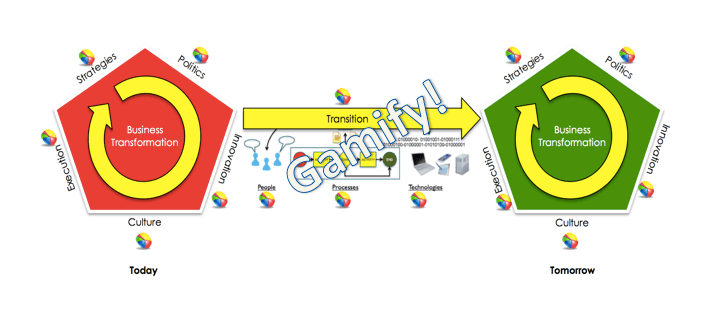
The term gamification refers to “the use of game design elements in non-game contexts.” (Deterding et al.) The non-game contexts imply that gamification is different than games and can be applied to society, business, technology, and individuals at various levels. Gartner goes a step further and defines gamification to be “the use of game mechanics and experience design to digitally engage and motivate people to achieve their goals.” Essentially what this means is that gamification is used to change the norms, attitudes, and habits of individuals and organizations from a current state to a desired future state typically through the utilization of technology. Generally speaking, the use of gamification in the organization can be categorized into external uses (e.g., customer engagement) and internal uses (e.g., employee engagement).

In order for organizations to effectively leverage gamification as a game-changer, they have to ask the following questions:

Today

Tomorrow

Who is using gamification externally and internally?Who should be using gamification externally and internally?
What is gamified?What should be gamified?
Where it is being used?Where it should be used?
When are gamified types of activities are happening?When should gamified types of activities be happening?
Why it is becoming a competitive advantage?Why you should be using it as a competitive advantage?

When you are asking the above questions across all levels of the organization, here are few things to keep in mind (1) have clearly defined goals for the players/users and the organization, (2) blindly applying gamification without thinking through organizational repercussions can be costly, (3) measure progress, get feedback and iterate, (4) create value since it is a not a one-way street but a multi-way street and (5) balance between intrinsic considerations and extrinsic rewards.

Here organizations have a choice about gamification as a (1) passing fad or (2) as a strategic lever that can help them transform. So, the real question about using gamification becomes, “Can you afford not to do it?”

Gamify SPICE
Gamify SPICE

References:

  1. Sebastian Deterding, Dan Dixon, Rilla Khaled, and Lennart Nacke. 2011. From game design elements to gamefulness: defining “gamification”. In Proceedings of the 15th International Academic MindTrek Conference: Envisioning Future Media Environments (MindTrek ’11). ACM, New York, NY, USA, 9-15. DOI=10.1145/2181037.2181040 http://doi.acm.org/10.1145/2181037.2181040
  2. “Gamification – Gartner IT Glossary.” Gartner IT Glossary. Gartner, n.d. Web. http://www.gartner.com/it-glossary/gamification-2/
  3. Werbach, Kevin. “Coursera – Gamification.” Coursera. Coursera, n.d. Web. https://www.coursera.org/course/gamification
  4. Krogue, Kevin. “5 Gamification Rules From The Grandfather Of Gamification.” Forbes. Forbes Magazine, n.d. Web. http://www.forbes.com/sites/kenkrogue/2012/09/18/5-gamification-rules-from-the-grandfather-of-gamification/
  5. Stanley, Robert. “Top 25 Best Examples of Gamification in Business.” Clickipedia. Clickipedia, 24 Mar. 2014. Web. http://blogs.clicksoftware.com/clickipedia/top-25-best-examples-of-gamification-in-business/
  6. Kleinberg, Adam. “Brands That Failed with Gamification.” – IMediaConnection.com. – IMediaConnection.com, 23 July 2012. Web. http://www.imediaconnection.com/content/32280.asp

Processing…
Success! You're on the list.

5 Questions to Ask About Internet of Things (IoT)

According to Gartner, “Internet of Things (IoT) is the network of physical objects that contain embedded technologies to communicate and sense or interact with their internal states or the external environment.” The communication of these physical devices with itself and/or with its environment (e.g., other physical devices, information systems, etc.) generates tremendous amounts of data. Depending upon the end goal, this data can be used anywhere from determining the foot traffic in retail stores to monitoring environmental effects on trees. Since there are so many different uses of the data generated from these IoT devices thus it is difficult to determine how many of these devices would be used in the future. However, Gartner has taken a stab at this and estimates that within 6 years (by 2020) there would be about 26 billion active IoT devices in use. With so many devices in use within a short period, it would be naïve of organizations to think that these IoT devices would have no effect on existing business models and operations.

In order to understand the challenges and opportunities, the following questions need to be asked about your current and future uses of IoT devices:


Today

Tomorrow

Who uses them? Who should use them?
What business processes use them? What business processes would use them?
Where is the data being captured? Where should the data be captured?
When are they used? When would they be used?
Why do they affect the bottom line? Why would they affect the bottom line?

When you are asking the above questions, keep in mind that organizations who know how to increase the bottom line through the effective use of technology would get into your space even before you think they are your competition. This means that as an organization, you have a choice of either ignoring the IoT revolution or getting ahead by fully immersing yourself into how IoT can provide competitive advantages across all business units.

In conclusion, while it may seem that IoT is only an “IT thing” but in reality, IoT affects the business-side more than it affects the IT-side and not leveraging it can mean the difference between staying alive or quickly becoming irrelevant.

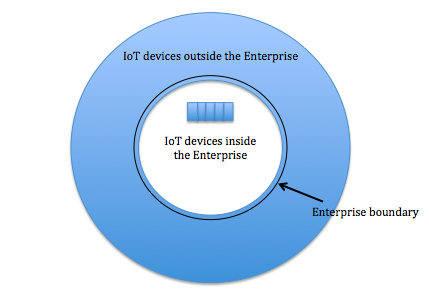
IoT devices with respect to your Enterprise

References:

  1. Gartner’s definition of Internet of Things
  2. Gartner’s Internet of Things Installed Base Projections