
Khan’s Oath For Technology Professionals

I swear to fulfill, to the best of my ability and judgment, this pledge:

I will respect but also appropriately challenge the hard-won technological gains of those technology professionals in whose steps I walk, and gladly share such knowledge as is mine with that diversity of people who are to follow.

I will apply, for the benefit of organizations and society, all measures which are required, avoiding those twin traps of technology-first and technology-last.

I will remember that there is art in technological implementations in addition to business and technology frameworks, and that warmth, empathy, ethics, and understanding should outweigh the manager’s bias, the analyst’s conclusion, and the system’s algorithms.

I will not be ashamed to say “I know not”, nor will I fail to call in my colleagues when the skills of another one are needed for technological improvements.

I will respect the privacy of my users, for their information is not disclosed to me that the world may know. Most especially I must tread with care in matters of using data to positively or negatively affect decisions. If it is given to me to have a positive impact, all thanks. But it may also be within my power to have a negative impact; this must never happen as I should make every effort to be aware of my own biases while being aware of the big picture. Above all, I must realize although important, technology shouldn’t be the de facto solution to everything.

I will remember that I do not just address a support ticket, a software bug, a cybersecurity threat, a network issue, a system feature, but my actions can directly and indirectly adversely affect people in organizations and societies. My responsibility includes taking into account these interconnected issues and solutions if I am to improve anything.

I will prevent misuse of technology whenever I can, for addressing issues immediately is preferable to delaying it.

I will remember that I remain a member of society, with special obligations to all my fellow human beings, those who understand the technology and those who do not.

If I do not violate this oath, may I enjoy life and art, respected while I live and remembered with inspiration thereafter? May I always act so as to preserve the finest traditions of my calling and may I long experience the joy of helping those who seek my technological expertise.

Processing…
Success! You're on the list.

What About The Issue Of Bias In The Data Sets For AI?

Processing…
Success! You're on the list.

How Mediocre Hiring Managers Hire Mediocre Employees

Once upon a time, there was a hiring manager who always worked with mediocre employees and had never worked with a great employee.

One day a great employee A from another organization decided to work for the organization of the hiring manager.

The hiring manager took a long, hard look at employee A’s resume and said, “Oh my, what funny mediocre employee you are!”

The hiring manager thought employee A was a mediocre employee because s/he had never worked with a great employee but had always worked with many mediocre employees.

“I am not a mediocre employee at all.” said employee A by explaining s/he goes above and beyond the basic expectations.

“Nonsense!” said the hiring manager. “I’ve worked with more mediocre employee than you have years of experience, and I know a mediocre employee when I see one.”

“If you’re so sure that I’m a mediocre employee,” said employee A, “then why do you say I am a funny mediocre employee?”

“Well, just look at the way you communicate,” said the hiring manager. “It’s all so refined. Mediocre employee don’t have good listening or extrapolating skills. And look at all those experiences and qualifications! Mediocre employee don’t have experience and qualifications like that. And look at the way you dress! It’s too refined and needs to come back to reality. Mediocre employees don’t dress nicely like that.”

And before employee A could reply, the hiring manager hired the great employee.  The hiring manager informed employee A that s/he doesn’t need to showcase/use their experience and skillsets in this position. The hiring manager informed employee A how s/he should communicate in the organization. And the hiring manager made the great employee go for an organizational orientation which emphasized organizational values and dressing sharp was not one of them.

As soon as the hiring manager was finished with the demands, it was lunchtime. So employee A met up with another great employee B from another organization.

“Well, well,” said employee B. “Aren’t you a funny great employee!”

“Well, at least you know I’m a great employee,” said employee A. “Thank goodness for that!”

“What happened to you?” asked employee B.

“Well,” said employee A, “A hiring manager thought I was a mediocre employee. And since mediocre employee don’t go above and beyond the basic expectations, s/he asked me to do the same. And since mediocre employee don’t have good communication skills, I was asked to communicate how the rest of the organization communicates. And since mediocre employee don’t dress sharp, I was asked to conform to the dress code of the organization.”

“The hiring manager must be very foolish, indeed,” said employee B. And with that, employee B told employee A about an organization where hiring managers used rewards and incentives and appreciated (1) how you communicate, (2) how you use your experiences and qualifications to go above and beyond and (3) how you dress.”

“Also remember this”, employee B continued, “there are a lot silly hiring managers in the world who think that mediocre employees are great employees, or that great employees and mediocre employees, or that all sorts of things are like other things without understanding context/nuance and are unable to extrapolate beyond the immediate needs. And when they are silly like that, they do very foolish things. We must be sure to stay away for that hiring manager and other hiring manager like her/him.”

What do you think happened next? Did employee A leave the organization or remain in the organization to be forced to become mediocre.

Processing…
Success! You're on the list.

How To Save Tweets Using Free Tools

Twitter is a great free tool to send, receive and share micro (small) messages (aka tweets) with other Twitter users. These tweets are limited to 280 characters (as of writing this post) and can include images and videos. Once you login to your Twitter account, it defaults to Home where you can see your timeline. This timeline shows all the tweets from the users that you follow on Twitter. These users can be people and/or organizations.

Your timeline can get long (would seem like infinite scrolling) if you follow many users and those users post at different times of the day. This means is that you have to be constantly checking Twitter to see what other users are tweeting about. For most people, this can be very time-consuming. No worries, there is a solution (a little applet) that can help.

Here is what you will need:

  1. Twitter Account (free)
  2. Google Account (free)
  3. IFTTT Account (free)

Here are the steps for IFTTT:

  1. Log in to IFTTT
  2. Click on New Applet
  3. Click on ‘+this’IFTTT 1
  4. Click on the Twitter serviceIFTTT 2
  5. Click on the trigger ‘New tweet by a specific user’IFTTT 3.png
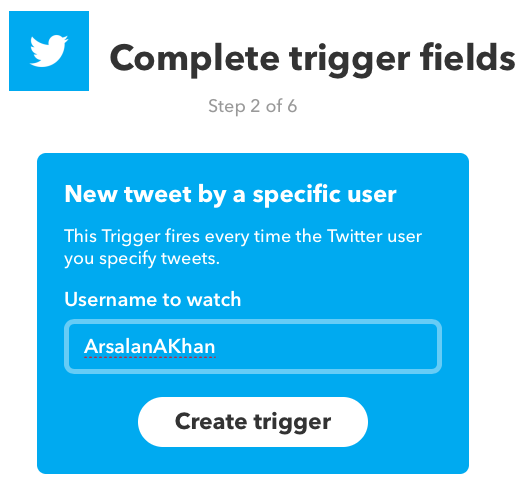
  6. Type the Twitter user name you want follow and click on ‘Create trigger’IFTTT 4
  7. Click on ‘+that’IFTTT 5
  8. Click on Google SheetsIFTTT 6
  9. Click on ‘Add row to spreadsheet’IFTTT 7
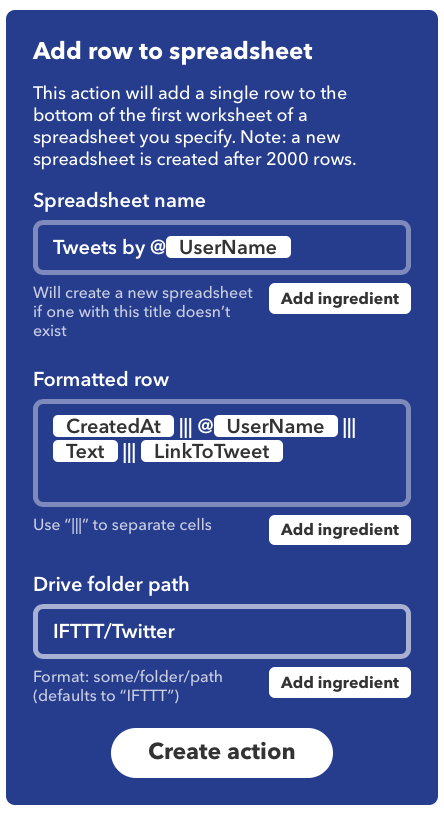
  10. Verify what information you want in the Google Spreadsheets rows, the Google Sheets location and then click ‘Create action’IFTTT 8
  11. Verify applet information and then click on Finish.
    IFTTT 9

Congratulations you have created an applet on IFTTT! Now, simply go to your Google Sheets and see the tweets being collected automatically!

But wait there is more! The tweets that you are collecting can be used to do many things such as:

  1. Easily search through the Twitter user’s tweets
  2. Determine when (day and time) the Twitter user is most active
  3. Determine the most words used by the Twitter user

Get Started on Google’s G Suite and get 20% off the first year on either G Suite Basic plan or G Suite Business plan by using thee promotion codes:

  • Basic Plan – C3VLCH3RJFVHAWU

  • Business Plan – AD4XQPHWAYFMEQW

Note:

  1. Don’t forget to link your Google account to the IFTTT account
  2. Google Sheets don’t count toward your Google account size limit
  3. Google Sheets have a limit of 2000 rows (by default) but more rows can be added
  4. Adhere to all rules and regulations pertaining to Twitter, Google, and IFTTT

Processing…
Success! You're on the list.

Top 5 Team Lessons From The World Cup

The 2018 FIFA World Cup began in Russia on June 14, 2018, and ends on July 15, 2018. It is the largest sporting event in the world that happens every 4 years. This year’s FIFA World Cup brings together the men’s national football (aka soccer) teams from 32 countries. It is projected that almost half of the entire world’s population would be watching one of the national teams lift the FIFA World Cup Trophy and be crowned the best football team in the world.

Here are the top 5 team lessons that organizations can learn from the FIFA World Cup:

  • Strategy – Have a game plan but adapt when ground realities change
  • Politics – Select team members based on expertise and not biases (stardom)
  • Innovation – Be open to different ways of accomplishing the same goal
  • Culture – Create an environment that rewards both individual and collective wins
  • Execution – Have a clear mission, train rigorously and regroup often to assess
Team.png

Processing…
Success! You're on the list.