
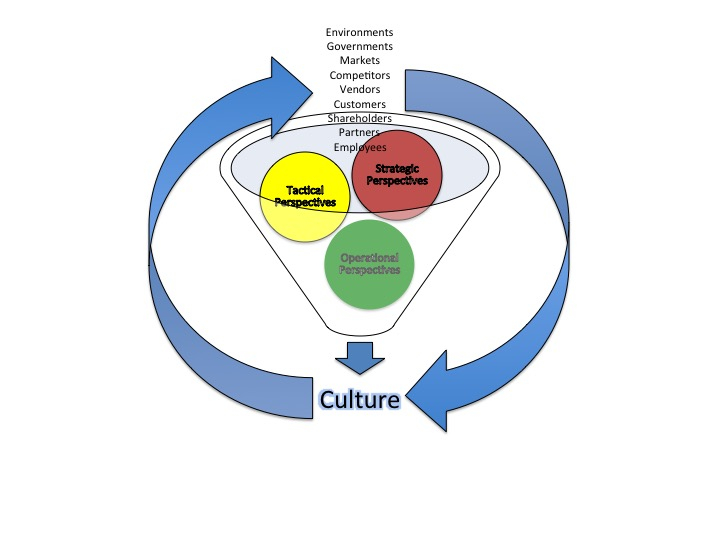
Peter Drucker, one of the most influential management consultants in the world, is often attributed to coining the phrase “Culture eats strategy for breakfast.” Organizations that can harness the power of culture can create environments where everyone can contribute towards the attainment of strategic objectives. However, most organizations are unable to create such environments and hence their pursuit of strategic objectives never fully comes to fruition. The three main reasons for this failure are:
- The fallacy that culture is considered something fuzzy thus unquantifiable
- The lack of a holistic approach to forming/enhancing positive attributes of the inherent cultures
- The half-baked idea that culture equates to only people
An organization’s culture is a way of thinking, behaving and working within the physical, virtual, legal and mental organizational boundaries. What an organization thinks about its place in the world is shown by its vision, mission statement and (un)displayed values that directly influence internal and external stakeholders. How an organization behaves is shown by leadership examples, levels of (un)trustworthiness, encouragement and discouragement of cross-collaboration and camaraderie. How an organization works is shown by its (un)biased business processes, (non)adoption of technological advancements, (un)approved frameworks/methodologies/approaches, employee (non)recognitions, (un)real career ladders, risk averseness, salaries, (non)physical locations, clothing, and subcultures.
Culture is not just one thing but it is a collection/combination of different things/subcultures that can be observed and also measured. Thus, how organizations measure, incentivize and reward from the selection of the right people to optimized processes and efficient use of technology becomes crucial towards achieving organizational objectives. In order to understand and effectively bring cultural change, the following questions need to be asked:
Strategic Perspectives on Culture:
|
Today |
Tomorrow | |
| 1. |
Who is incentivized at the executive level to transform culture? | Who should be incentivized at the executive level to transform culture? |
| 2. | What governance structures are in place for strategic cultural transformation? | What governance structures should be in place for strategic cultural transformation? |
| 3. | Where is technology integrated into transforming culture? | Where should technology be integrated into transforming culture? |
| 4. | When and how often cultural transformation objectives are communicated? | When and how often cultural transformation objectives should be communicated? |
| 5. | Why cultural transformation is critical to achieving strategic objectives? |
Why transformation should be critical to achieving strategic objectives? |
Tactical Perspectives on Culture:
|
Today |
Tomorrow | |
| 1. |
Who is incentivized at the middle management level to be champions of transforming culture? | Who should be incentivized at the middle management level to be champions of transforming culture? |
| 2. | What business units, functional areas, and teams are included to bring about transformation? | What business units, functional areas, and teams should be included to bring about transformation? |
| 3. | Where technology hinders in cultural transformation? | Where technology might hinder in cultural transformation? |
| 4. | When is the start and end of cultural transformation communicated? | When should the start and end of cultural transformation communicate? |
| 5. | Why cultural transformation is critical to achieving tactical objectives? |
Why cultural transformation should be critical to achieving tactical objectives? |
Operational Perspectives on Culture:
|
Today |
Tomorrow | |
| 1. |
Who sees cultural transformation as an obstacle? | Who might see cultural transformation as an obstacle? |
| 2. | What business processes provide views on the organization’s culture? | What business processes should provide views on the organization’s culture? |
| 3. | Where is technology part of your understanding of the organization’s culture? | Where should technology be a part of the understanding of the organization’s culture? |
| 4. | When were you informed about the cultural transformation objectives? | When should you have been informed about the cultural transformation objectives? |
| 5. | Why cultural transformation is critical to achieving your daily tasks? |
Why transformation should be critical to achieving your daily tasks? |
Culture transcends most of our thoughts and how we function within organizations and outside of it. This overarching effect of culture can create biases in terms of what people we hire, what processes we put in place, what technologies we choose to use, who we talk to and what we care to observe. By asking the right questions and putting the right measurements in place, we can have a quantifiable understanding of the baseline cultures and enhance it for the better. In doing so we have to be cognizant of our own biases, biases of others and any prevailing biases that result in cultural stagnation.

 Welcome to Khan's Blog
You must be logged in to post a comment.