Take the free 5-minute SPICE assessment — a scored readout across Strategy, Politics, Innovation, Culture, and Execution, plus reading recommendations.
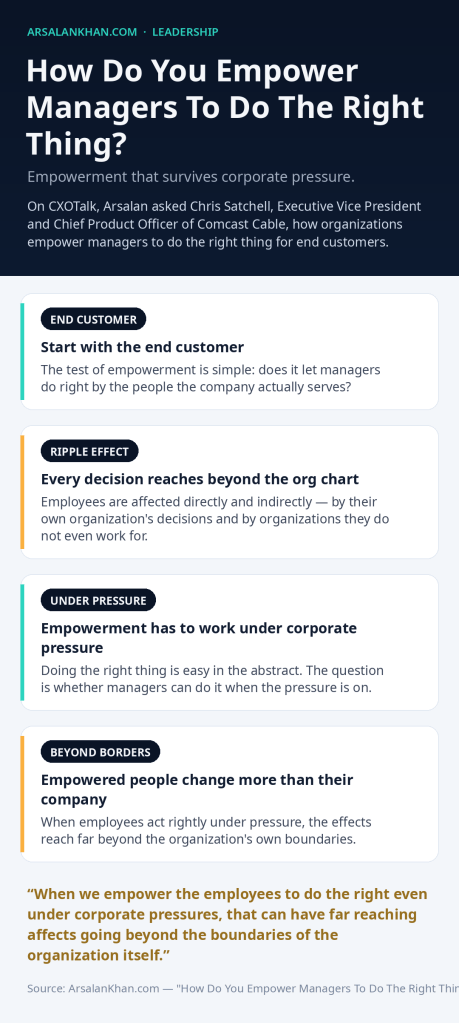
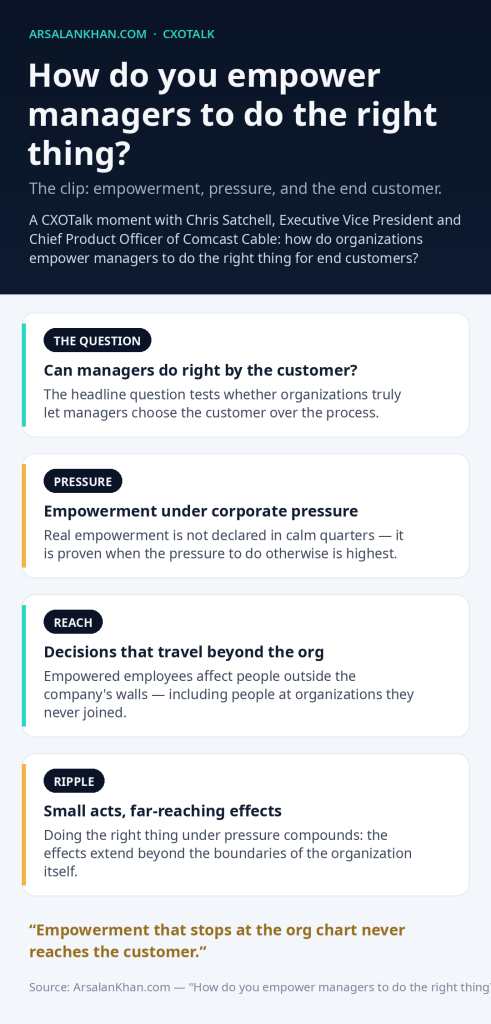
In the video below on CxO Talk, I asked Chris Satchell, Executive Vice President and Chief Product Officer of Comcast Cable about how can organizations empower managers to do the right thing for the end customers.
In my view, an organization’s employees are directly and indirectly affected by decisions of the organization and by other organizations that they don’t work for. In a way, when we empower the employees to do the right even under corporate pressures that can have far reaching affects going beyond the boundaries of the organization itself.
Business is “the activity of making, buying, or selling goods or providing services in exchange for…”
Corporations –> Money
Non-profits –> Social Causes
Education –> Knowledge
Government –> Citizen Services
Military –> National Defense
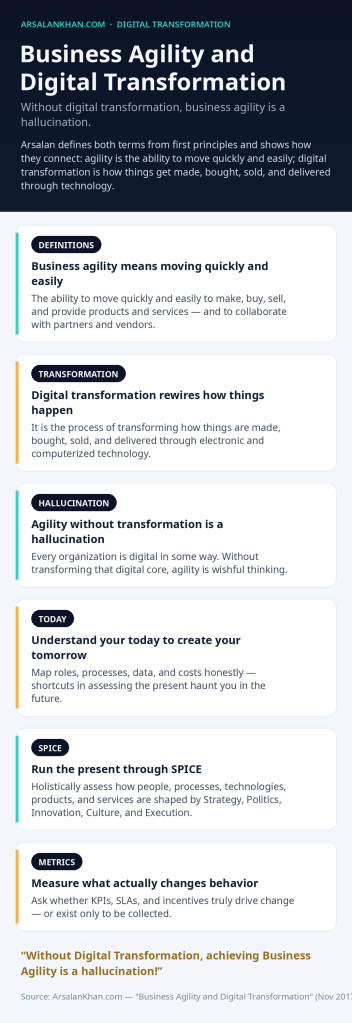
Agility is the “ability to move quickly and easily.”
Business Agility is the ability to move quickly and easily to:
Make products and services
Buy products and services
Sell products and services
Provide products and services
to employees and customers along with the ability to effectively and efficiently collaborate with partners and vendors.
What is Digital Transformation?
Digital is “electronic and especially computerized technology.”
Transformation is “an act, process, or instance of transforming or being transformed.”
Digital Transformation is the process of transforming:
How things are made
How things are bought
How things are sold
How products and services are provided
through electronic and especially computerized technology.
What are the Relationships between Business Agility and Digital Transformation?
All organizations are digital in one way or another. Some are more digital and some are less but fundamentally they utilize a mix of the following to achieve their desired outcomes and capabilities:
Determine if current capture of KPIs, SLAs and other metrics (e.g., employee incentives) are just for collection or are these measurements truly bringing change within the organization
While it is great to imagine and document your future, but any shortcuts you take in the assessing your present will come back to haunt you in the future!
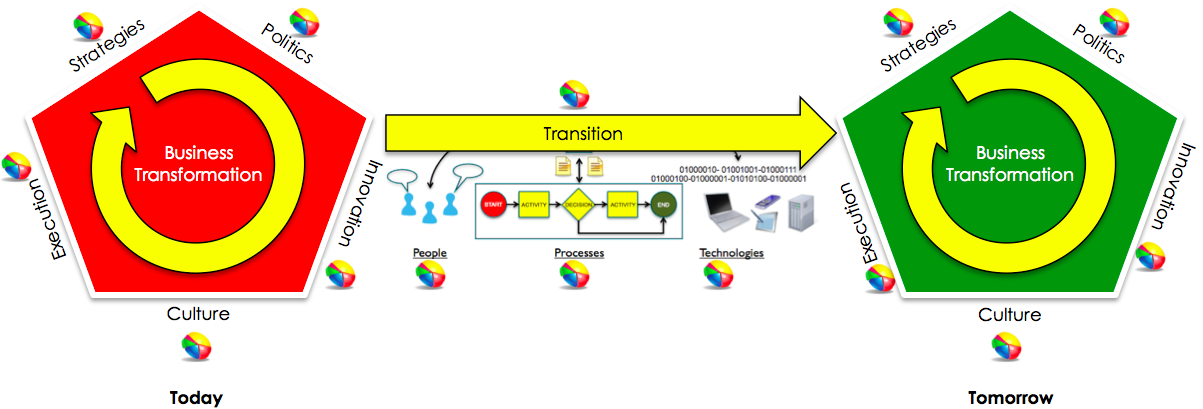
Analysis
Today (Where you are)
Create a list of roles and responsibilities for everyone in your organization, partners, and vendors
Map hybrid business processes that show people-technology interactions
Determine what data is being captured, managed and disseminated during people-technology interactions
Determine the relevancy of the data for informed decision-making
Assign a cost to each business process
Assess how quickly and easily your organization can respond to employee and customer needs
Determine the various obstacles that result in poor execution of strategy
Understand organizational and individual biases
Tomorrow (Where you want to be)
Eliminate overlapping and redundant roles and responsibilities that don’t provide value to your organization
Create governance, functions, teams and business processes that optimize the use of data across people and technologies
Create metrics that result in effective decision-making and lessons learned to improve those metrics
Communicate effectively to eliminate any preconceived notions of your transformation journeys
Create test labs for all employees to test business models, enhance current capabilities and new capabilities
Create a new culture through norms, standards, communications, and incentives and know that not everyone is motivated by the same things
Continuously self-evaluate your maturity level and make use of lessons learned
Asking Questions
Strategy
Who is affected by transformation?
What siloed/outdated/imaginary/undocumented processes are affecting strategic execution?
What technology and non-technology tools are used to make a strategic decision?
Politics
Who is distorting transformation communications?
What processes and data are leading to transformation easily being vetoed?
What technologies’ decisions are empowering transformation?
Innovation
Who is assessing frontline employees, external customers, similar industries and different industries to bring innovation to the organization?
What processes are in place to raise people’s ability to contribute?
Are there technologies to test out new capabilities and business models?
Culture
Who is motivated to participate in transformation journeys?
What kind of processes are in place to encourage culture change?
What kinds of technologies are used to assess culture and changes?
Execution
Who is setting the expectation at all levels for the transformation journeys?
What processes are in place that obstructs strategic execution?
What technologies are in place that obstructs strategic execution?
Transitions
Organizational Structures
Optimize organizational structures based on a mix of functions, products, services, and geography
Create formal and informal strategic linking through processes and coordination
Governance and Processes
Create governance structures and processes to evaluate how data can be captured, managed, modeled, assembled and deployed
People
Find people from top, middle, and frontlines to champion transformation journeys
Show how transformation actually makes people’s lives easier
Program Mission
Views transformation journeys as an investment portfolio of multiple projects and operations
Connects business and technical operations to business capabilities and outcomes
Measures relevant metrics and abandon irrelevant metrics that cannot be connected to business value
Creates alignment of IT with non-IT functions (e.g., Accounting, Administration, Business Development, Customer Service, Finance, HR, Management, Manufacturing, Operations, Productions, R&D, Sales, etc.)
Creates effective feedback loops across the organization
Processing…
Success! You're on the list.
Whoops! There was an error and we couldn't process your subscription. Please reload the page and try again.




You must be logged in to post a comment.