Take the free 5-minute SPICE assessment — a scored readout across Strategy, Politics, Innovation, Culture, and Execution, plus reading recommendations.
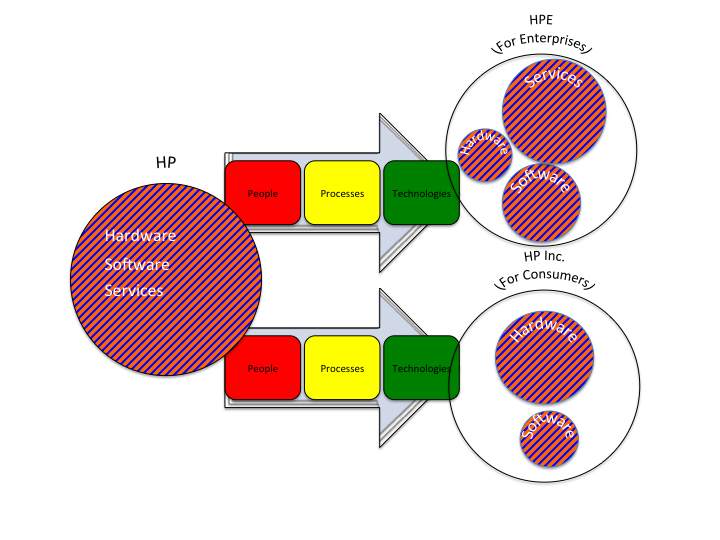
A year ago Hewlett Packard (HP) decided that it was going to split into two companies. This decision became real last week when HP officially split into HP Inc. and Hewlett Packard Enterprise (HPE) as announced by Meg Whitman on her LinkedIn post. The main reason given for this split was the focus. HP Inc. would focus on selling consumer products such as personal computers and printers. HPE would focus on selling enterprise products, enterprise software and enterprise services such as cloud computing, big data, cybersecurity to improve operations.
It seems that on the surface the announcement of the split of HP into HP Inc. and HPE has received a mixed bag of optimism and skepticism from different corners of the tech industry. On the optimistic side, this is a good move since it would help these companies focus on their core competencies and provide focused customer service and client experience. On the skeptical side, this is a little too late since the tech industry has been moving from merely selling computer products to selling more technology software and services for at least 20 years.
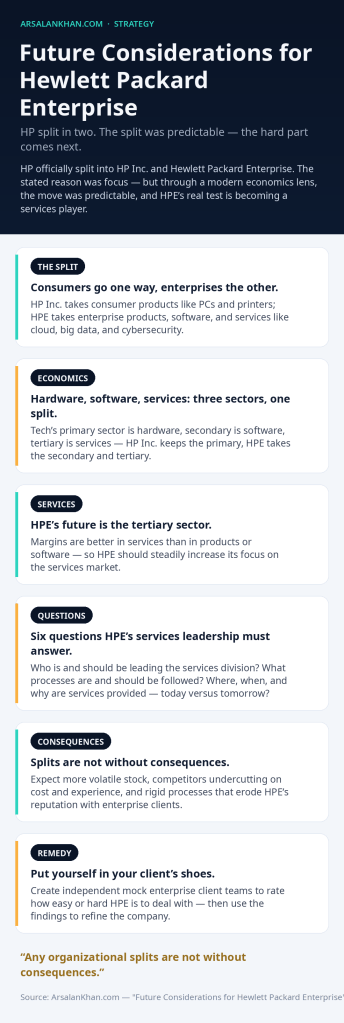
If we observe the tech industry from a modern economics lens we would find that this split is not something that is novel but it is very predictable. From a modern economics lens, the ‘primary sector’ for the tech industry focused on hardware and products, the ‘secondary sector’ for the tech industry focused on software and the ‘tertiary sector’ for the tech industry focuses on technology services. What is interesting is that this split lets HP Inc. focus on the ‘primary tech sector’ for consumers while HPE focuses on both the ‘secondary tech sector’ and the ‘tertiary tech sector’ simultaneously for enterprises. Eventually, though, HPE would increase its focus on the ‘tertiary tech sector’ since the margins are much better in services as compared to just products and software. In order for HPE to become a bigger player in the services market, they should consider the following:
Currently
In the Future
Who is leading the services division?
Who should be leading the services division?
What processes are being followed to provide services?
What processes should be followed to provide services?
Where the mix of tech and non-tech services are being provided?
Where a mix of tech and non-tech services should be provided?
When are services bundled with hardware and software?
When should services be bundled with hardware and software?
Why standalone services are provided?
Why should standalone services be provided?
HPE leadership has to realize that any organizational splits are not without consequences. These consequences could entail: (1) Stocks becoming more volatile as any budget cuts with client enterprises could affect the bottom line, (2) Competitors might be able to provide the same level of service at a cheaper cost with better client experiences and (3) Lack of optimized processes with no flexibility to adjust for enterprise clients needs could reduce overall reputation of HPE.
One of the ways to address the above-mentioned split issues would be to create independent mock enterprise client teams that would rate how easy or difficult it was to deal with HPE in light of changing economic conditions, client experiences and efficient and effective processes. These independent mock enterprise client teams would be used to further refine HPE and put itself in the shoes of its enterprise clients.
Processing…
Success! You're on the list.
Whoops! There was an error and we couldn't process your subscription. Please reload the page and try again.
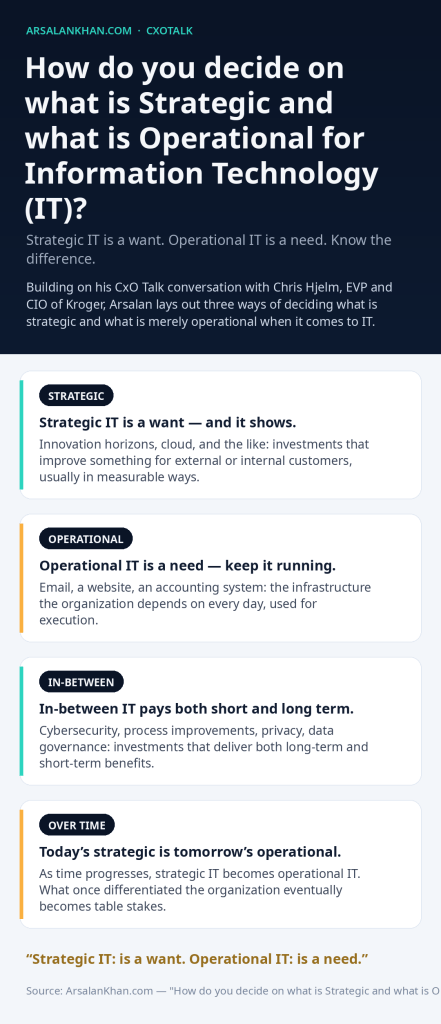
In the video below on CxO Talk, I asked Chris Hjelm, Executive Vice President and Chief Information Officer (CIO) of Kroger, how do they decide which IT projects are strategic versus operational.
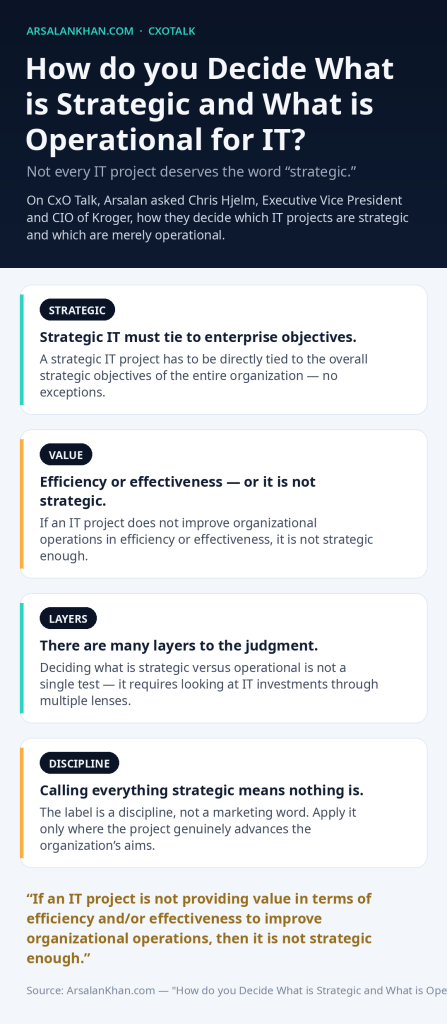
In my view, there are many layers to look at when it comes to deciding what is strategic and what is operational for IT projects. For starters, IT strategic project have to be directly tied to overall strategic objectives of the entire organization. This means is that if an IT project is not providing value in terms of efficiency and/or effectiveness to improve organizational operations, then it is not strategic enough.
In the video below, I ask Chri Hjelm, EVP and CIO of Kroger about IT priorities.
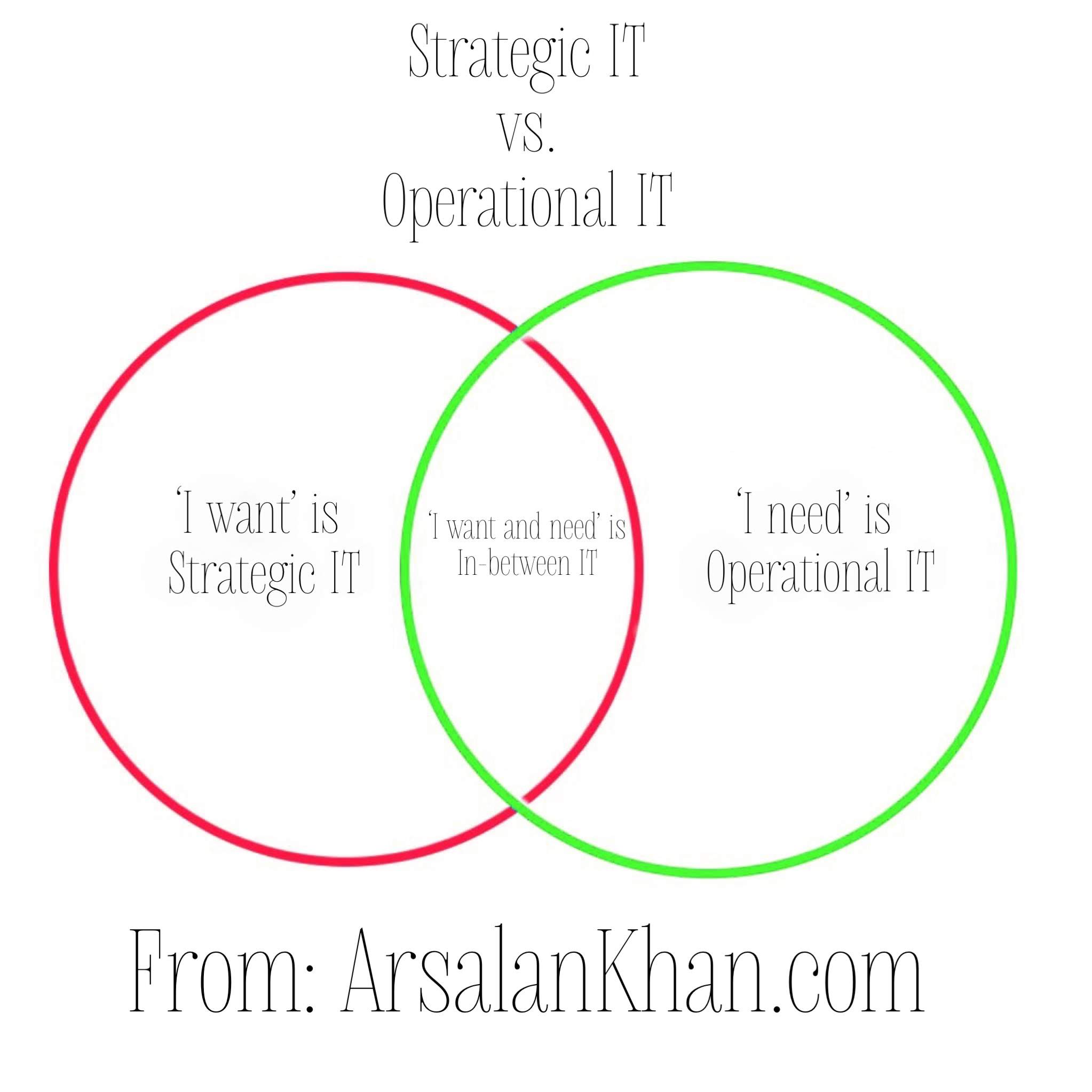
In my view, there are three ways of looking at and deciding what is strategic and what is just operationally used for execution when it comes to Information Technology (IT):
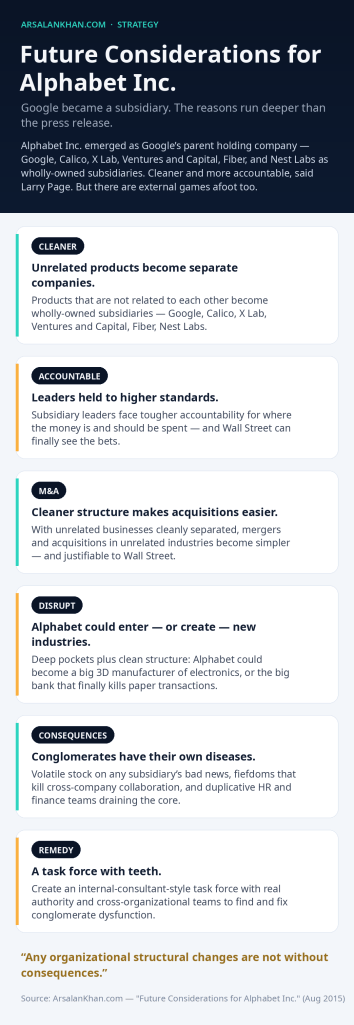
A couple of weeks ago Alphabet Inc. emerged as a parent holding company of Google as announced by Larry Page on Google’s blog. The two main reasons given for this move is to make the company cleaner and more accountable. By cleaner, it means that products that are not related to each other would become separate wholly-owned subsidiaries of Alphabet Inc. which includes Google, Calico, X Lab, Ventures and Capital, Fiber and Nest Labs. By becoming more accountable, it means that leaders of these wholly-owned subsidies would be held to even higher standards and accountability of where the money is and should be spent. This move would help Wall Street understand that Alphabet is willing and structurally capable of going into areas that are unrelated.
It seems that on the surface the announcement of creating Alphabet Inc. has deemed to be a good move as many pundits and professors have pointed out ever since its emergence. The reasons of cleanliness and accountability are great for internal purposes. However, if we dig a little deeper we would find that there are external purposes that are at play here as well. Firstly, due to Alphabet Inc.’s cleaner approach, mergers and acquisitions of unrelated industries would become much easier and thus accountability of each wholly-owned subsidiaries would be justifiable to Wall Street. Secondly, Alphabet Inc. would now be able to enter into industries or create new industries altogether. This move could mean that Alphabet Inc. could also be the next big 3D manufacturer of electronic equipment or even the next Big Bank that finally removes paper-based transactions. While both of these examples are interesting and achievable due to Alphabet Inc.’s deep pockets. In order for Alphabet Inc. to really disrupt or create new industries, strategic consideration should be taken into the following:
Currently
In the Future
Who is leading the organization(s)?
Who should lead the organization(s)?
What processes are being followed?
What processes should be followed?
Where are the products and services being deployed?
Where products and services should be deployed?
When do people, processes, technologies, products, and services disrupt/create markets?
When should people, processes, technologies, products, and services disrupt/create markets?
Why already bought companies make sense?
Why companies should be bought?
Alphabet Inc.’s leadership also has to realize that any organizational structural changes are not without consequences. These consequences could entail: (1) Stocks could become more volatile as even any slightly negative news concerning the wholly-owned subsidiaries could affect Alphabet Inc. stocks, (2) Due to autonomy and fiefdom creation, collaboration across people, process, technologies, products and services among the wholly-owned subsidiaries could be compromised and (3) There could be rise of duplicative functional teams (e.g., HR, Finance, etc.) across all wholly-owned subsidiaries thus taking resources away from core business pursuits.
One of the ways to address the above-mentioned conglomerate issues would be to create a task force with enough teeth within Alphabet Inc., and cross-organizational teams across all wholly-owned subsidiaries who can help find and remedy these issues. This task force and its teams could be similar to internal consultants whose lessons learned and methodologies could help Alphabet Inc. become more efficient and effective. Perhaps these practices could also open the door for Alphabet Inc. to dominate the Management Consulting industry as well.
Processing…
Success! You're on the list.
Whoops! There was an error and we couldn't process your subscription. Please reload the page and try again.
This article proposes looking at Predictive Analytics from a conceptual standpoint before jumping into the technical execution considerations. For the implementation aspect, organizations need to assess the following keeping in mind the contextual variances:
Strategies
Tactics
Operations
Top Down
Bottom-Up
Hybrid
Organizational Maturity
Change Management
Training
Practical Implications
Pros and Cons of Technology Infrastructure
Providing Enabling Tools to Users
Best Practices
Describing Predictive Analytics
Predictive Analytics is a branch of data mining that helps predict probabilities and trends. It is a broad term describing a variety of statistical and analytical techniques used to develop models that predict future events or behaviors. The form of these predictive models varies, depending on the behavior or event that they are predicting. Due to the massive amount of data organizations are collecting, they are turning towards Predictive Analytics to find patterns in this data that could be used to predict future trends. While no data is perfect in predicting what the future may hold there are certain areas where organizations are utilizing statistical techniques supported by information systems at strategic, tactical and operational levels to change their organizations. Some examples of where Predictive Analytics is leveraged include customer attrition, recruitment and supply chain management.
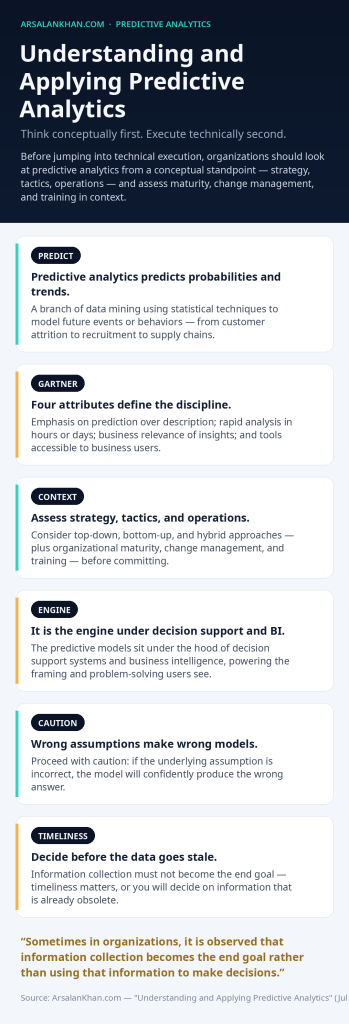
Gartner describes Predictive Analytics as any approach to data mining with four attributes:
Emphasis on prediction (rather than description, classification or clustering)
The rapid analysis measured in hours or days (rather than stereotypical months of traditional data mining)
An emphasis on the business relevance of the resulting insights (no ivory tower analyses)
An (increasing) emphasis on ease of use, thus making tools accessible to business users
The above description highlights some important aspects for organizations to consider namely:
More focus on prediction rather than just information collection and organization. Sometimes in organizations, it is observed that information collection becomes the end goal rather than using that information to make decisions.
Timeliness is important otherwise organizations might be making decisions on information that is already obsolete.
Understanding of the end goal is crucial by asking why Predictive Analytics is being pursued and what value it brings to the organization.
Keeping in mind that if the tools are more accessible to business users then they would have a higher degree of appreciation of what Predictive Analytics could help them achieve.
Relationship of Predictive Analytics with Decision Support Systems or Business Intelligence
The University of Pittsburg describes Decision Support Systems as interactive, computer-based systems that aid users in judgment and choice activities. They provide data storage and retrieval but enhance the traditional information access and retrieval functions with support for model building and model-based reasoning. They support framing, modeling and problem-solving. While Business Intelligence according to Gartner is an umbrella term that includes the applications, infrastructure and tools, and best practices that enable access to and analysis of information to improve and optimize decisions and performance. These descriptions point to the fact that Decision Support Systems or Business Intelligence are used for decision making within the organization.
Interestingly, it seems like Predictive Analytics is the underlying engine for Decision Support Systems or Business Intelligence. What this means is the predictive models that result in Predictive Analytics could be under the hood of Decision Support Systems or Business Intelligence. It should be noted that organizations should proceed with caution with regards to the Decision Support Systems or Business Intelligence since if the underlying assumption is incorrect in making the predictive models then the decision-making tools would be more harmful then helpful. A balanced approach would be to create expert systems where Decision Support Systems or Business Intelligence is augmented by human judgment and the underlying models are checked and verified periodically.
Implementation Considerations for Predictive Analytics
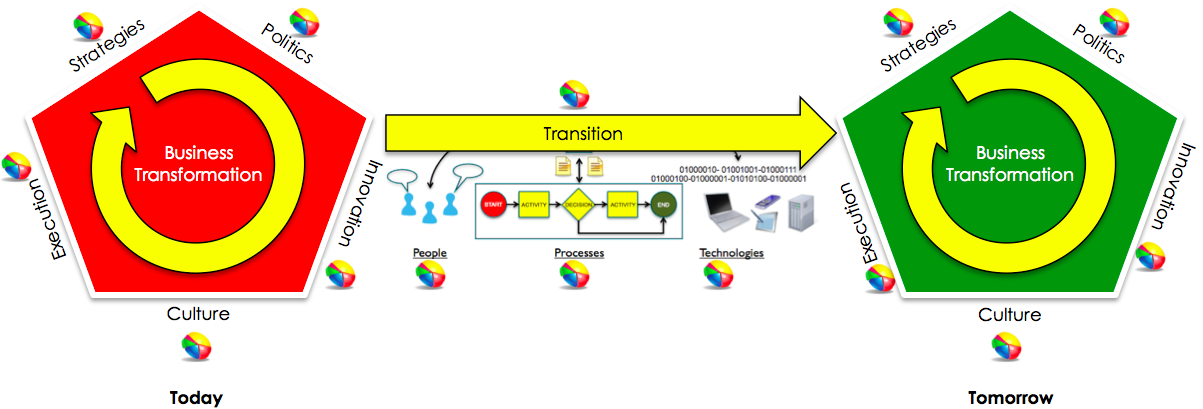
As the descriptions above have indicated that the aim of Predictive Analytics is to recognize patterns and trends that can be utilized to transform the organization. This requires organizations to first educate themselves on what value they want and what can be derived from Predictive Analytics. Predictive Analytics is about business transformation and it needs to show what value it brings to the organization. In this regard, we have to assess people, processes and technologies of the organization in terms of the current state (where the organization is right now) and future state (where the organization wants to be). Typically, this revolves around Strategies, Politics, Innovation, Culture and Execution (SPICE) as shown below.
SPICE Factors
The assessment of people for Predictive Analytics means understanding what users will be leveraging Predictive Analytics and if they understand that simply relying on Predictive Analytics is not enough but in order to have an effective system, they need to be part of the system. This means that analytics insights need to be augmented by human expertise to make intelligent decisions. The assessment of processes for Predictive Analytics entails looking at how organizations make decisions right now and how future decisions would be made if Predictive Analytics is put into place. This includes having appropriate governance structures in place. The assessment of technology entails looking at what technologies exist within the organization and if they could be leveraged for Predictive Analytics. If not then looking at what Predictive Analytics products are in the market that would work for the organization and are they flexible enough in case the underlying assumptions for the predictive models change and when predictive models become obsolete.
The advanced techniques mentioned in the book, Seven Methods for Transforming Corporate Data into Business Intelligence would be applicable to Predictive Analytics. These methods are:
Data-driven decision support
Genetic Algorithms
Neural Networks
Rule-Based Systems
Fuzzy Logic
Case-Based Reasoning
Machine Learning
Technologies Used for Predictive Analytics
Gartner has been publishing its Magic Quadrant on Business Intelligence and Analytics Platforms since 2006. Due to the increased importance of Predictive Analytics in the marketplace, Gartner decided to create a separate Magic Quadrant for Advanced Analytics Platforms which focuses on Predictive Analytics and published its first version in February 2014. Since it is the first version of the Magic Quadrant, all vendors listed are new and no vendors were dropped.
Gartner’s Magic Quadrant for Advanced Analytics Platforms
As we can see from this Magic Quadrant that it includes well-known vendors but also vendors that are not as big or as well-known. It is interesting to note that open-source vendors such as RapidMiner (a Chicago company) and Knime (a European company) are in the same Leaders Quadrant as well-established vendors such as SAS and IBM. While there are some issues with these open-source vendors as stated in the report but perhaps this Magic Quadrant is also an indication of where the next generation of analytics would come from. Due to the very nature of open-source, there are more opportunities for cheaper customization which would give the organizations the flexibility to be as granular as they want to be. Of course code stability and lack of proper documentation are issues that organizations need to be cognizant about. Organizations may also want to “try-out” these open source tools before they make a big commitment to proprietary software to see if Predictive Analytics is something they want to invest heavily in.
Using Predictive Analytics in Specific Industries
There are many industries that utilize Predictive Analytics. The organizations in these industries either use Predictive Analytics to transform their business and/or to address certain areas that they would like to improve upon. Following is a list of some of the industries that utilize Predictive Analytics:
Industry
How is Predictive Analytics used?
Retail
Customer Retention
Inventory Optimization
Low-Cost Promotions
Oil and Gas
Well and Field Asset Surveillance
Production Optimization
Equipment Reliability and Maintenance
Automotive
Adjust production schedules
Tweak marketing campaigns
Minimize Inventory
Food
Human Resources Allocation
Supply Chain Optimization
Healthcare
Electronic Health Records
Government
Nation-wide Blood Levels
Social Media
New Business Models
While there are many examples of industries that have embraced Predictive Analytics but there are other industries that have not fully accepted it as a new reality. These industries have many excuses for not considering Predictive Analytics but typically revolve around scope, quality, cost, and fear of the known. However, the tide might be changing for these industries as well since industry bloggers are beginning to insist on how Predictive Analytics could be leveraged for competitive advantages.
My Opinion
Predictive Analytics can come in handy in making organizations analytical and becoming a better version of themselves. However, Predictive Analytics can be a deal-breaker if organizations have attempted and failed in the past and for this very reason, Predictive Analytics should start as a discussion first. This discussion should revolve around asking which areas need improvements and among other things determine if Predictive Analytics could be something that could help. After a successful Predictive Analytics initiative, other areas could be potential candidates as well.
An important thing to note is that Predictive Analytics is an organization-wide initiative that has touchpoints across the organization and thus the maturity of the organization has to be seriously considered prior to go on a Predictive Analytics journey. No matter how good Predictive Analytics can be for the organization but if the organization is not mature enough and it does not have the right governance, processes and feedback mechanisms in place then it might turn out to be another attempt at glory but nothing to show for it.




You must be logged in to post a comment.