
Processing…
Success! You're on the list.
Whoops! There was an error and we couldn't process your subscription. Please reload the page and try again.
Business transformation is the process of transforming (1) how things are made, (2) how things are bought, (3) how things are sold and/or (4) how services are provided. It has been pursued by organizations ever since the first organization came into being and would continue to be pursued in the foreseeable future. It is the way for organizations to know their current state (i.e., know where they are), their future state (i.e., know where they want to be) and their transition (i.e., what steps to take) by considering the people, business processes, services, products and technologies that can help them achieve their objectives. To be clear, business transformation is not merely a “business” only pursuit but rather it is an organizational pursuit that encompasses Information Technology (IT) and digital transformation journeys as well.
While the promise of business transformation is great, it is still something that organizations consistently struggle with. There are multiple factors that can lead to failed business transformation efforts but the number one reason seems to go back to a typical conversation within organizations. In the 21st century, technology for organizations is not just an enabler but paramount to their success. But how many times have you said or heard someone say, “business” wants this and “business” wants that and that “business” does not understand that systems cannot be developed overnight. Ingrained in this sort of thinking is the idea that somehow IT is different from “business”. Somehow there is this “us” vs. “them” mentality.
It is time to change this “us” vs. “them” culture. It is time to think about IT as not something that is outside of “business” but is part of “business”. To have this conversation there has to be a mutual understanding that neither should downplay the importance of the other. This requires an understanding that all technical and non-technical aspects of the organization are there to support the end objectives of business transformation and that collaboration works much better than just mere animosity.
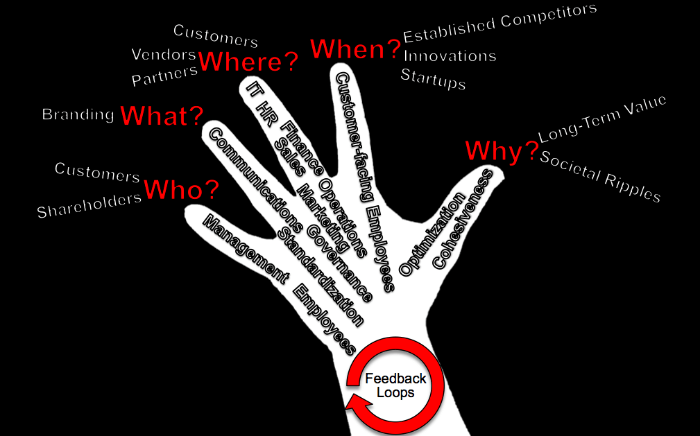
When organizations’ bread and butter business models are shattered in light of the new digital and sharing economy, “business” and technical folks have no one else to blame but themselves. As such it becomes imperative that organizations don’t get lost in complacency and infighting. These organizations should view business transformation as a holistic endeavor by paying enough attention to people, business processes, products, services and technologies that directly and indirectly affect them otherwise business transformation is just a pipe dream. In order for organizations to figure out their own business transformation journey, they need to ask the following questions from internal and external perspectives:
|
Today |
Tomorrow | |
| 1. | Who is helped by business transformation? | Who should be helped with business transformation? (E.g., management, employees, customers, shareholder, etc.) |
| 2. | What does business transformation teach us? | What should business transformation teach us? (E.g., better internal communications, governance, standardization, discipline, branding, etc.) |
| 3. | Where does the business transformation start? | Where should business transformation start? (E.g., IT, marketing, operations, customers, vendors, partners, etc.) |
| 4. | When is business transformation considered? | When should the business transformation be considered? (E.g., customer-employee conversations, competitors’ disruption/re-imagination of business models, new innovations, new methods, etc.) |
| 5. | Why is business transformation is being done? | Why should the business transformation be done? (E.g., optimization, cohesiveness, long-term value, positive societal ripples, etc.) |
When you ask the above questions, keep in mind that without effective and unbiased feedback loops most business transformation journeys would be just nearsighted one-time initiatives and not something that would make organizations self-improving entities. Smart organizations have realized this and are taking advantage of not only technological changes but also setting themselves up for the future before they themselves get disrupted.

In the video below, on CxO Talk, I asked Jay Ferro, Chief Information Officer (CIO) of The American Cancer Society about the relationship between business operations and Information Technology (IT).
In my view, broadly speaking, there are two types of operations:
When business operations and technology operations are not in aligment that is where handing off things from one function to another not only creates friction but also creates silos.
This article discusses the various strategic, political and cultural factors that were associated with the decision to develop an online employee portal at SmFedCon. The cause and contributing factors that led to the software development project are explored in detail. Focus is placed on SmFedCon’s decision processes to make the initial decision not to develop the employee portal.
Examples are included that show how factors such as personal biases and financial conservatism influenced SmFedCon from realizing the potential of the online employee portal.
SmFedCon was a small US Federal government contractor that provided Information Technology (IT) services in the areas of strategic planning, project management, and software development. It had approximately 240 employees and 98% of these employees worked onsite at various government locations across 14 states and Washington DC. It was growing rapidly and was involved with multiple high-level projects. Due to this rapid growth, a decision needed to be made if SmFedCon was going to spend time and resources to create an online employee portal.
Within a few months of joining SmFedCon, CIO noticed a pattern where the quality of documentation deliverables was declining due to a lack of a version control system and no central document repository. What broke the camel’s back was an incident where one of the federal clients was about to receive different versions of the same document from the main office, project manager and the project team member. Although this was stopped in time, CIO realized that this as an issue and needed to be addressed. This issue was also confirmed by some of the employees who worked on-site at federal client facilities.
The following table shows the reporting structure, roles, and actors involved in the decision-making process for creating an online employee portal:
|
Actors | Roles |
Reported To |
|
Chief Executive Officer (CEO) |
|
|
| Chief Financial Officer (CFO) |
|
|
| Chief Information Officer (CIO) |
|
|
In regards to the online employee portal decision process, (1) the CFO’s role was to determine if new project budget requests made financial sense, (2) the CIO’s role was to provide a 2-page business case document to the CEO and (3) the CEO’s role was to decide.
Although the initial decision not to develop the employee portal was overturned due to changing circumstances but at the beginning, it was based on SmFedCon’s technology roadmap. The technology roadmap was written some year back before the company started to see rapid growth and did not take into account potential issues that might occur due to mismanagement and miscommunications.
The CFO and CIO reported to the CEO however the CFO had more power at SmFedCon. CFO could easily influence the CEO in certain decisions. The CFO’s power came from the 20-year friendship with the CEO and as a trusted advisor to the CEO. The CFO was also responsible for IT prior to the CIO joining the company.
While costs should be kept under control in all organizations but small businesses are especially sensitive to this. However, this sensitivity can blind small businesses from what is possible. This was the case with SmFedCon. Even though they saw how an online employee portal could help solve some of the issues they had it was just not in the budget to pursue this direction.
After the issues were identified, CIO met with the CEO to discuss that an employee portal could be the answer. CEO requested a 2-page business justification document to show if the employee portal could address the current and perhaps future needs.
The 2-page business case linked current issues with quality degradation, loss of productivity and eventually loss of clientele. It also listed the various types of options that were considered to stand up an online employee portal. These options included proprietary software vs. open source, existing application customization vs. software development and associated costs. The document listed the only option that was most feasible for SmFedCon.
The CEO discussed the 2-page business case with the CFO during one late hectic evening. The next day CEO informed CIO that the company had decided not to move ahead with the online employee portal project.
Next week, the CEO was working on a federal solicitation response when the computer died. At that time CEO was the only person who had the latest version of the document. CEO was also collaborating with other writers but they only had previous versions. Although the documents were retrieved CEO realized how the online employee portal with the documentation management system could have saved time and would have been beneficial. The next day SmFedCon won a contract that they were working on and the CEO asked the CIO to go ahead with managing the development of the online employee portal.
The following diagram shows the decision-making process at SmFedCon.

In hindsight, there are a number of things that could have been handled better.
As companies grow, they have to realize that what worked in the past when there were only a few employees would not be sufficient in the future. Processes and tools should be in place and scalable to the growing needs of the organizations. In regards to SmFedCon, this was not the case. Although the company was growing rapidly it did not invest in processes and tools that could have helped it become a well-oiled machine. In the case of an online employee portal, it was a necessity not a luxury since a vast majority of the employees were not on corporate locations but they still needed to access the correct version of the documentation and be able to collaborate with other team members.
When CIO joined SmFedCon, the problem with documentation management, project management, and team collaboration was not defined. There was no framing of what was going on. Although CIO was were not hired to improve operations but suspected that it might have been one of the underlying Blink moments that the CEO had. CIO suspected this because CIO had worked with the CEO as a consultant and helped one of SmFedCon’s clients improve operations. It would have been advantageous to the company if they had given CIO the opportunity to conduct a thorough study of the company to see what other areas could be improved upon.
In the decision-making process for the online employee portal, there were definitely some biases from all actors. CIO’s bias came from working with small businesses in the past where cost was always a major issue. Additionally, in those organizations, CIO was responsible for recognizing patterns and improving operations and thus tried to do the same with SmFedCon. Due to CIO’s background in technology, CIO believed that most operational issues can be solved through well thought out management and technology systems which were another bias. CIO’s decision not to get buy-in from the CFO prior to giving the 2-page business case and not getting CFO involved in determining the project budget stemmed from an unpleasant experience working with a previous CFO. All of this played into the CIO developing the business case without working with the CFO.
There were some biases from the CFO as well. Since CFO handled IT before CIO joined, it seems like CFO was reluctant in giving up control. As CIO looks back, s/he remembers an incident where the CEO had to have a closed-door meeting with CFO so that CEO would give CIO login credentials for a corporate system. CFO was skeptical about IT projects and was quick to make judgments about them. CFO was also double the age of the CIO and might have not understood/accepted why SmFedCon hired a young CIO at the company only in their 20s. In regards to the online employee portal, all these biases might have played a role in the CFO convincing the CEO that it was not feasible to start this project.
Although the CEO was not quick to make judgments the 20-year-old relationship with the CFO might have played a role in the decision. Additionally, the decision not to be moving ahead on the project might have been exacerbated by that hectic late evening.
The 2 pages CIO chose to concentrate on stated what issues SmFedCon was having and how they could be solved through the online employee portal. The document did not have many alternatives to select from. It only listed that SmFedCon can create the online employee portal (1) using open source technologies, (2) the CIO would guide the developers and vendors in the design and (3) CIO would manage its development.
Although a decision-making process was followed initially it did not result in the desired outcome. As discussed earlier, while there are many reasons for this however establishing good relationships and getting buy-in would certainly have helped. Some of the other decision-making processes that could have helped include:
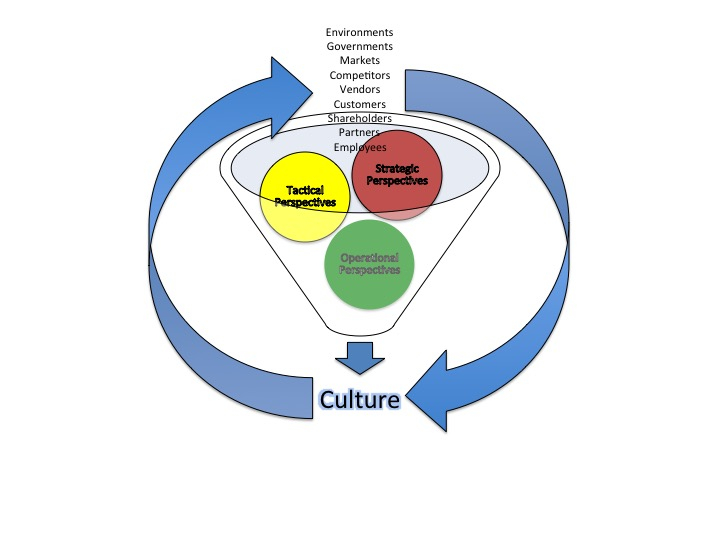
Peter Drucker, one of the most influential management consultants in the world, is often attributed to coining the phrase “Culture eats strategy for breakfast.” Organizations that can harness the power of culture can create environments where everyone can contribute towards the attainment of strategic objectives. However, most organizations are unable to create such environments and hence their pursuit of strategic objectives never fully comes to fruition. The three main reasons for this failure are:
An organization’s culture is a way of thinking, behaving and working within the physical, virtual, legal and mental organizational boundaries. What an organization thinks about its place in the world is shown by its vision, mission statement and (un)displayed values that directly influence internal and external stakeholders. How an organization behaves is shown by leadership examples, levels of (un)trustworthiness, encouragement and discouragement of cross-collaboration and camaraderie. How an organization works is shown by its (un)biased business processes, (non)adoption of technological advancements, (un)approved frameworks/methodologies/approaches, employee (non)recognitions, (un)real career ladders, risk averseness, salaries, (non)physical locations, clothing, and subcultures.
Culture is not just one thing but it is a collection/combination of different things/subcultures that can be observed and also measured. Thus, how organizations measure, incentivize and reward from the selection of the right people to optimized processes and efficient use of technology becomes crucial towards achieving organizational objectives. In order to understand and effectively bring cultural change, the following questions need to be asked:
Strategic Perspectives on Culture:
|
Today |
Tomorrow | |
| 1. |
Who is incentivized at the executive level to transform culture? | Who should be incentivized at the executive level to transform culture? |
| 2. | What governance structures are in place for strategic cultural transformation? | What governance structures should be in place for strategic cultural transformation? |
| 3. | Where is technology integrated into transforming culture? | Where should technology be integrated into transforming culture? |
| 4. | When and how often cultural transformation objectives are communicated? | When and how often cultural transformation objectives should be communicated? |
| 5. | Why cultural transformation is critical to achieving strategic objectives? |
Why transformation should be critical to achieving strategic objectives? |
Tactical Perspectives on Culture:
|
Today |
Tomorrow | |
| 1. |
Who is incentivized at the middle management level to be champions of transforming culture? | Who should be incentivized at the middle management level to be champions of transforming culture? |
| 2. | What business units, functional areas, and teams are included to bring about transformation? | What business units, functional areas, and teams should be included to bring about transformation? |
| 3. | Where technology hinders in cultural transformation? | Where technology might hinder in cultural transformation? |
| 4. | When is the start and end of cultural transformation communicated? | When should the start and end of cultural transformation communicate? |
| 5. | Why cultural transformation is critical to achieving tactical objectives? |
Why cultural transformation should be critical to achieving tactical objectives? |
Operational Perspectives on Culture:
|
Today |
Tomorrow | |
| 1. |
Who sees cultural transformation as an obstacle? | Who might see cultural transformation as an obstacle? |
| 2. | What business processes provide views on the organization’s culture? | What business processes should provide views on the organization’s culture? |
| 3. | Where is technology part of your understanding of the organization’s culture? | Where should technology be a part of the understanding of the organization’s culture? |
| 4. | When were you informed about the cultural transformation objectives? | When should you have been informed about the cultural transformation objectives? |
| 5. | Why cultural transformation is critical to achieving your daily tasks? |
Why transformation should be critical to achieving your daily tasks? |
Culture transcends most of our thoughts and how we function within organizations and outside of it. This overarching effect of culture can create biases in terms of what people we hire, what processes we put in place, what technologies we choose to use, who we talk to and what we care to observe. By asking the right questions and putting the right measurements in place, we can have a quantifiable understanding of the baseline cultures and enhance it for the better. In doing so we have to be cognizant of our own biases, biases of others and any prevailing biases that result in cultural stagnation.

 Welcome to Khan's Blog
You must be logged in to post a comment.