Category: Business Improvement and Transformation

Business Improvement and Transformation

  • 5 Questions to Ask About Machine Learning (ML)

    Machine learning is a subfield of artificial intelligence (AI) that focuses on developing algorithms and models that enable computers to learn and improve from experience without being explicitly programmed. Through the analysis of data and patterns, machine learning allows systems to make predictions, identify insights, and automate decision-making processes.

    Types of Machine Learning

    1. Supervised Learning: In supervised learning, the algorithm is trained on labeled data, where the correct outcomes are known. The model learns to make predictions based on this labeled dataset.
    2. Unsupervised Learning: Unsupervised learning deals with unlabeled data, and the algorithm learns to identify patterns and structures within the data without predefined outcomes.
    3. Reinforcement Learning: Reinforcement learning involves an agent interacting with an environment and learning to take actions that maximize rewards over time.

    The Pros of Machine Learning

    1. Automation: Machine learning automates complex tasks, enabling efficient and accurate processing of large volumes of data.
    2. Data-Driven Insights: Machine learning algorithms can uncover patterns and insights that humans may not easily identify.
    3. Personalization: Machine learning enables personalized experiences in various applications, such as recommendations and targeted advertising.
    4. Continuous Improvement: Machine learning models can learn and improve over time as they are exposed to more data.
    5. Wide Applicability: Machine learning finds applications across diverse domains, including healthcare, finance, marketing, and more.

    The Cons of Machine Learning

    1. Data Dependence: Machine learning models heavily rely on the quality and quantity of data, which may introduce biases and inaccuracies.
    2. Overfitting: Models may become too specialized to the training data, resulting in poor performance on new, unseen data.
    3. Complexity: Developing and maintaining machine learning models requires expertise in data science and specialized tools.
    4. Interpretability: Some machine learning models, like deep neural networks, can be challenging to interpret, raising concerns in critical applications.
    5. Ethical Considerations: Machine learning models may make decisions that have ethical implications, requiring careful attention to fairness and accountability.

    Intriguing Questions about Machine Learning

    1. Who: Who are the pioneers and leading researchers in the field of machine learning, and what are their groundbreaking contributions?
    2. What: What are the most exciting recent advancements in machine learning and their potential impact on society and industries?
    3. Where: Where is machine learning most effectively deployed – in scientific research, autonomous vehicles, healthcare, or financial markets?
    4. When: When should organizations consider adopting machine learning solutions, and what challenges may arise during implementation?
    5. Why: Why is machine learning considered a transformative technology, and what challenges are researchers currently striving to overcome?

    Conclusion

    Machine learning has revolutionized the way we process data and make decisions, offering powerful tools for automation, insights, and personalization. With its ability to learn from data and adapt over time, machine learning holds the promise of driving innovations across numerous domains. However, ensuring data quality, addressing ethical concerns, and understanding the limitations of machine learning models remain crucial aspects of successful implementation. As research continues to push the boundaries of machine learning, its impact on society, industry, and scientific advancement is expected to be even more profound in the years to come.
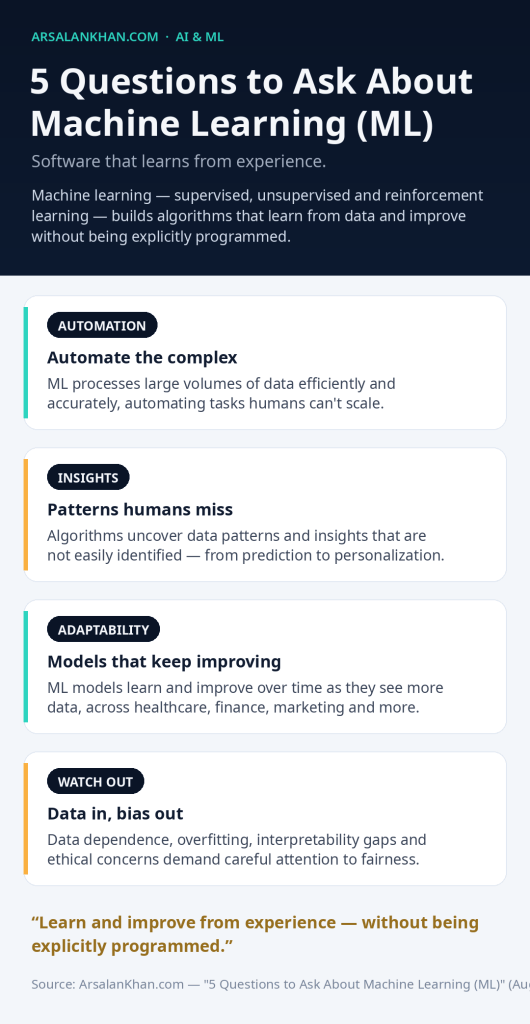
    Infographic: 5 Questions to Ask About Machine Learning (ML)
  • 5 Questions to Ask About Fuzzy Logic

    Fuzzy Logic is a mathematical approach to deal with uncertainty and imprecision in reasoning and decision-making processes. It was introduced by Lotfi A. Zadeh in the 1960s as an extension of classical binary logic, which deals with true/false or 0/1 values. Unlike binary logic, which represents crisp distinctions, fuzzy logic allows for gradual or partial membership, where elements can belong to multiple categories to varying degrees.

    Key Concepts of Fuzzy Logic

    1. Membership Functions: Fuzzy Logic uses membership functions to assign a degree of membership to elements within a set. Instead of being strictly in or out of a set, elements can have partial membership.
    2. Fuzzy Sets: Fuzzy sets are sets in which elements can belong to more than one category with varying degrees of membership.
    3. Fuzzy Rules: Fuzzy logic employs if-then rules based on linguistic variables. These rules allow for approximate reasoning.
    4. Defuzzification: The process of converting fuzzy outputs into crisp values is known as defuzzification.

    The Pros of Fuzzy Logic

    1. Handling Uncertainty: Fuzzy Logic can effectively deal with uncertainty and imprecision in data and reasoning, making it suitable for real-world scenarios where ambiguity exists.
    2. Human-Like Decision Making: Fuzzy Logic emulates human decision-making, allowing systems to make more natural and human-like choices.
    3. Adaptability: Fuzzy Logic can adapt to changes in input data and accommodate new information without requiring significant modifications to the model.
    4. Wide Application: Fuzzy Logic has been successfully applied in various fields, including control systems, pattern recognition, data mining, and artificial intelligence.
    5. Combining Multiple Inputs: Fuzzy Logic allows the combination of multiple inputs with different degrees of relevance, enabling a more comprehensive decision-making process.

    The Cons of Fuzzy Logic

    1. Complexity: Implementing and interpreting fuzzy logic models can be more complex compared to traditional binary logic systems.
    2. Lack of Standardization: Fuzzy Logic lacks standardized rules and guidelines, leading to variations in implementation across different applications.
    3. Data Representation: Representing fuzzy data in a meaningful way can be challenging, especially when dealing with large datasets.
    4. Computation Overhead: Fuzzy Logic calculations may require more computational resources compared to traditional binary logic.
    5. Subjectivity: Fuzzy Logic relies on subjective human input to define membership functions and fuzzy rules, leading to potential biases.

    Intriguing Questions about Fuzzy Logic

    1. Who: Who were some of the key contributors to the development and popularization of fuzzy logic in various fields?
    2. What: What are some real-world applications of fuzzy logic, and how does it compare to traditional logic in those scenarios?
    3. Where: Where has fuzzy logic seen the most significant impact – in control systems, robotics, or other domains?
    4. When: When should fuzzy logic be preferred over classical logic approaches, and what are the key factors influencing this decision?
    5. Why: Why is fuzzy logic considered a powerful tool in managing uncertainty and complexity in decision-making processes?

    Conclusion

    Fuzzy Logic offers a flexible and powerful approach to handle uncertainty and imprecision in reasoning and decision-making. By allowing for gradual membership and approximate reasoning, fuzzy logic can model real-world situations more effectively. While it introduces complexity and challenges in data representation, its adaptability, human-like decision-making, and wide range of applications make it a valuable tool in various fields, particularly in scenarios where crisp distinctions and binary logic fall short. As technology continues to advance, fuzzy logic is likely to find even more applications, contributing to more intelligent and human-centric systems.

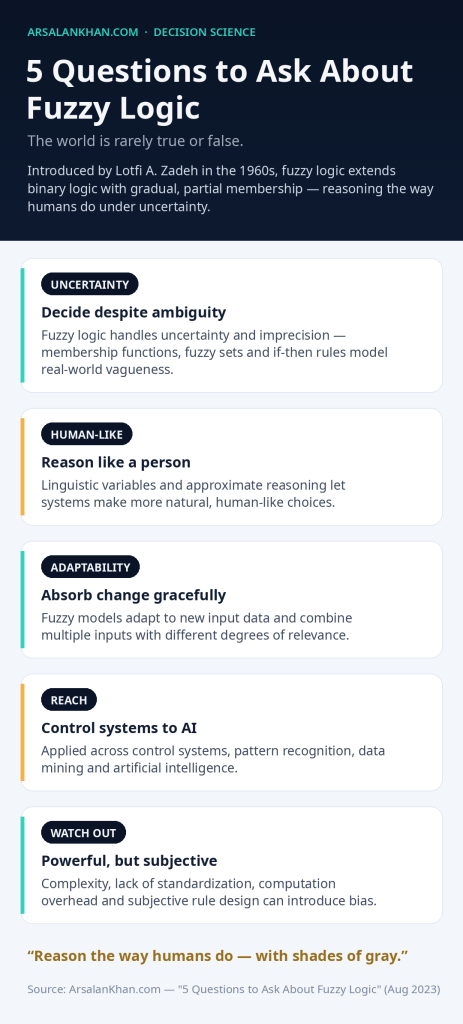
    Infographic: 5 Questions to Ask About Fuzzy Logic
  • 5 Questions to Ask About Data Brokers

    A data broker is a company or entity that collects, aggregates, and analyzes large volumes of data from various sources, including online activities, transactions, and public records. Data brokers act as intermediaries, buying and selling data to businesses, marketers, and other organizations seeking valuable insights for targeted marketing, analytics, risk assessment, and decision-making.

    Key Functions of Data Brokers

    1. Data Collection: Data brokers gather data from diverse sources, such as websites, social media platforms, government records, and consumer transactions.
    2. Data Aggregation: They combine and organize the collected data into comprehensive datasets, often enriched with demographic, behavioral, and geographic information.
    3. Data Analysis: Data brokers use advanced analytics to extract valuable insights, patterns, and trends from the aggregated data.
    4. Data Monetization: Data brokers generate revenue by selling the collected and analyzed data to their clients, who use it for various purposes.

    The Pros of Data Brokers

    1. Data Accessibility: Data brokers provide access to vast and diverse datasets that may be challenging for individual organizations to collect on their own.
    2. Market Insights: Businesses can gain valuable market insights, consumer behavior patterns, and trends by utilizing data broker services.
    3. Targeted Marketing: Data brokers facilitate targeted marketing efforts, enabling businesses to reach specific audiences more effectively.
    4. Risk Assessment: Data brokers help organizations assess credit risk, detect fraud, and make informed decisions based on data-driven assessments.
    5. Innovation Support: Data brokers contribute to data-driven innovation by making valuable datasets available to researchers and entrepreneurs.

    The Cons of Data Brokers

    1. Privacy Concerns: The collection and aggregation of personal data by data brokers raise privacy concerns, as individuals may be unaware of how their data is being used.
    2. Data Accuracy: The accuracy and quality of data can vary among different data brokers, potentially leading to erroneous insights and decisions.
    3. Data Security Risks: Holding vast amounts of sensitive data, data brokers may become targets for cyberattacks and data breaches.
    4. Lack of Transparency: Some data brokers operate with limited transparency, making it challenging for individuals to understand how their data is being utilized.
    5. Ethical Considerations: The ethical implications of data collection and usage by data brokers have sparked debates about data ownership and consent.

    Intriguing Questions about Data Brokers

    1. Who: Who are the major players in the data broker industry, and what types of data do they typically collect and aggregate?
    2. What: What are some of the most innovative use cases of data broker services in different industries?
    3. Where: Where is the line between valuable data aggregation and potential invasion of privacy in the operations of data brokers?
    4. When: When and how should organizations determine whether to utilize data broker services or focus on in-house data collection and analysis?
    5. Why: Why is data broker regulation and transparency crucial for safeguarding individual privacy and maintaining trust in the data-driven economy?

    Conclusion

    Data brokers play a significant role in the data-driven economy, offering valuable insights and datasets to organizations seeking to enhance their marketing efforts, risk assessments, and decision-making processes. While their services facilitate innovation and data accessibility, data brokers must navigate complex privacy and ethical considerations. Striking a balance between data accessibility and individual privacy protection is vital to ensure the responsible and ethical use of data broker services in the digital landscape.

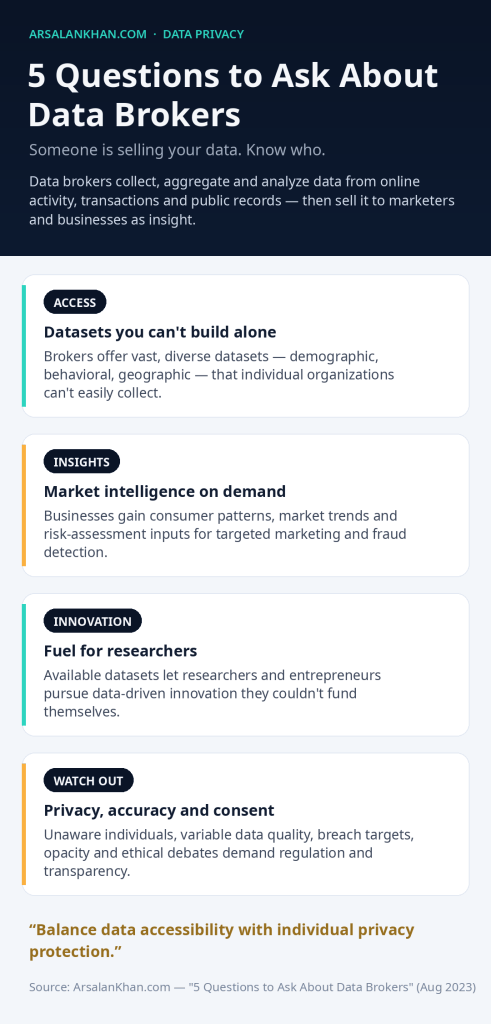
    Infographic: 5 Questions to Ask About Data Brokers
  • 5 Questions to Ask About Digital Divide

    The digital divide refers to the unequal access to and use of digital technologies, including the internet and other digital tools, among different individuals, communities, and regions. This divide is characterized by disparities in technology adoption, digital skills, and online connectivity, which can lead to significant social, economic, and educational inequalities.

    Key Dimensions of the Digital Divide

    1. Access Divide: Unequal access to internet connectivity and digital devices, particularly in rural or economically disadvantaged areas.
    2. Usage Divide: Differences in how people use digital technologies, including access to online services, digital literacy, and the ability to leverage technology for personal and professional purposes.
    3. Skills Divide: Disparities in digital literacy and technical skills needed to effectively navigate and utilize digital tools.
    4. Participation Divide: Differences in online participation, engagement, and the ability to take advantage of the opportunities offered by the digital world.

    The Pros of Bridging the Digital Divide

    1. Inclusive Access: Bridging the digital divide ensures that everyone, regardless of their background, has equal access to information and resources available on the internet.
    2. Educational Opportunities: Improved access to digital resources enhances educational opportunities and supports online learning, especially relevant during times of remote education.
    3. Economic Empowerment: Digital skills and access enable individuals to participate in the digital economy, access job opportunities, and develop online businesses.
    4. Civic Engagement: Bridging the digital divide facilitates broader participation in civic activities, democratic processes, and public services.
    5. Social Equity: Reducing the digital divide promotes social equity and reduces disparities, fostering a more inclusive and cohesive society.

    The Cons of the Digital Divide

    1. Exclusion: Those on the wrong side of the digital divide face exclusion from critical services, education, and economic opportunities available online.
    2. Education Disparities: Lack of digital access and skills can lead to educational disparities, hindering students’ ability to succeed in a technology-driven world.
    3. Economic Inequality: The digital divide can perpetuate existing economic inequalities and prevent marginalized communities from accessing emerging economic opportunities.
    4. Social Isolation: Limited digital access can lead to social isolation, particularly in the context of remote work, communication, and social interactions.
    5. Missed Opportunities: Those without access to digital resources miss out on valuable information, networking, and participation in the digital age.

    Intriguing Questions about the Digital Divide

    1. Who: Who are the individuals and communities most affected by the digital divide, and how do various factors contribute to these disparities?
    2. What: What innovative solutions, policies, and initiatives are being implemented to bridge the digital divide and promote digital inclusion?
    3. Where: Where are the most significant gaps in digital access and skills – is it primarily a global issue or does it vary across regions?
    4. When: When is the most critical time to address the digital divide, and how can short-term and long-term strategies be balanced?
    5. Why: Why is bridging the digital divide not just a matter of technology, but a fundamental step towards achieving social and economic equity?

    Conclusion

    The digital divide represents a critical challenge in our increasingly interconnected world. Bridging this divide is essential not only for individual opportunities but also for building inclusive societies and economies. By addressing the disparities in digital access, skills, and usage, we can work towards a more equitable and empowered global community where the benefits of the digital age are accessible to all, regardless of their background or location.

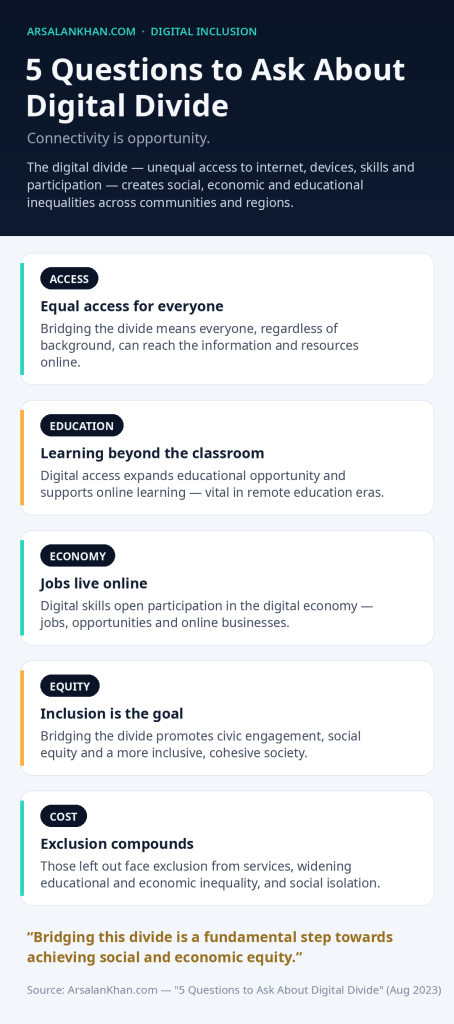
    Infographic: 5 Questions to Ask About Digital Divide
  • 5 Questions to Ask About Automated Trading Systems

    Automated trading systems, often referred to as algorithmic trading or algo trading, are computer programs that use complex algorithms to execute trading orders in financial markets. These systems aim to make trading decisions based on pre-defined rules and strategies, often involving high-frequency trading and the rapid execution of trades.

    Key Aspects of Automated Trading Systems

    1. Algorithm Development: Traders and developers create algorithms that define trading strategies, including entry and exit points, risk management, and position sizing.
    2. Data Analysis: These systems analyze real-time market data, historical price trends, and other relevant information to make informed trading decisions.
    3. Execution Automation: Once a trading signal is generated, automated trading systems execute orders without human intervention, often at speeds impossible for humans to achieve.
    4. Risk Management: These systems incorporate risk management techniques to mitigate potential losses, such as setting stop-loss orders and position limits.
    5. Backtesting: Before deployment, algorithms are tested using historical data to assess their performance under various market conditions.

    The Pros of Automated Trading Systems

    1. Speed and Efficiency: Automated trading systems execute trades at lightning-fast speeds, capitalizing on market opportunities quickly.
    2. Elimination of Emotional Bias: These systems eliminate emotional decision-making, which can lead to more disciplined and consistent trading strategies.
    3. 24/7 Trading: Automated trading systems can operate around the clock, taking advantage of global market movements even when traders are asleep.
    4. Backtesting and Optimization: Algorithms can be backtested and optimized to refine trading strategies based on historical data.
    5. Diversification: Automated trading systems can manage multiple trades and strategies simultaneously, leading to diversification and reduced risk.

    The Cons of Automated Trading Systems

    1. Technical Complexity: Developing and maintaining automated trading systems requires advanced technical skills and expertise.
    2. Data Dependencies: The accuracy and effectiveness of automated systems rely heavily on the quality and reliability of market data.
    3. Over-Optimization: Over-optimizing algorithms based on historical data can lead to poor performance in real-time markets.
    4. Technical Glitches: Software bugs or technical glitches can lead to erroneous trades and significant financial losses.
    5. Market Volatility: Rapid and automated trading can exacerbate market volatility and contribute to flash crashes.

    Intriguing Questions about Automated Trading Systems

    1. Who: Who are the key figures driving innovation in automated trading systems, and how are they shaping the future of algorithmic trading?
    2. What: What are some real-world examples of successful automated trading strategies, and how have they influenced market dynamics?
    3. Where: Where does automated trading have the most significant impact – in equities, forex, cryptocurrency markets, or other financial sectors?
    4. When: When are automated trading systems most effective – in high-frequency trading, day trading, or long-term investing?
    5. Why: Why is the concept of automated trading systems both exciting and controversial in the financial world, and how can they be used responsibly to benefit investors and markets?

    Conclusion

    Automated trading systems have revolutionized the financial industry, bringing speed, efficiency, and data-driven decision-making to trading activities. While they offer numerous advantages, the technical complexity, potential for technical glitches, and market impact require careful consideration. Striking the right balance between human expertise and algorithmic precision will be crucial as automated trading systems continue to shape the landscape of financial markets.

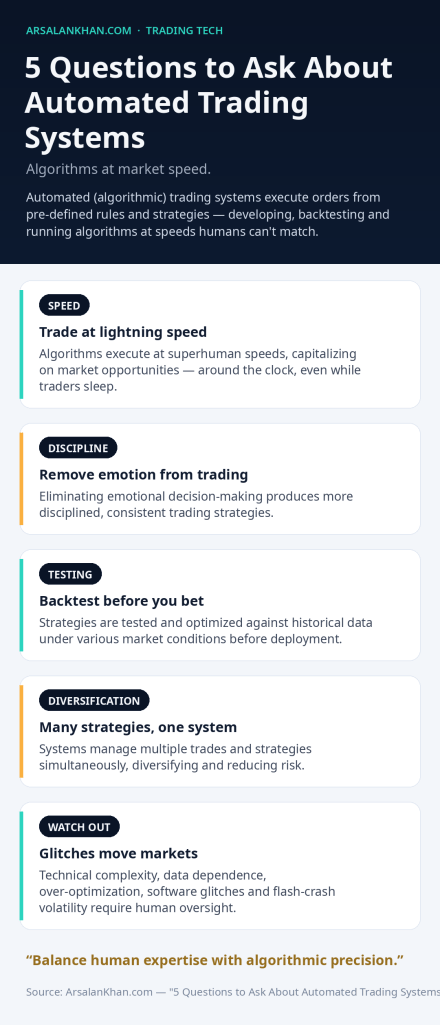
    Infographic: 5 Questions to Ask About Automated Trading Systems