Category: Business Improvement and Transformation

Business Improvement and Transformation

  • 5 Questions to Ask About a Lean Enterprise

    Lean Enterprise is a management philosophy and methodology that originated from the Toyota Production System in the 1940s. It aims to optimize efficiency, minimize waste, and deliver value to customers while fostering a culture of continuous improvement. Originally developed for manufacturing, Lean principles have since been applied across various industries and functions to create a more agile and responsive organization.

    Key Principles of Lean Enterprise

    1. Value: Focus on identifying and delivering value to customers by understanding their needs and preferences.
    2. Value Stream: Map and analyze the entire value stream, including all the steps and activities involved in delivering the product or service.
    3. Flow: Ensure smooth and uninterrupted flow of work through the value stream, reducing bottlenecks and delays.
    4. Pull: Use a pull-based system where work is initiated based on customer demand, avoiding overproduction.
    5. Continuous Improvement: Encourage a culture of continuous improvement, empowering employees to seek out and implement process enhancements.

    The Pros of Lean Enterprise

    1. Increased Efficiency: Lean principles optimize workflows, reduce redundant activities, and enhance overall efficiency.
    2. Waste Reduction: By identifying and eliminating non-value-added activities, Lean Enterprise reduces waste and improves resource utilization.
    3. Enhanced Quality: Emphasizing continuous improvement leads to higher product and service quality, resulting in increased customer satisfaction.
    4. Customer-Centric Approach: Lean Enterprise places customers at the center of decision-making, ensuring their needs are met effectively.
    5. Employee Engagement: Lean principles encourage employee involvement in problem-solving, fostering a sense of ownership and empowerment.

    The Cons of Lean Enterprise

    1. Cultural Resistance: Implementing Lean principles may face resistance from employees who are accustomed to traditional practices.
    2. Complex Implementation: Transitioning to a Lean Enterprise requires careful planning and may require significant changes in organizational culture and processes.
    3. Limited Applicability: While Lean principles are effective in many industries, some organizations may find them challenging to apply in certain contexts.
    4. Overemphasis on Efficiency: An excessive focus on efficiency may overshadow other critical aspects, such as creativity and innovation.
    5. Resource Intensive: Implementing Lean principles may require considerable resources, including time, training, and investment in new technologies.

    Intriguing Questions about Lean Enterprise

    1. Who: Who are some exemplary companies or leaders known for successfully implementing Lean principles and driving significant improvements?
    2. What: What are some specific examples of waste reduction and efficiency enhancements achieved through Lean Enterprise?
    3. Where: Where has Lean Enterprise been most effectively implemented – in manufacturing, service industries, or software development?
    4. When: When should organizations consider adopting a Lean Enterprise approach, and what challenges might they face during implementation?
    5. Why: Why is Lean Enterprise considered a transformative approach for organizations seeking sustainable success and improved competitiveness?

    Conclusion

    Lean Enterprise offers organizations a systematic and proven approach to streamline operations, reduce waste, and deliver exceptional value to customers. By fostering a culture of continuous improvement and employee engagement, Lean principles create a more agile and customer-centric organization. While implementing Lean Enterprise may pose challenges, the benefits of increased efficiency, waste reduction, and enhanced customer satisfaction make it a compelling strategy for organizations striving for excellence and long-term success in today’s dynamic business landscape.
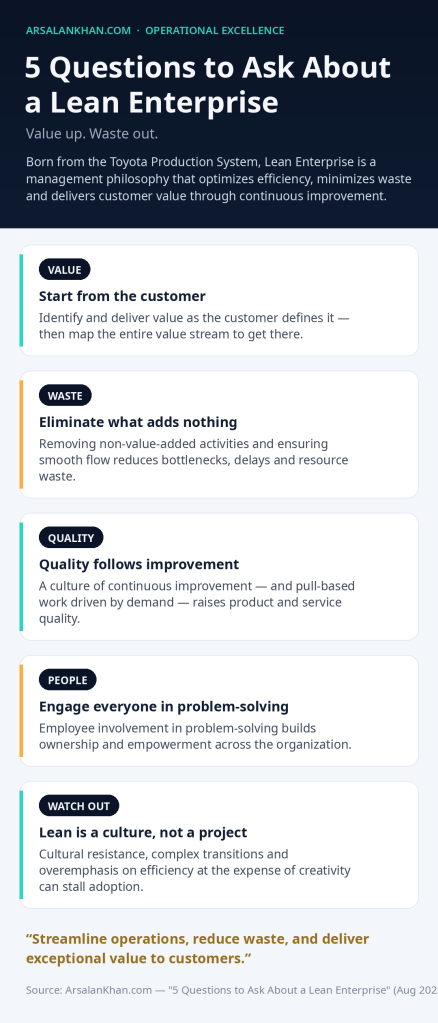
    Infographic: 5 Questions to Ask About a Lean Enterprise
  • 5 Questions to Ask About Value Ops

    Value Ops is an extension of the DevOps philosophy, which aims to bridge the gap between development (Dev) and IT operations (Ops) by fostering collaboration and automation. In the context of Value Ops, the focus is not only on improving the efficiency and speed of software development and delivery but also on aligning these activities with the creation of value for customers and the business.

    The Integration of Value Ops

    Value Ops extends the DevOps culture of continuous integration, continuous delivery, and automation to include a customer-centric and value-driven approach. It aims to deliver valuable products and services to customers quickly and with high quality. In Value Ops, the end-to-end process, from idea to customer delivery, is optimized for maximum value creation.

    The Pros of Value Ops

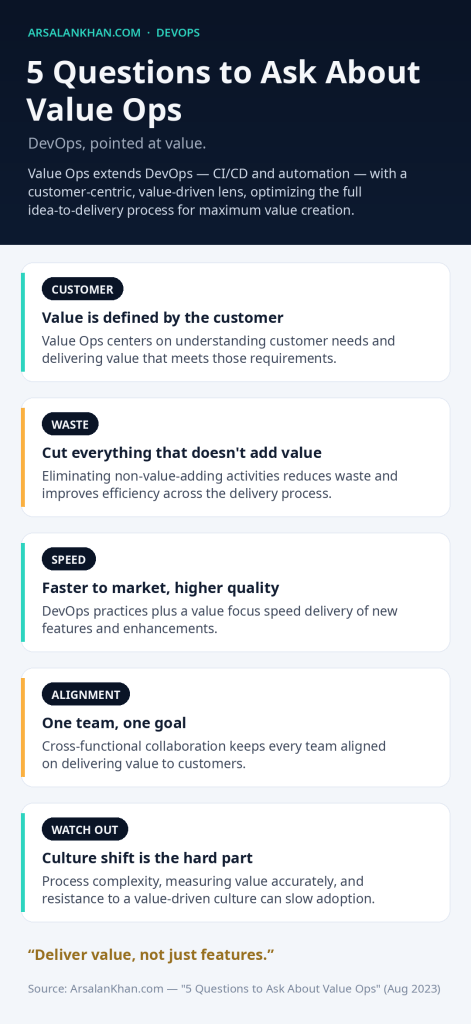
    1. Customer-Centric Focus: Value Ops puts a strong emphasis on understanding customer needs and delivering value that meets those requirements.
    2. Waste Reduction: By focusing on value creation and eliminating non-value-adding activities, Value Ops reduces waste and improves efficiency.
    3. Faster Time-to-Market: The integration of DevOps practices with a value-driven approach speeds up the delivery of new features and enhancements.
    4. Cross-Functional Collaboration: Value Ops promotes collaboration between different teams and departments, ensuring everyone is aligned with the goal of delivering value to customers.
    5. Continuous Improvement: Adopting a value-driven approach fosters a culture of continuous improvement and innovation.

    The Cons of Value Ops

    1. Complexity: Implementing Value Ops may require significant changes to existing processes and workflows, which can be complex and time-consuming.
    2. Cultural Shift: Shifting to a value-driven culture may face resistance from individuals or teams accustomed to traditional ways of working.
    3. Data and Metrics: Obtaining accurate data and defining metrics to measure value can be challenging.
    4. Integration Challenges: Integrating DevOps and value-driven practices may require careful planning and coordination.
    5. Skillsets: Adopting Value Ops may require employees to develop new skillsets and adapt to changes in their roles.

    Intriguing Questions about Value Ops

    1. Who: Who within an organization typically leads the implementation of Value Ops – DevOps teams, value stream managers, or cross-functional teams?
    2. What: What are the key practices and methodologies that support the integration of DevOps and value-driven principles?
    3. Where: Where do we see the most significant impact of Value Ops – in software development, IT services, or other industries?
    4. When: When is the optimal time for organizations to adopt Value Ops – during a digital transformation, when facing customer-centric challenges, or as part of a process improvement initiative?
    5. Why: Why is Value Ops considered a promising approach to aligning software delivery with customer needs and business value?

    Conclusion

    Value Ops represents an evolution of the DevOps culture, combining the principles of delivering software quickly and efficiently with a customer-centric focus on creating value. By integrating value-driven practices with DevOps methodologies, organizations can optimize their processes, improve customer satisfaction, and stay competitive in a fast-paced and customer-driven market. While the implementation of Value Ops may face challenges, the benefits of a customer-centric approach, waste reduction, and faster time-to-market make it a valuable strategy for organizations seeking to enhance their overall value delivery and achieve business success.

    Infographic: 5 Questions to Ask About Value Ops
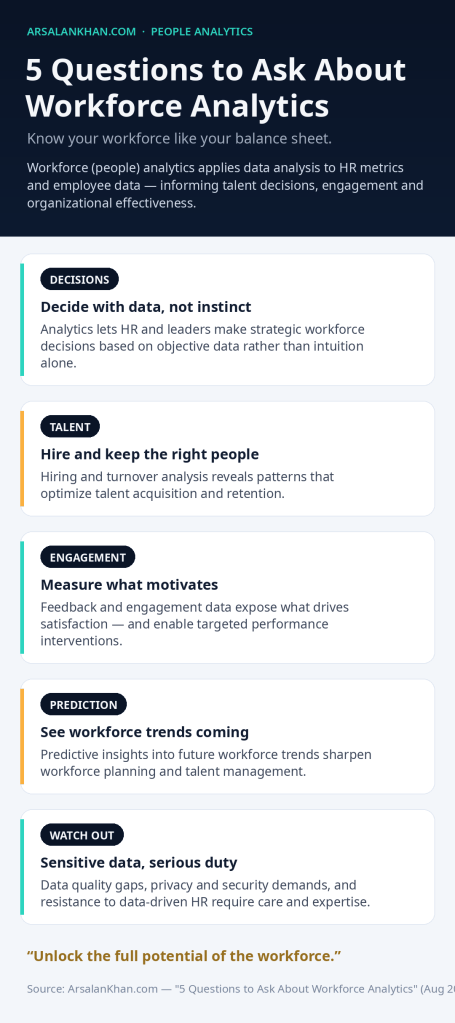
  • 5 Questions to Ask About Workforce Analytics

    Workforce analytics, also known as HR analytics or people analytics, is the application of data analysis and statistical techniques to gather insights and make data-driven decisions related to the workforce. It involves collecting, measuring, and analyzing various HR metrics and employee data to gain a deeper understanding of workforce trends, performance, engagement, and overall organizational effectiveness. Workforce analytics enables HR professionals and business leaders to optimize talent management strategies, improve employee experiences, and align HR initiatives with organizational goals.

    The Pros of Workforce Analytics

    1. Data-Driven Decision-Making: Workforce analytics empowers HR professionals and leaders to make strategic decisions based on objective data rather than relying on intuition alone.
    2. Talent Acquisition and Retention: By analyzing hiring and turnover data, organizations can identify patterns and optimize talent acquisition and retention efforts.
    3. Performance Management: Workforce analytics provides insights into employee performance, enabling targeted interventions and performance improvement initiatives.
    4. Employee Engagement and Satisfaction: Analyzing employee feedback and engagement data helps organizations understand factors influencing employee satisfaction and engagement.
    5. Predictive Insights: Workforce analytics can offer predictive insights into future workforce trends, aiding in workforce planning and talent management strategies.

    The Cons of Workforce Analytics

    1. Data Quality and Availability: The effectiveness of workforce analytics relies on the availability and quality of HR data, which may not always be comprehensive or accurate.
    2. Data Privacy and Security: Handling sensitive employee data requires strict data privacy and security measures to protect employee confidentiality.
    3. Interpreting Complex Data: Analyzing and interpreting complex workforce data may require specialized skills and expertise.
    4. Resistance to Change: Some employees or stakeholders may be resistant to data-driven decision-making, preferring traditional HR practices.
    5. Resource Intensive: Implementing workforce analytics may require investments in technology, training, and data infrastructure.

    Intriguing Questions about Workforce Analytics

    1. Who: Who within an organization typically oversees workforce analytics – HR analytics teams, HR business partners, or data scientists?
    2. What: What are the key HR metrics and data points that organizations should focus on when implementing workforce analytics?
    3. Where: Where do we see the most significant impact of workforce analytics – in talent acquisition, performance management, or employee engagement?
    4. When: When is the optimal time for organizations to adopt workforce analytics – during periods of growth, restructuring, or talent shortages?
    5. Why: Why is workforce analytics considered a game-changer for HR management, talent optimization, and organizational success?

    Conclusion

    Workforce analytics is a transformative practice that empowers HR professionals and business leaders with data-driven insights to make informed decisions related to the workforce. By leveraging HR data and analytics, organizations can improve talent acquisition, optimize performance management, and enhance employee engagement. While challenges related to data quality, privacy, and interpretation exist, the benefits of data-driven decision-making, predictive insights, and talent optimization position workforce analytics as a critical aspect of modern HR management. Embracing workforce analytics as a core HR practice enables organizations to unlock the full potential of their workforce, foster a culture of continuous improvement, and drive success in today’s dynamic business environment.

    Infographic: 5 Questions to Ask About Workforce Analytics
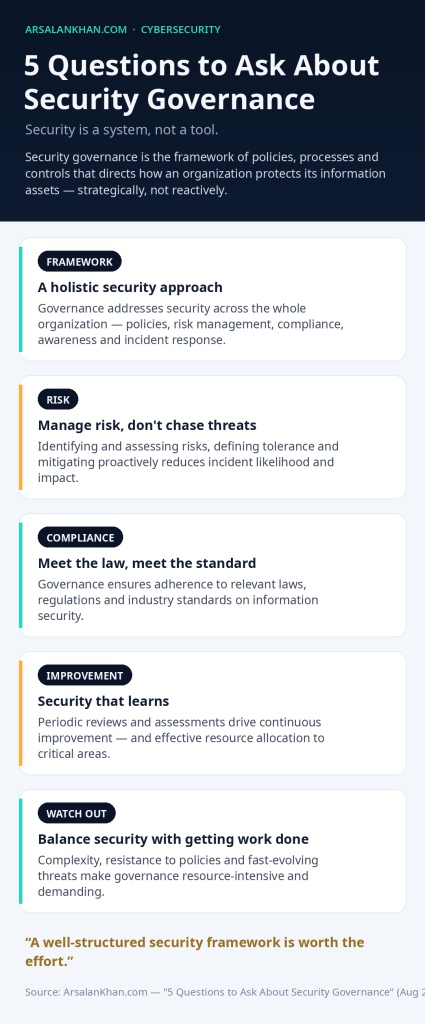
  • 5 Questions to Ask About Security Governance

    Security governance refers to the system of policies, processes, and controls that an organization establishes to ensure the effective management and protection of its information assets and technology infrastructure. It is a critical component of an organization’s overall security strategy, providing a framework for making strategic security decisions, allocating resources, and managing security risks.

    Key Components of Security Governance

    1. Security Policies and Procedures: Security governance includes the development and implementation of comprehensive security policies and procedures that outline the organization’s security objectives, responsibilities, and rules.
    2. Risk Management: Security governance involves identifying and assessing security risks, defining risk tolerance levels, and implementing measures to mitigate and manage these risks.
    3. Compliance and Regulatory Adherence: Security governance ensures that the organization complies with relevant laws, regulations, and industry standards pertaining to information security.
    4. Security Awareness and Training: It involves educating employees and stakeholders about security best practices and raising awareness about security threats and vulnerabilities.
    5. Security Incident Response and Reporting: Security governance establishes protocols for detecting, responding to, and reporting security incidents promptly and effectively.

    The Pros of Security Governance

    1. Holistic Security Approach: Security governance provides a comprehensive framework to address security across all aspects of the organization, fostering a holistic security approach.
    2. Risk Mitigation: By identifying and managing security risks proactively, security governance helps reduce the likelihood and impact of security incidents.
    3. Regulatory Compliance: It ensures that the organization meets legal and regulatory requirements related to information security.
    4. Resource Allocation: Security governance helps allocate resources effectively, focusing on critical security areas based on risk assessments.
    5. Continuous Improvement: Through periodic reviews and assessments, security governance facilitates continuous improvement of security measures and practices.

    The Cons of Security Governance

    1. Complexity: Implementing and managing security governance can be complex, especially for large organizations with diverse operations.
    2. Resource Intensive: Establishing and maintaining a robust security governance program requires significant resources and ongoing commitment.
    3. Resistance to Change: Some employees may resist security policies and procedures, leading to challenges in enforcing security protocols.
    4. Emerging Threats: Security governance must adapt to rapidly evolving cyber threats, requiring continuous monitoring and updates.
    5. Balancing Security and Productivity: Striking the right balance between stringent security measures and seamless business operations can be challenging.

    Intriguing Questions about Security Governance

    1. Who: Who within an organization is typically responsible for overseeing security governance – IT security teams, executive leadership, or a dedicated security committee?
    2. What: What are some common challenges organizations face in implementing and maintaining effective security governance?
    3. Where: Where does security governance have the most significant impact – in large enterprises, government organizations, or specific industries?
    4. When: When should organizations conduct security governance reviews and assessments to ensure ongoing effectiveness?
    5. Why: Why is security governance an essential aspect of an organization’s overall cybersecurity strategy, and how does it contribute to overall risk management?

    Conclusion

    Security governance plays a crucial role in establishing a strong and resilient security framework for organizations. By defining security policies, managing risks, ensuring compliance, and promoting security awareness, security governance helps organizations protect their valuable information assets and maintain business continuity. While implementing security governance can be complex and resource-intensive, the benefits of a well-structured security framework outweigh the challenges, enabling organizations to respond effectively to security threats and safeguard against potential cyber risks.

    Infographic: 5 Questions to Ask About Security Governance
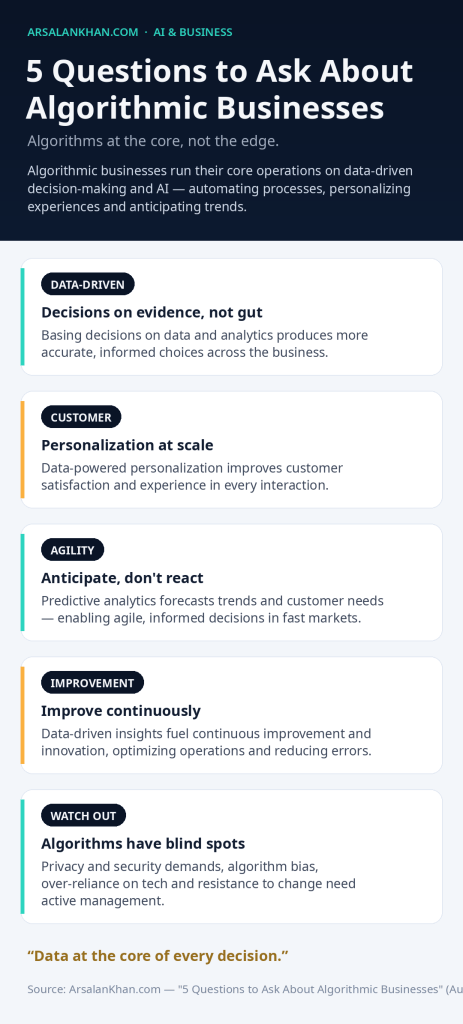
  • 5 Questions to Ask About Algorithmic Businesses

    Algorithmic businesses are organizations that rely heavily on data-driven decision-making and artificial intelligence algorithms to drive their core operations, improve customer experiences, and gain a competitive edge. These businesses leverage advanced analytics, machine learning, and AI to extract valuable insights from data, automate processes, and optimize their strategies. By embracing data-centric approaches, algorithmic businesses can better understand their customers, anticipate market trends, and make agile, informed decisions in the fast-paced digital landscape.

    The Pros of Algorithmic Businesses

    1. Data-Driven Decision-Making: Algorithmic businesses base their decisions on data and analytics, leading to more accurate and informed choices.
    2. Enhanced Customer Experiences: By leveraging data, algorithmic businesses can personalize customer interactions, leading to improved customer satisfaction.
    3. Optimized Operations: Automation and AI-driven processes enhance operational efficiency and reduce human errors.
    4. Predictive Analytics: Algorithmic businesses can use predictive analytics to forecast trends and anticipate customer needs.
    5. Continuous Improvement: Data-driven insights enable continuous improvement and innovation within the organization.

    The Cons of Algorithmic Businesses

    1. Data Privacy and Security: Algorithmic businesses must address data privacy and security concerns, particularly when handling sensitive customer information.
    2. Dependency on Technology: Over-reliance on algorithms may lead to a lack of human judgment and creativity.
    3. Algorithm Bias: AI algorithms can inherit biases from training data, potentially leading to biased decision-making.
    4. Complexity: Implementing and managing algorithms and AI systems can be complex and resource-intensive.
    5. Resistance to Change: Some employees and stakeholders may resist the shift towards data-driven decision-making.

    Intriguing Questions about Algorithmic Businesses

    1. Who: Who are the trailblazers and pioneers in adopting algorithmic approaches across various industries – the companies leading the way?
    2. What: What are the key factors that differentiate algorithmic businesses from traditional data-driven organizations?
    3. Where: Where do we see the most significant impact of algorithmic businesses – in tech startups, established enterprises, or specific sectors like finance or healthcare?
    4. When: When did algorithmic businesses gain prominence, and how have they evolved over time?
    5. Why: Why are algorithmic businesses considered a disruptive force in the modern business landscape, reshaping industries and market dynamics?

    Conclusion

    Algorithmic businesses represent the forefront of digital transformation and data-driven decision-making in the contemporary business world. By harnessing the power of data, AI, and advanced analytics, these organizations can stay agile, optimize operations, and deliver exceptional customer experiences. Despite challenges in data privacy, algorithm bias, and complexity, the benefits of data-driven decision-making, predictive analytics, and continuous improvement position algorithmic businesses for sustainable growth and success. As they continue to evolve, algorithmic businesses are likely to shape the future of industries, drive innovation, and revolutionize customer engagement in the digital era.

    Infographic: 5 Questions to Ask About Algorithmic Businesses