This video shows how you can use AppleScript to search for jobs online.
In addition to automation of job searches based on your keywords, this script gives you the ability to reduce the email job alerts that you get in your inbox since you have a choice not to sign-up for them.
Although this script has to be initiated by you and you can set it so that it runs at a certain time.
A few weeks back I posted an article (Why IT Should Be on the CEO’s Agenda) on the Massachusetts Institute of Technology (MIT) LinkedIn group about why Information Technology (IT) should matter to the CEO. A reader commented and referred me to his blog post. After reviewing his post, I have the following responses:
I would argue the perception that IT is too complex and decision-makers need to have a deep understanding of IT in order to leverage it. For most organizational decision-makers, simply recognizing that IT can be leveraged for competitive advantage can be sufficient to have a leg up over the competition. Think about it, although the CEO might have a high-level understanding of Finance, Accounting, Operations, and Sales but does s/he needs to be an expert in all of them? Absolutely not and similarly CEO does not need to have a deep understanding of IT although the better understanding s/he has, the better-equipped s/he will be to face the challenges of the future.
On the point that IT has “complex processes and structures” is a blanket statement and would not apply to each and every organization. I would say that it all depends upon the organization and careful review should be done to understand the reasons for the existence of these processes and structures. This review can help in improving the organization and create an appreciation for all sides.
In terms of Enterprise Architecture (EA),
it has many flavors to it but it almost always starts with strategy/analysis and should result in execution/operations. While EA cannot predict each and every scenario that can happen but by involving the people who are doing the day-to-day operations, EA is able to create concrete solutions that work in the real world and is not merely theory.
one of the biggest mistakes organizations make is that they think EA is only an IT-thing, only about artifact development, only about future planning and only about software application development. While all of these are noble pursuits, EA has a much broader view of the world that goes beyond the IT world. A well-run EA practice will consistently produce qualitative (e.g., management best practices, better communications, etc.) and quantitative (e.g., increased productivity/sales, cost savings, etc.) benefits for both IT and business. So, EA sits in between IT and business and whenever you limit it to an IT-thing then it defeats the overarching purpose of EA.
organizations already “do” EA, no matter what they call it, how broken it is and no matter if they use custom or industry frameworks to capture the information. Each framework has its pros and cons but organizations simply cannot put the blame on EA when the business itself is not aware of how it can leverage EA across the organization.
since EA is the highest level of abstraction, it looks at the business and IT sides holistically and is used to drive various objectives such as organization change, business intelligence, and portfolio management to name a few. It is up to the organization collectively to understand this and then help themselves to continuously improve organizational assets such as people, processes and technologies.
I hope the above response helps shed some light on the different things that organizations need to consider. I would leave you with some questions to think about?
Does the organization really know what it wants to be when it grows up?
Does the organization really know who it wants as friends?
Does the organization really know what house it wants to build?
After reading my previous blog post (5 Observations on being Innovative), a reader inquired if I had any thoughts on how an individual innovates. Here is my response.
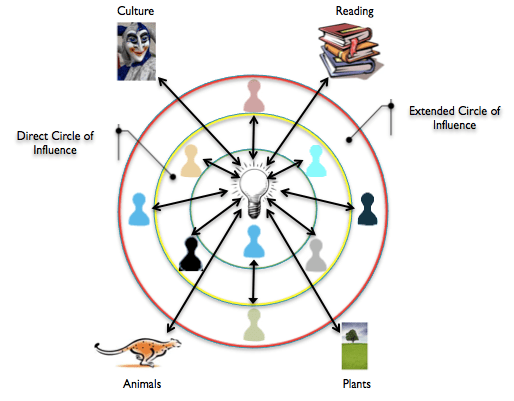
Since organizations are composed of individuals, the observations in my previous blog post can also be applied at an individual level. Basically, similar to organizations, individuals can also come up with ideas from everyone and everything around them. These ideas can be disruptive or incremental or both. Disruptive ideas can create new industries and/or significantly change existing industries (e.g., iTunes) while incremental ideas can improve upon existing products (e.g., iPhone 4, blackberry, etc.) or services (e.g., banking, consulting, etc.). Generally speaking, ideas for products, services, and management frameworks can come from various sources such as:
Talking to and sharing ideas with your direct circle of influence (e.g., family, friends, etc.).
Talking to and improving upon your ideas through your extended circle of influence (e.g., co-workers, alumni associations, professional associations, etc.).
Having experience in the areas that you are interested in by:
Reading (e.g., books, articles, newspapers, blogs). Sometimes even walking through a library or a bookstore and reading various titles can generate ideas.
Talking to people who have experience in that area.
Exploring seemingly unrelated areas to generate ideas by:
Reading a diverse genre of books.
Talking to and interacting with a diverse group of people.
Experiencing different cultures.
Observing the plant kingdom.
Observing the animal kingdom.
Stitching, applicability, and combination of the above.
Idea Generation Map for Individuals
On a personal note, some years ago, I found it very inefficient that I could use only one hand to write or use the computer mouse. This meant that every time I wanted to write something on a physical notebook I had to stop using the computer mouse and then write. So, I trained my other hand to use the mouse and have seen significant personal productivity gains. This idea came to me one day as I remembered an instance where a substitute teacher used both of his hands to write on the blackboard.


 Welcome to Khan's Blog
You must be logged in to post a comment.