5 Questions to Ask About Your Information Supply Chain

Today’s organizations fundamentally revolve around people, processes and technologies. The underlying common thread across all of these areas is the ability to communicate and manage information. Information is used to make decisions that can be either good or bad. Based on the article Bad Decisions Arise from Faulty Information, Not Faulty Brain Circuits, we can decipher that sometimes in organizations there is so much information aka “noise” that decisions either get delayed or are made without understanding holistically how that information can affect the organization. Specifically, organizations need to understand the end-to-end flow of information through an Information Supply Chain lens and then leverage that information for competitive advantage. The concept of Information Supply Chain is derived from Supply Chain Management (SCM) that focuses on the coordinated and smooth flow of products. In the Information Supply Chain, we are interested in the coordinated and smooth flow of information within and across the organizations. In order to understand and take advantage of this Information Supply Chain, organizations need to ask the following 5 questions:

  1. Where does my information reside? (hint: it is not all documented)
  2. How is my information managed across people, processes, and technologies? (hint: look at your formal and informal information governance structures)
  3. How easily does information flow from when it is first created/consumed to how it is used to help me make decisions? (hint: think beyond information systems)
  4. What information you had in the past that resulted in good and bad decisions? (hint: hindsight is 20/20 only if you replicate the successes and reduce failures)
  5. What are you doing right now to avoid information duplication and increase information flow? (hint: capturing lessons learned is an exercise in futility if you cannot decipher intelligence from those lessons for your next endeavor)

Another thing to think about is…if we turn back the pages of time, we will realize that organizations are not that much different then what has existed in the past. The only thing that continuously changes is technology. Technology does not mean Information Technology(IT) only but also any methodologies and tools that make you manage information more effectively and scale-up quickly. A case in point is paper which changed the direction of mankind and was once considered a “technology”. Information Supply Chain considerations

What’s Wrong With My Enterprise Architecture? – a response

Recently, a fellow Enterprise Architect reached out and asked my opinion on his article.  Below is my response:

• Enterprise Architecture has many definitions. Here is one that I tried to create in 160 characters. “EA bridges business and IT via enterprise integration/standardization resulting in people becoming more efficient and effective in achieving their objectives.”

• While there are many reasons behind failures of EA within organizations but as I see it, they essentially boil down to only one thing (i.e., lack of communication in understanding the true value of what EA brings to the organization). It takes effort from everyone (EA, Business and IT) in the organization to use EA for business transformation. Before anything else organizations need to decide:

  • Why they need/want EA? Here is a good video that alludes to this.
  • What quantitative and qualitative values does EA bring to the table?

• Unfortunately, EA has turned into merely an information collection activity and moved away from why this information is being collected in the first place. What is the strategic intent? In my observation, most EA is not strategic (e.g., the Federal Government’s use of EA)

• My biggest issue with EA these days is where it resides within the organization. These days EA reports to or is a part of IT and suffers the same fate as IT (e.g., reduced budgets, no executive representation, etc.). Ideally, EA should report into Chief Strategy Officer (CSO) or Chief Executive Officer (CEO) but not to the Chief Information Officer (CIO) or Chief Technology Officer (CTO).

• EA is a conceptual mindset. In my view, it is not about frameworks, modeling or programming languages. EA is about a business transformation that may or may not require IT to accomplish the transformation. Blasphemy! I know ☺

• True EA is difficult to do and it takes a long-term commitment from the organization to pursue it.

In today’s business world quickness and agility are often used as a pretext/excuse for a lot of things mostly because the people using these terms just want additional lines added to their resume before they move on. To put in an analogy, what kind of car would you like to drive? One that goes really fast but has bare minimum safety or one that has optimum safety but you might get it a month late? The short answer is, it depends. Mainly it depends on what is the end goal the organization or person is trying to achieve. The same is true for EA. Without measurable end-goals, EA just becomes a complacent black hole.

Top 5 Articles of 2013

Thank you to the readers in 72 countries that read my articles in 2013. Following are the top 5 articles that you have been interested in:

  1. 5 Observations on Being Innovative (at an individual level)
  2. 5 Observations on Being Innovation (at an organizational level)
  3. Future Considerations for Kodak
  4. 5 Factors for Business Transformation
  5. Where is My Big Data Coming From and Who Can Handle It

Following are the top 20 countries where most readers have come from:

  1. United States
  2. Canada
  3. United Kingdom
  4. India
  5. Australia
  6. France
  7. Pakistan
  8. Germany
  9. Netherlands
  10. Philippines
  11. Finland
  12. Colombia
  13. New Zealand
  14. Brazil
  15. Switzerland
  16. Singapore
  17. Saudi Arabia
  18. Italy
  19. Ireland
  20. Greece

Where is My Big Data Coming From and Who Can Handle It

Recently, a reader asked my insights on the article (Data Scientists are the New Rock Stars as Big Data Demands Big Talent).  Here is my response.

It seems like in today’s world people and organizations are somewhat struggling with this big data concept and do not know where to begin. Due to this reason, they are collecting everything they can think of in the hopes that one day they will be able to use this data in a meaningful way such as better customer experience, new products/services, better collaboration, increasing revenue, etc. This hope approach of “let’s collect data and later decide what we can use it for” on the surface might seem sound but last I checked hope is not a strategy. Perhaps this is one of the reasons that even now only <1% of the data collected is actually being analyzed. What good is more data when one cannot even make sense of the other 99%+ of data it already has? Are we chasing a ghost?

While it is true that vast amounts of data are and will be generated from financial transactions, medical records, mobile phones, and social media to the Internet of Things but there are questions that need to be asked to understand data’s meaningful use:

  1. How will data be managed?
  2. How will data be shared?

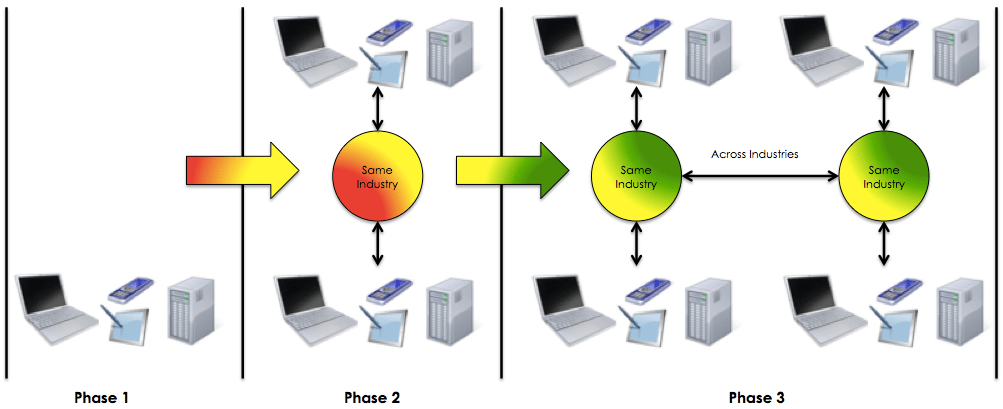
I believe that in order to come to a point where data becomes meaningful and useful it would require (broadly speaking) three phases:

  1. Establishment of standards, governance, guidelines. (E.g., open architectures)
  2. Creation of industry specific data exchanges. (E.g., healthcare data exchanges, environment data exchanges, etc.)
  3. Creation of cross-industry data exchanges. (E.g., healthcare data exchanges seamlessly interacting with environmental data exchanges, etc.)

Additionally, let’s keep this in mind that the data we are talking about is data that can be captured by current tools and systems but the data which is perhaps the most difficult to capture is unstructured human data which within organizations is called Institutional Knowledge. This does not reside in a document or a system but in the minds of the people of an organization who understand what needs to be done in order to move things forward.

So, the question becomes, do we really need Data Scientists who have a mix of coding skills with PhDs in scientific disciplines and business sense or do we need someone who is able to connect the dots and have the ability to create the future. The answer is not a simple one. Perhaps you need both. The ability to code should not be the deciding factor but rather the ability to leverage technology and data should be. I agree that there is a shortage of people with diverse talent but there is also a shortage of people who actually know how to leverage this kind of talent.

Before organizations go on a hiring spree they should consider:

  1. Why do they need a Data Scientist? (E.g., have strategic intent, jumping on the bandwagon, etc.)
  2. Who will the Data Scientist report to? (E.g., Board, CEO, CFO, COO, CIO, etc.)
  3. Does the organization have the ability to enhance/change its business model? (E.g., making customers happy, leading employees, etc.)
  4. Is the Data Scientist really an IT person with advanced skills or does s/he have advanced skills and happens to know how to leverage technology and data?
  5. How often will you measure the relevancy of the data? (E.g., key data indicators)
3 Phases of Big Data Harmonization

5 Factors for Business Transformation

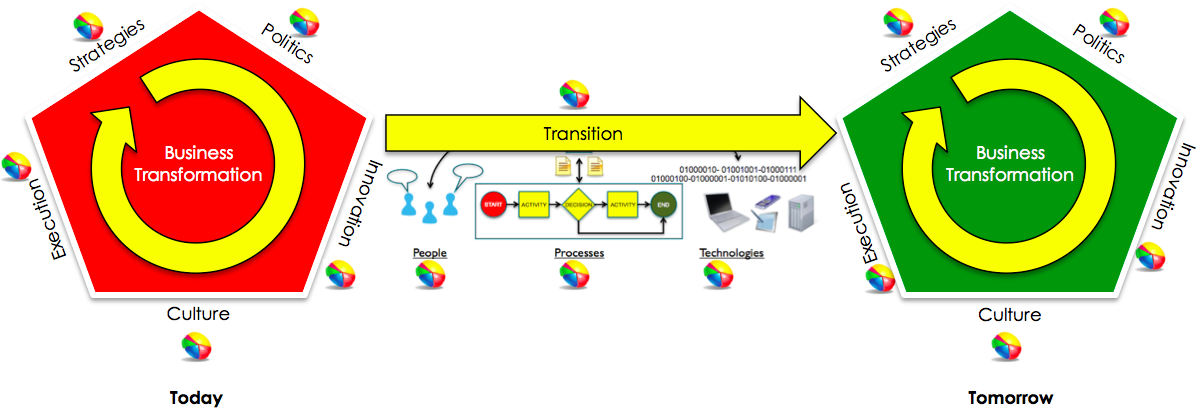
Business transformation entails assessing people, processes, and technologies of the organization in terms of the current state (where the organization is right now) and future state (where the organization wants to be). In these assessments people, processes and technologies are not standalone areas but are part of an integrated and holistic organization. If any of these areas are ignored or not given enough attention then true business transformation is just a pipe dream.

In order to have a holistic understanding of an organization and its broader role in society, there are 5 factors that need to be considered. These factors should have an inward focus and an outward focus. If the organization only has an inward focus then sooner or later it will be taken over by competitors and if the organization only has an outward focus then it will crumble under the weight of its own (mis)management. So, both are necessary. The 5 factors that will determine an organization’s success and longevity are Strategies, Politics, Innovation, Culture, and Execution or simply called The SPICE Factors. It is critical to remember that:

  1. Strategies are to be used as blueprints. They are not shelf-ware.
  2. Politics is a reality and needs to be understood.
  3. Innovation is the lifeline and not only the responsibility of the R&D department.
  4. Culture is the soul. Lip service is not culture but your actions are.
  5. Execution is evolution. Without it you become stagnant.

All of the above need to be measured constantly, managed consistently and reviewed periodically.

SPICE Factors
SPICE Factors

Below is a poll on what people think are the most important areas and factors for Business Transformation: