Author: Khan

  • 5 Questions to Ask About Software Analysis

    Software Analysis is the investigative process of scrutinizing software applications to gain insights into their behavior, performance, and structure. It involves examining code, data, and algorithms to identify potential issues, optimize performance, and ensure the software meets specified requirements. Software analysis plays a vital role in understanding, improving, and refining software solutions. This post delves into the significance of software analysis, presenting its benefits, challenges, and thought-provoking questions that intrigue developers and stakeholders alike.

    Understanding Software Analysis

    Software Analysis involves techniques like code review, static analysis, dynamic analysis, and profiling to assess the quality, efficiency, and correctness of software applications. It aims to uncover bugs, vulnerabilities, and performance bottlenecks.

    The Pros of Software Analysis

    1. Bug Detection: Software analysis identifies bugs and defects early in the development process, reducing the cost and effort of fixing issues later.
    2. Performance Optimization: Analysis helps in identifying performance bottlenecks, enabling developers to optimize software for better efficiency.
    3. Enhanced Security: Through security analysis, potential vulnerabilities can be uncovered and addressed to enhance the software’s resilience.
    4. Software Maintenance: Analysis provides valuable insights for software maintenance, ensuring the software remains reliable and up-to-date.
    5. Compliance and Standards: Software analysis validates compliance with coding standards and industry best practices.

    The Cons of Software Analysis

    1. Resource Intensive: Comprehensive software analysis may require significant time, effort, and computational resources.
    2. False Positives and Negatives: Analysis tools may generate false positives or miss certain issues, requiring human validation.
    3. Complexity of Code: Analyzing complex codebases can be challenging, making analysis efforts more intricate.
    4. Limitations of Tools: Analysis tools may have limitations in understanding certain programming languages or specific application domains.
    5. Expertise and Training: Effective software analysis requires skilled professionals with expertise in the relevant analysis techniques.

    Intriguing Questions about Software Analysis

    1. What: What are the different types of software analysis techniques, and how do they contribute to improving software quality?
    2. Who: Who are the key individuals involved in software analysis, and what roles do they play in ensuring thorough analysis?
    3. Where: Where do we see the most significant impact of software analysis – in consumer applications, critical systems, or specialized domains?
    4. When: When should organizations prioritize software analysis – during specific development phases, before release, or in response to user feedback?
    5. Why: Why is software analysis considered an essential step in the software development lifecycle, and how does it influence overall software reliability?

    Conclusion

    Software Analysis is the detective work that uncovers the secrets hidden within the code, leading to improved software quality and performance. By embracing rigorous analysis practices, developers can ensure the software is robust, secure, and efficient. While software analysis may present challenges, the benefits of delivering reliable and high-performing software far outweigh the efforts invested. Embracing continuous analysis and staying vigilant about potential issues will pave the way for software solutions that redefine technology and provide users with seamless experiences.

    Infographic: 5 Questions to Ask About Software Analysis
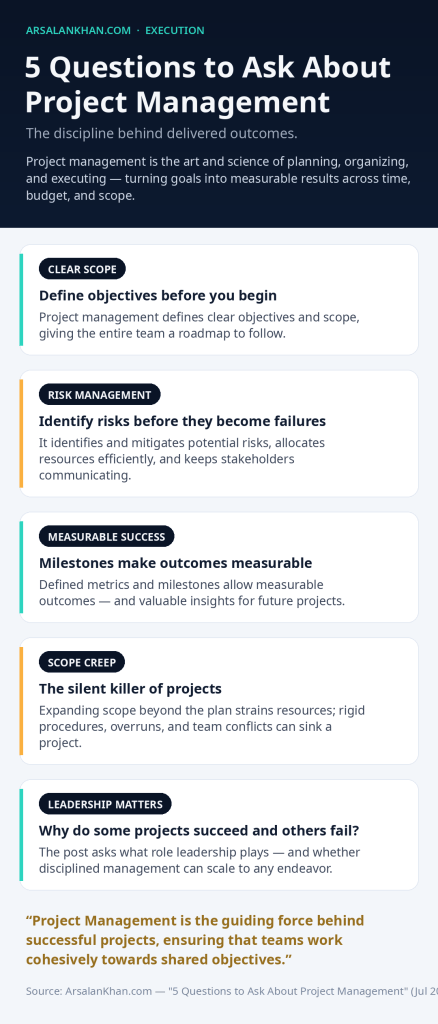
  • 5 Questions to Ask About Project Management

    Project Management is the art and science of planning, organizing, and executing projects to achieve specific goals and objectives. Whether it’s launching a new product, constructing a building, or implementing a complex IT system, project management provides a structured approach to navigate the intricacies of any endeavor. This post sheds light on the world of project management, exploring its advantages, challenges, and thought-provoking questions that arise in this dynamic field.

    Understanding Project Management

    Project Management involves the application of knowledge, skills, tools, and techniques to ensure project success. It encompasses initiating, planning, executing, controlling, and closing projects, taking into account constraints such as time, budget, scope, and resources.

    The Pros of Project Management

    1. Clear Objectives and Scope: Project Management defines clear objectives and scopes for projects, providing a roadmap for the entire team to follow.
    2. Efficient Resource Allocation: It ensures efficient allocation of resources, maximizing productivity and minimizing waste.
    3. Risk Management: Project Management identifies and mitigates potential risks, reducing the likelihood of project failures.
    4. Improved Communication: It fosters effective communication among stakeholders, ensuring everyone is on the same page throughout the project’s lifecycle.
    5. Measurable Success: With defined metrics and milestones, project management allows for measurable outcomes, providing valuable insights for future projects.

    The Cons of Project Management

    1. Resource Constraints: Limited resources may hinder project progress or lead to compromises in scope or quality.
    2. Rigid Procedures: Overemphasis on strict project management procedures may stifle creativity and flexibility.
    3. Time and Cost Overruns: Unforeseen challenges and changes may result in project delays and increased costs.
    4. Scope Creep: Expanding project scope beyond the original plan can strain resources and hinder successful completion.
    5. Human Factors: Conflicts, turnover, and skill gaps within the project team can impact project success.

    Intriguing Questions about Project Management

    1. What: What are the key project management methodologies, and how do they differ in their approach to handling projects?
    2. Who: Who are the essential stakeholders in project management, and how can their collaboration influence project outcomes?
    3. Where: Where do we see the greatest impact of project management, and how has it transformed various industries?
    4. When: When is the most appropriate time to implement project management in a project’s lifecycle, and can it be applied to any scale of endeavor?
    5. Why: Why do some projects succeed with effective project management while others fail, and what role does leadership play in project success?

    Conclusion

    Project Management is the guiding force behind successful projects, ensuring that teams work cohesively towards shared objectives. By embracing the principles of project management, organizations can navigate complexities, mitigate risks, and achieve their desired outcomes efficiently. However, it is essential to strike a balance between structure and adaptability, as each project presents unique challenges. As the landscape of business continues to evolve, project management will remain a cornerstone of success, empowering teams to deliver excellence in every endeavor they undertake.

    Infographic: 5 Questions to Ask About Project Management
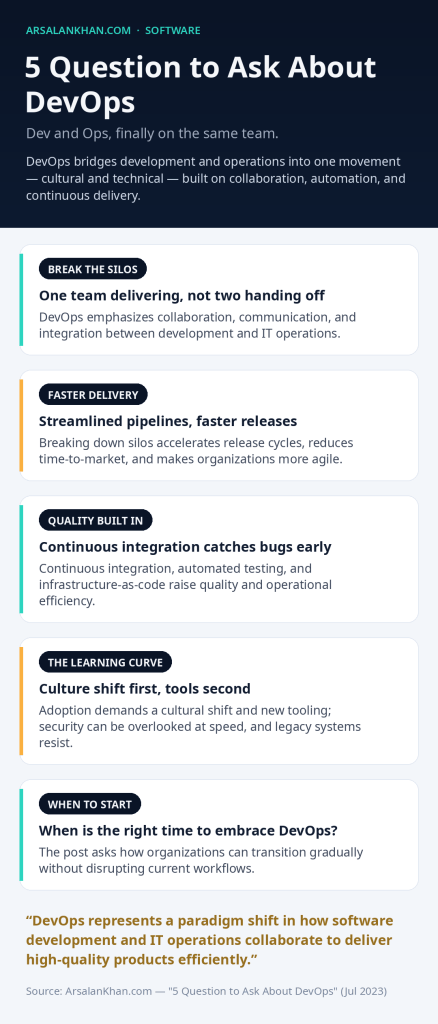
  • 5 Question to Ask About DevOps

    In the fast-paced world of software development, DevOps has emerged as a game-changing approach that bridges the gap between development and operations teams. DevOps aims to streamline and automate the software delivery process, fostering collaboration, and enabling organizations to deliver high-quality products faster. This post provides an in-depth background on DevOps, exploring its benefits, drawbacks, and intriguing questions it raises for the future of software development.

    Understanding DevOps

    DevOps is a cultural and technical movement that emphasizes collaboration, communication, and integration between software development (Dev) and IT operations (Ops). The primary objective is to enable continuous delivery, ensuring that software changes are deployed efficiently and reliably, and the development process becomes more agile and responsive.

    The Pros of DevOps

    1. Accelerated Software Delivery: By breaking down silos between development and operations teams, DevOps streamlines the software delivery pipeline, leading to faster release cycles and reduced time-to-market.
    2. Improved Collaboration and Communication: DevOps fosters a culture of collaboration and open communication, promoting shared responsibilities and a collective focus on delivering value to customers.
    3. Enhanced Product Quality: Continuous integration and automated testing in DevOps ensure a higher level of software quality, with bugs and issues detected and resolved early in the development process.
    4. Increased Operational Efficiency: Automation of manual tasks and the use of infrastructure-as-code (IaC) in DevOps lead to greater operational efficiency, reducing the risk of human errors and enabling scalable infrastructure.
    5. Greater Business Agility: DevOps enables organizations to respond quickly to market changes and customer feedback, allowing them to adapt their software offerings to meet evolving demands.

    The Cons of DevOps

    1. Learning Curve: Implementing DevOps practices requires a cultural shift and adoption of new tools and technologies, which may lead to a steep learning curve for some teams.
    2. Complexity of Automation: While automation is a key tenet of DevOps, designing and maintaining automated workflows can be complex and time-consuming.
    3. Security Concerns: The rapid pace of DevOps can sometimes lead to overlooking security aspects, necessitating a strong focus on integrating security into the development process.
    4. Legacy Systems Compatibility: Integrating DevOps practices with legacy systems and applications may pose challenges due to differences in technology and processes.
    5. Dependency on Tools: DevOps relies heavily on a range of tools for automation, monitoring, and deployment, and organizations must ensure tool compatibility and stability.

    Intriguing Questions about DevOps

    1. What: What are the key cultural barriers that organizations face when adopting DevOps, and how can they overcome resistance to change?
    2. Who: Who are the key stakeholders involved in driving successful DevOps transformations, and what roles do they play in promoting collaboration between teams?
    3. Where: Where do we see the most significant impact of DevOps in the software development lifecycle, and how does it differ across various industries?
    4. When: When is the right time for organizations to embrace DevOps, and how can they gradually transition to this approach without disrupting their current workflows?
    5. Why: Why has DevOps become an essential methodology for modern software development, and what specific pain points does it address for development and operations teams?

    Conclusion

    DevOps represents a paradigm shift in how software development and IT operations collaborate to deliver high-quality products efficiently. While it offers numerous advantages, it is crucial for organizations to address potential challenges and embrace a culture of continuous learning and improvement. As software development continues to evolve, DevOps will remain a critical enabler for organizations seeking to stay agile, innovative, and competitive in the dynamic world of technology.

    Infographic: 5 Question to Ask About DevOps
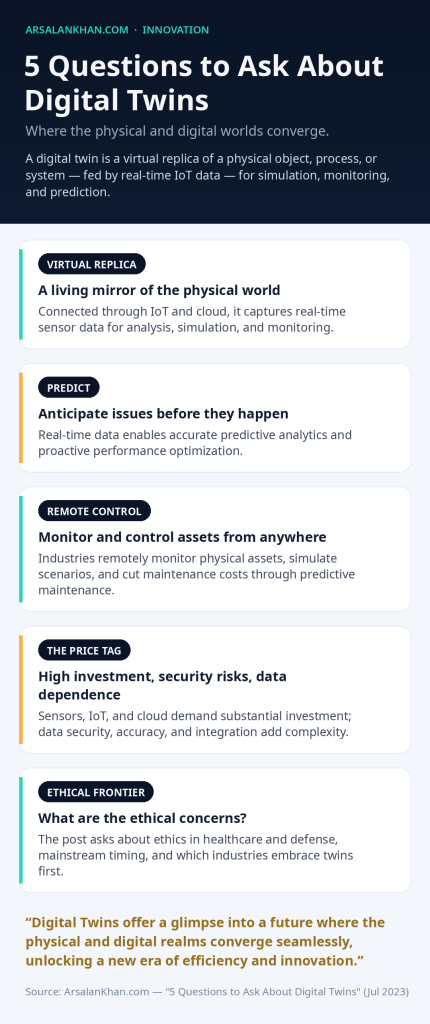
  • 5 Questions to Ask About Digital Twins

    In the realm of cutting-edge technology, the concept of Digital Twins has emerged as a revolutionary force. A Digital Twin is a virtual replica of a physical object, process, or system, integrated with real-time data and analytics. This fusion of the physical and digital worlds empowers industries to optimize operations, enhance efficiency, and make data-driven decisions. In this post, we delve into the world of Digital Twins, exploring their benefits, drawbacks, and intriguing questions they raise for the future.

    What are Digital Twins?

    A Digital Twin is a digital representation of a physical entity, connected through the Internet of Things (IoT) and cloud computing. It mirrors its real-world counterpart, capturing real-time data from sensors and devices, allowing for analysis, simulation, and monitoring in a virtual environment.

    The Pros of Digital Twins

    1. Enhanced Predictive Capabilities: By leveraging real-time data, Digital Twins enable accurate predictive analytics, helping anticipate potential issues and optimize performance proactively.
    2. Improved Efficiency and Productivity: Digital Twins empower industries to optimize processes, reduce downtime, and enhance productivity by simulating various scenarios and identifying optimal solutions.
    3. Remote Monitoring and Control: Industries can remotely monitor and control physical assets through their Digital Twins, saving time and resources while enabling better decision-making.
    4. Reduced Maintenance Costs: Predictive maintenance facilitated by Digital Twins minimizes unplanned downtime and reduces maintenance costs by addressing issues before they escalate.
    5. Accelerated Innovation and Design: Digital Twins allow for rapid prototyping and testing of new products and processes, leading to faster innovation cycles and improved product development.

    The Cons of Digital Twins

    1. Data Security and Privacy Risks: The integration of real-time data from physical assets raises concerns about data security and privacy, necessitating robust safeguards.
    2. High Initial Investment: Establishing a Digital Twin infrastructure can be costly, requiring substantial investments in sensors, IoT devices, and cloud computing resources.
    3. Dependency on Accurate Data: The accuracy and reliability of Digital Twins heavily rely on the quality of data collected from physical assets; inaccurate data can lead to flawed outcomes.
    4. Complex Integration Challenges: Integrating Digital Twins with existing systems and legacy infrastructure can be complex and require careful planning and execution.
    5. Limited Applicability: While Digital Twins have a wide range of applications, not all industries or processes may benefit equally from their implementation.

    Intriguing Questions about Digital Twins

    1. What: What are the potential ethical concerns surrounding the use of Digital Twins, especially in sensitive areas like healthcare and defense?
    2. Who: Who are the key players in driving the adoption of Digital Twins across industries, and what challenges do they face in implementing this technology?
    3. Where: Where do we see the greatest impact of Digital Twins in the future? Will they revolutionize entire industries or remain limited to specific applications?
    4. When: When can we expect Digital Twins to become mainstream, and how will this technology evolve in the coming years?
    5. Why: Why do some industries embrace Digital Twins more readily than others, and what are the cultural and organizational factors influencing their adoption?

    Conclusion

    Digital Twins offer a glimpse into a future where the physical and digital realms converge seamlessly, unlocking a new era of efficiency and innovation. While they hold immense potential to revolutionize industries, addressing their drawbacks and ethical implications will be essential. As we navigate this exciting technological frontier, it is crucial to approach Digital Twins with a balanced perspective, recognizing both their transformative power and the responsibility that comes with their implementation.

    Infographic: 5 Questions to Ask About Digital Twins
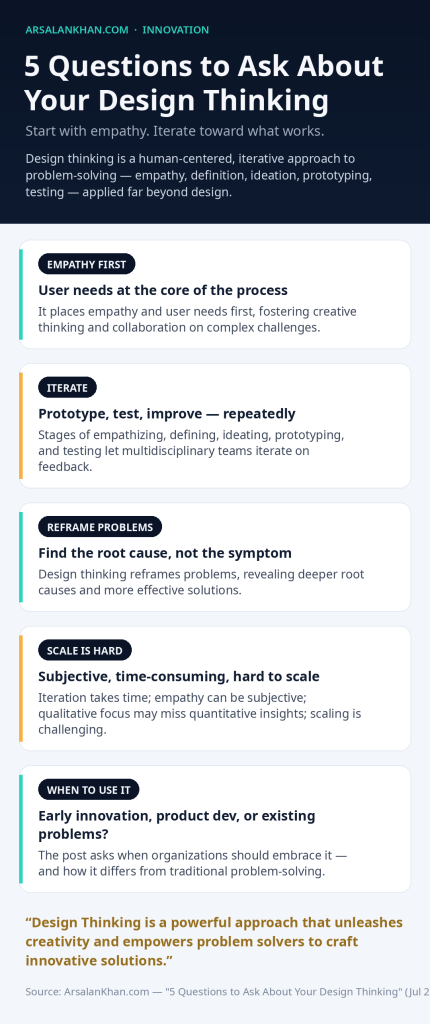
  • 5 Questions to Ask About Your Design Thinking

    Design Thinking is a human-centered and iterative approach to problem-solving and innovation. It places empathy and user needs at the core of the process, fostering creative thinking and collaboration to address complex challenges. Design Thinking is not limited to the field of design; it has found applications across industries, from product development to business strategy. This post explores the significance of Design Thinking, presenting its advantages, challenges, and thought-provoking questions that intrigue problem solvers and innovators alike.

    Understanding Design Thinking

    Design Thinking involves a series of stages, including empathizing with users, defining problems, ideating solutions, prototyping, and testing. It encourages multidisciplinary teams to work together, iterating solutions based on feedback and insights.

    The Pros of Design Thinking

    1. User-Centric Solutions: Design Thinking prioritizes user needs, leading to products and services that genuinely meet customer requirements.
    2. Creativity and Innovation: The approach fosters creative thinking and novel solutions to complex problems.
    3. Iterative and Adaptive: Design Thinking allows for continuous improvement and adaptability through iterative cycles.
    4. Collaborative Teamwork: It encourages collaboration and diverse perspectives, enhancing teamwork and creativity.
    5. Problem Framing: Design Thinking helps in reframing problems, leading to a deeper understanding of root causes and effective solutions.

    The Cons of Design Thinking

    1. Time-Consuming: The iterative nature of Design Thinking can be time-consuming, especially in time-sensitive projects.
    2. Subjectivity: The reliance on empathy and user perspectives may lead to subjective interpretations and solutions.
    3. Resistance to Change: Some organizations may face resistance when implementing Design Thinking, requiring a cultural shift.
    4. Lack of Data-Driven Insights: Design Thinking may rely on qualitative data, potentially overlooking valuable quantitative insights.
    5. Challenge of Scale: Scaling Design Thinking across large organizations or complex projects can be challenging.

    Intriguing Questions about Design Thinking

    1. What: What are the core principles and methodologies that underpin Design Thinking, and how can they be applied to diverse problem domains?
    2. Who: Who are the key individuals involved in Design Thinking, and what roles do they play in the creative process?
    3. Where: Where do we see the most significant impact of Design Thinking – in product design, service innovation, or social problem-solving?
    4. When: When should organizations embrace Design Thinking – at the early stages of innovation, during product development, or for addressing existing challenges?
    5. Why: Why has Design Thinking gained prominence as a problem-solving approach, and how does it differ from traditional methods?

    Conclusion

    Design Thinking is a powerful approach that unleashes creativity and empowers problem solvers to craft innovative solutions. By adopting a user-centric and iterative mindset, organizations can address complex challenges effectively and create meaningful experiences for their users. While Design Thinking may present challenges, the benefits of fostering innovation, collaboration, and empathy far outweigh the efforts invested. Embracing Design Thinking will pave the way for transformative solutions that redefine industries and positively impact the lives of users worldwide.

    Infographic: 5 Questions to Ask About Your Design Thinking