I'll say the quiet part out loud: your reskilling program is theater. And everyone — the employees clicking through modules at double speed, the managers quietly denying anyone time to learn, the executives presenting the completion stats — everyone knows.
Look at what gets measured. Course enrollments. Hours logged. Badges issued. Certificates downloaded. Every dashboard is green, every quarterly review applauds the "investment in our people" — and the skills gap sits exactly where it was last year, untouched. If the goal were new capabilities, someone would have noticed by now that nobody can do anything they couldn't do before the program started.
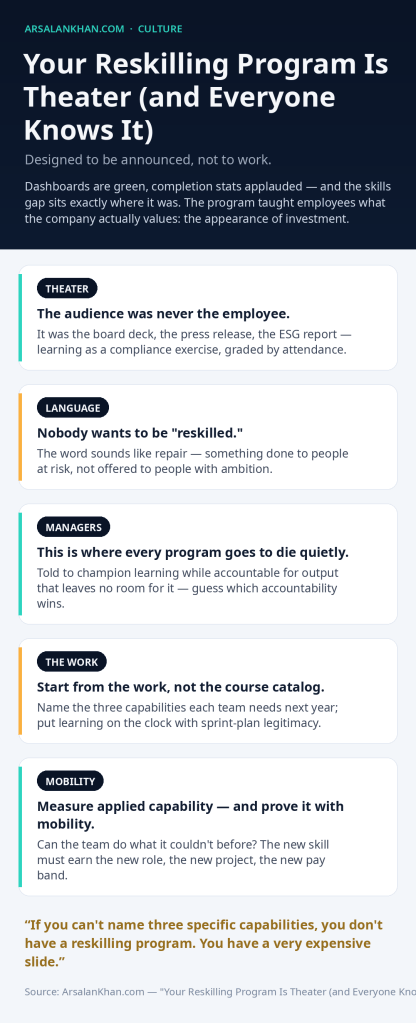
Theater needs an audience, and the audience was never the employee. It was the board deck, the press release, the ESG report. The program was designed to be announced, not to work.
That's the Culture problem, and it's the deeper of the two. A reskilling program teaches your people something — just not what's in the curriculum. It teaches them what the company actually values: the appearance of investment over the investment itself. It teaches them that learning is a compliance exercise, something done to you on a deadline and graded by attendance. And it teaches them the quietest lesson of all: that the organization would rather fund the illusion of growth than do the uncomfortable work of changing how work gets done.
There's a second cultural poison in the framing itself. Nobody wants to be "reskilled." The word sounds like repair — you're broken, we'll fix you, then put you back on the shelf. It's something done to people at risk, not something offered to people with ambition. So the employees who most need to grow avoid it, the ones who show up are the already-motivated, and HR reports record enrollment as if it meant engagement.
And then there's the manager layer, where every reskilling program goes to die quietly. The manager is told to champion learning while being held accountable for output that leaves no room for it. Guess which accountability wins. The employee who blocks two hours for a lab gets the look. The one who finishes the course goes back to the same job, the same metrics, the same manager who never once asked what they learned. Everyone's watching, and everyone absorbs the real lesson: growth is a hobby you're permitted on your own time.
Execution is where the theater becomes visible — because real reskilling looks nothing like a catalog.
Real starts from the work, not the course library. Name the three capabilities each team will actually need next year — the ones tied to where the business is going, not where the LMS vendor's content happens to be. Build the learning around those. Put it on the clock, in the sprint plan, with the same legitimacy as a customer deliverable. Make the manager accountable for the team's growth the way they're accountable for the team's output — same review, same weight.
Then measure the thing that matters: applied capability. Can the team now do the thing it couldn't do before? Not "did they finish the module" — can they do the work. I've never seen a completion-rate dashboard close a skills gap. And close the loop visibly: the person who builds the new skill gets the new role, the new project, the new pay band. Mobility is the proof. Right now the loop runs in reverse — learn on your own time, return to the same desk — and then leadership wonders why the ambitious ones leave for the competitor who will actually use what they learned.
None of this is complicated. It's just uncomfortable, because it moves reskilling out of HR's budget line and into the operating model — into managers' calendars, into promotion decisions, into what gets rewarded on Monday morning. Theater is cheaper. Theater doesn't require a single executive to change anything about how their organization actually runs.
So here's the honest audit, and it takes about ten minutes. Pull up your reskilling dashboard. Now answer: what can your people do today that they couldn't do before the program existed? If you can't name three specific capabilities, you don't have a reskilling program.
You have a very expensive slide.


Leave a Reply