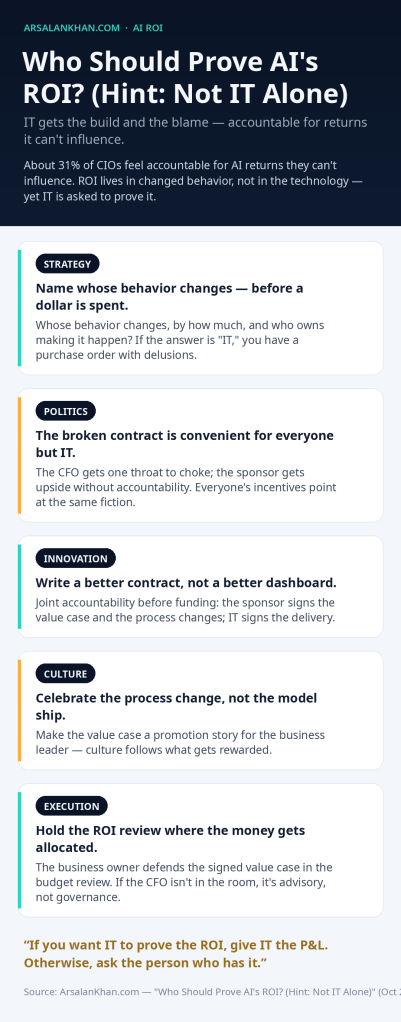
The CFO wants ROI. The business unit wants the capability. And IT gets handed both the build and the blame. About 31% of CIOs say they feel accountable for returns they can't influence — and that number should embarrass everyone who isn't in IT, because it describes a broken contract, not a failed function.
Think about what we're actually asking. IT is told to prove the financial return of a transformation it doesn't control. The business unit owns the process, the people, the incentives, and the decision rights — IT owns the model. When the process doesn't change, the model can't produce returns. And then the CIO gets the question: "Where's the ROI?" As if the algorithm were supposed to reorganize the department on its own.
Notice the asymmetry: when the transformation works, the business unit led it. When it doesn't, IT picked the wrong tool. The CIO gets accountability in both directions and authority in neither — responsible for the outcome, powerless over the inputs. No other executive would accept that deal. CIOs accept it every budget cycle.
This is accountability without authority — the oldest trap in organizational life — and we've rebuilt it around AI with a straight face.
Run it through SPICE:
Strategy. ROI doesn't live in the technology; it lives in the changed behavior the technology enables. A model that predicts churn produces zero return until someone changes how retention is worked. A document agent saves zero hours until the approval chain is actually shortened. Strategy means naming, before a dollar is spent, whose behavior changes, by how much, and who owns making that change happen. If the answer to "who owns the change" is "IT," you don't have a strategy. You have a purchase order with delusions.
Politics. Here's why the broken contract persists: it's convenient for everyone except the CIO. The CFO gets a single throat to choke — one budget line, one accountable executive, clean governance theater. The business sponsor gets the upside of the capability with none of the accountability for the outcome; if it works, they led the transformation, and if it doesn't, IT picked the wrong tool. And the CIO accepts the deal because refusing it looks like dodging accountability. Everyone's incentives point at the same fiction: that returns are a property of the technology rather than a property of the organization using it.
Innovation. The genuinely innovative move here isn't a better dashboard — it's a better contract. Joint accountability, written before funding: the business sponsor signs the value case and the specific process changes they commit to, and IT signs the capability delivery. No signed value case, no build. The signature matters more than the spreadsheet, because it converts a vague hope into a named human being with something at stake. Organizations that do this discover something uncomfortable: half their AI backlog evaporates, because nobody will sign for it. That's not a loss. That's the filter working.
Culture. Watch what gets celebrated. In most companies, IT gets praised for shipping the model and blamed for the missing returns — celebrated for the part it controls, punished for the part it doesn't. Flip it: celebrate the business leader who changed their process and can show the number. Make the value case a promotion story, not an IT metric. Culture follows what gets rewarded, and right now we're rewarding IT for building things and business units for watching.
Execution. So here's the machinery. IT measures what's technical: adoption, reliability, latency, usage. The business owner measures what's economic: cycle time, cost per transaction, revenue per head — the numbers that actually appear in the P&L. The two meet in a quarterly review where the business sponsor defends the value case they signed, not the CIO defending a model they built. One more mechanical detail: put that review on the same calendar as the budget review, with the same audience. If the ROI conversation happens in a side meeting with no CFO in the room, it's advisory. If it happens where the money gets allocated, it's governance. And the CFO? Stop accepting ROI reports from IT alone. Demand them from the business owner, and watch how quickly the numbers get honest — nothing sharpens a value case like having to sign it.
Today, we ask the people who build the capability to prove the return, then act surprised when the proof is thin. Tomorrow belongs to the organizations that put the measurement where the ownership is: with the business leader whose process, people, and P&L actually changed.
If you want IT to prove the ROI, give IT the P&L. Otherwise, ask the person who has it.


Leave a Reply