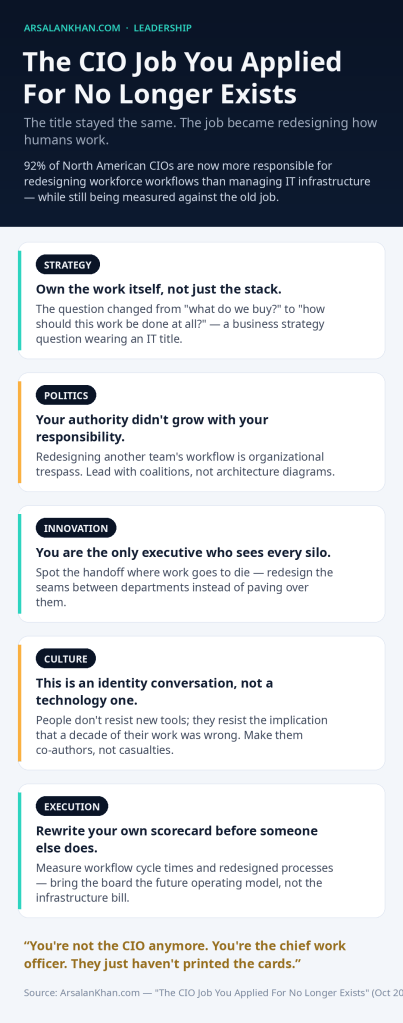
You applied for a job running technology. You got a job redesigning how humans work. Nobody sent the memo — the title stayed the same, the org chart stayed the same — but somewhere along the way, 92% of North American CIOs became more responsible for redesigning workforce workflows than for managing IT infrastructure. Read that number again: the job is no longer the job.
This isn't a promotion. It's a quiet rewrite of the contract, and most CIOs are still being measured against the old one. The board still asks about uptime, cost per ticket, and project delivery dates — the vital signs of a job that barely exists anymore — while the actual work on your calendar is transformation: which roles change, which processes get rebuilt, which parts of the organization learn to work with machines instead of around them.
Run it through SPICE:
Strategy. You used to own the stack. Now you own the work itself — how it's done, by whom, with what. The strategy question changed from "what do we buy?" to "how should this work be done at all?" That's a business strategy question wearing an IT title. The CIOs thriving in this shift stopped presenting technology roadmaps and started presenting work redesigns: here's the process today, here's who does what, here's what changes when agents take the repetitive half. The laggards are still presenting server refresh cycles to a board that stopped caring three years ago.
Politics. Here's the trap: your authority didn't grow with your responsibility. You are now accountable for how the sales team, the finance team, and the operations team do their jobs — but you don't run any of those teams. Redesigning someone else's workflow is an act of organizational trespass, and every peer executive knows it. The CIOs who survive this don't lead with architecture diagrams. They lead with coalitions — a business sponsor who owns the outcome, a shared definition of done, and the explicit backing to tell a VP that their twenty-year-old process is the problem. Without that, you're just the person with opinions about other people's departments.
Innovation. The irony is that the CIO is the only executive who sees across every silo. Finance sees finance. Operations sees operations. You see the whole workflow end to end, which makes you the only person in the building who can spot the handoff where work goes to die. That vantage point is the actual job now — not the infrastructure underneath it. The innovation isn't the agent or the model. It's finally having someone whose remit covers the seams between departments, redesigning the seams instead of paving over them.
Culture. And this is the part the job description will never capture: redesigning workflows means telling people their jobs change. That's not a technology conversation; it's an identity conversation. People don't resist new tools — they resist the implication that the way they've worked for a decade was wrong. The fear is rational, by the way. Every efficiency drive in corporate history ended with layoffs, and your people have excellent memories. You don't overcome that with a new org chart. You overcome it by making the redesigned work visibly better than the old work — not just cheaper. The CIO's new core skill isn't architecture. It's the ability to walk into a room of people who are afraid and leave them feeling like co-authors instead of casualties. No certification teaches that. No vendor sells it.
Execution. So stop defending the IT budget and start designing the work. Rewrite your own scorecard before someone else does: measure workflow cycle times, adoption of new ways of working, the percentage of processes redesigned versus merely digitized. And rewrite the relationship with your peers while you're at it — you can't redesign someone's workflow as a service provider, with "the business" ordering from "IT" like a restaurant. The new job requires a seat at the strategy table, not a ticket queue. Bring the board a picture of the future operating model, not the infrastructure bill. And have the explicit conversation with your CEO about the gap between what you're measured on and what you're actually doing — because that gap is where CIO careers go to stall.
Today, the title on your door still says technology while the work on your calendar says transformation. Tomorrow, the CIOs who named the shift out loud — who stopped pretending the old job still exists — will be the ones writing the new job description. Everyone else will be managed against a role that's already gone.
You're not the CIO anymore. You're the chief work officer. They just haven't printed the cards.


Leave a Reply