
5 Questions To Ask About Cloud

Gartner describes Cloud (Computing) as “a style of computing in which scalable and elastic IT-enabled capabilities are delivered as a service using Internet technologies.” While the National Institute of Standards and Technology (NIST), defines Cloud Computing as “a model for enabling ubiquitous, convenient, on-demand network access to a shared pool of configurable computing resources (e.g., networks, servers, storage, applications, and services) that can be rapidly provisioned and released with minimal management effort or service provider interaction.”

In layman terms, Cloud (computing) is a way for people to use hardware, software, and data through the Internet.

Basically, what this means is that instead of using their own devices (e.g., computers, mobile devices, etc.), we use our own device to access a cloud provider’s services. Some examples of cloud computing services used by consumers include Gmail, Facebook, and Amazon, etc. For organizations, ‘going to the Cloud’ can mean different things depending upon the business models and the main objectives to be achieved.

Within an organization, the Information Technology (IT) is responsible for all technology-related hardware, software, data, services, and security across all departments (e.g., accounting, administration, business development, customer service, finance, human resources, management, manufacturing, marketing, operations, production, R&D, sales, etc.) This is a huge undertaking especially when we consider that different departments within an organization can have different needs and those needs change can change rapidly based on consumer behaviors, market conditions, regulatory requirements, and other changes. This implies that rapid changes require organizations to move fast and adapt. This is where the IT department can help or become an obstacle.

The IT department responds to changing organizational needs by gathering relevant requirements from other departments to develop IT systems. These IT systems can be custom-built or bought from technology vendors or a combination. The hosting, development, maintenance, and update of these IT systems typically become the responsibility of the IT department. The speed at which these IT systems are deployed and respond can have a direct effect on the organization. For example, an IT system that is only capable of handling 2000 simultaneous users will crash if 30,000 simultaneous users accessed it. What to do? This is one example among many where Cloud Computing shines.

Generally speaking, cloud services provided by cloud service providers can be stacked into Infrastructure-as-a-Service (IaaS), Platform-as-a-Service (PaaS), and Software-as-a-Service (SaaS). Additionally, Cloud can be private – where it is hosted on an organization’s data center, public – where it is hosted on a cloud vendor’s data center or hybrid.

To begin your Cloud journey, here are some questions to ask:


Today Tomorrow
Who is going to use Cloud services? Who should be using Cloud services?
What organizational departments provide the Cloud requirements? What organizational departments should provide the Cloud requirements?
Where is the biggest Return on Investment (ROI) when it comes to going to the Cloud? Where should be the biggest Return on Investment (ROI) when it comes to going to the Cloud?
When are organizational weaknesses identified? When should organizational weaknesses be identified?
Why is the Cloud for you? Why should the Cloud be for you?

If the organization is going to the Cloud to provide software (cloud) services to consumers then some of the things they have to figure out how to make them easy to use and always available. If the organization is going to the Cloud to improve IT operations then they have to identify efficiencies, be specific in terms of time and costs, figure out vendor lockdowns, and data hosting considerations. Sometimes organizations want to tackle both the internal improvements and consumer-focused services which can add more complexity to what going to the Cloud could mean for them. In certain respects, Cloud computing is about being efficient but it is more about being flexible enough to respond to changes quickly.

To be clear, going to the Cloud is not for every organization but if proper due diligence is done then it is beneficial for most organizations.


5 Questions To Ask About Data Collection

Data, data, data. Every organization today, is collecting data in one way or another. Due to the declining cost of data storage, data collection has become an obsession for most organizations. This data can come from employees, customers, suppliers, governments and many other sources. The basic premise behind collecting all this data is that it can be used to make informed decisions. But is it?

Informed decision-making should be based on sound data which requires data to be collected in a way that does not portray a false landscape. In other words, if the way data collection methodology is incorrect then the decisions made on that data will also be incorrect. Whenever we do data collection, there are a couple of things we should consider:

  1. Is the data coming from a primary source or a secondary source?
  2. Is the data coming from an individual or an organization?
  3. Is the data coming from conducting a survey?
  4. Is the data coming from conducting a study?
  5. Is the data coming from ongoing business activities?

Sometimes comprehensive data collection is time-consuming, costly, cumbersome and impractical. Considering these restrictions, we have to collect sample data and have to be cognizant that if this data can or can’t be generalized for decision-making. The wrong generalization of data from a small data sample can result in errors that might not be evident to the people who are making decisions on this data. 

Let’s assume that you have been given the task of collecting data that can help the organization in Business-IT Alignment. For this, you conduct a survey in your organization to get a feel of what is going on. Your goal is to collect all this survey data, make sense of it and present it to the executives so they can make decisions.  Here are the steps you take:

Step 1: Create a survey to collect data

Step 2: Reach out to relevant respondents

Step 3: Understand what the data is saying

On the surface, the above steps sound good. But here are the problems with each of them. 

In step 1, when you are creating the survey, you can run into issues when:

  • You ask leading questions that direct the survey into a certain direction
  • The tone and mannerism of the survey/surveyor can make respondents uncomfortable
  • A standard question across various respondents can be easily compared but based on the context the answer may differ drastically

In step 2, who you think the respondents are can affect the survey when:

  • You only ask a subset of the respondents but you are unaware it was the wrong subset
  • Respondents provide no answers
  • Respondents don’t have access to the survey
  • Respondents provide false information

In step 3, your tallying and interpreting the data can have issues when:

  • Your personal biases (we all have them) influence your interpretation
  • Others’ personal biases influence your interpretation

As you can see from the above errors, you have to be careful in data collection so it reveals the truth rather than a skewed version of a hypothetical scenario. The basics start by asking the following questions even before you start creating the survey for data collection:

Today Tomorrow

Who is going to respond?

IT (Help Desk, Software Developers, Management, Database Developers, Network Support, Cybersecurity, etc.) 

vs.

Business (Accounting, Sales & Marketing, Finance, HR, Operations, Management, Customer Service, etc.) 

Who should respond?

IT (Help Desk, Software Developers, Management, Database Developers, Network Support, Cybersecurity, etc.)

vs.

Business (Accounting, Sales & Marketing, Finance, HR, Operations, Management, Customer Service, etc.) 

What areas are covered?

Person-to-person interaction

vs.

Organization-wide capabilities

What areas should be covered?

Person-to-person interaction

vs.

Organization-wide capabilities

Where do you think is the organizational misalignment?

Offline

vs.

Online

Where should be the organizational misalignment?

Offline

vs.

Online

When did organizational-misalignment appear and reported?When should organizational-misalignment be identified and reported?
Why is the data being collected?Why should the data be collected?


5 Questions To Ask About Business Continuity

Business Continuity is the idea that your organizations’ should be able to continue operations even after potential and/or direct threats. These threats can be internal and/or external. Some examples of internal threats include theft, sabotage, espionage, and IT-outage. Some examples of external threats include weather-related, vendor-dependent, health crisis, supply chain disruptions, and cybersecurity. The most important thing for any organization is its employees and its customers. Thus, organizations should be able to be well-equipped to make timely decisions with optimized business processes and relevant data that helps its employees and its customers.

In order to continue operations in difficult circumstances, organizations need to create a Business Continuity Plan (BCP) which addresses how people, processes, products, services, and technologies can be applied efficiently and effectively for the entire organization. The BCP should be created with support from all stakeholders especially employees who are in the frontlines dealing directly with customers and/or their work directly affects customers. The BCP should be a holistic document whose purpose is not only to identify risks, critical processes, and critical data but also to provide solutions to what should be done in case something happens. Most importantly, the BCP is an organization’s self-awareness document that should always be tested and updated to represent reality.

Depending upon your organization’s industry, size, culture, and technological capabilities, Business Continuity would be different from other organizations. However, Business Continuity would be similar for most organizations when it comes to payroll systems, financial systems, accounting systems, technology infrastructure systems and the ability for the employees to work remotely.  Now that we have a good understanding of what is Business Continuity, let’s keep the following questions whenever you are creating/analyzing, testing and implementing Business Continuity for your operations:
Today Tomorrow
Who is involved in creating the BCP? Who should be involved in creating the BCP?
What areas are critical for BCP? What areas should be critical for BCP?
Where does the data reside for BCP? Where should the data reside for BCP?
When is BCP tested and updated? When should BCP be tested and updated?
Why BCP is helping your organization? Why BCP should help your organization?

5 Questions To Ask About Business Intelligence (BI)

According to The Data Warehousing Institute (TDWI)‘s The Rise of Analytic Applications: Build or Buy?, Business Intelligence (BI) is the process, technologies, and tools needed to turn data into information, information into knowledge, and knowledge into plans that drive profitable business actions. BI encompasses data warehousing, business analytics tools, and content/knowledge management. In other words, Business Intelligence is the right mix of business operations and technology implementation that provides data to make effective decisions. By no means, BI is an IT-only or a business-only project.

BI is about capturing the data, interpreting the data and using the data to improve the organization. This BI data can come from internal sources such as accounting, customer service, finance, human resources, information technology, marketing, operations, and sales departments. This BI data can also come from external sources such as customers, vendors, partners, and governments. When your organization collects data from internal and external sources then this is the first step in understanding what data is used across the organization. Due to the siloed nature of most organizations, you would quickly find out that certain types of data is redundant and captured multiple times by humans (which is prone to errors) and by systems (which is prone to duplication).

Let’s say that you now have a better understanding and appreciation of how various types of data flows in your organization and which departments/teams use which data. The next step is to figure out which data is used for regulatory, compliance, legal, decision-making and is just nice-to-have. From this, you can also figure out which data is used more than once or should be used at least once across the organization. This will give you a good sense of which data is really relevant for improving the organization.

With all the information that you have gained, you have to now figure out ‘who’ will have access to this information and ‘how’. To figure out ‘who’, this will be a discussion with various organizational departments, top organizational executives and frontline employees. To figure out ‘how’, this will be a discussion with the IT department if they have the budget to build and maintain a system that can capture data from various sources or if they have the budget to buy and maintain a system that can capture data from various sources to make ad-hoc or canned reports through a dashboard and what models (forecasting, predictive, prescriptive and optimization) can be used. At the end of the day, BI is about providing data to the people who need it the most to carry on and improve their tasks.

By now, you have a better understanding that standing up a BI system is a holistic endeavor that requires cooperation and collaboration from all parts of the organization and even beyond the organizational boundaries. To keep the idea of organizational improvements at the front, always ask the following questions:

Today Tomorrow
Who is going to use the BI system?Who should use the BI system? 
What data is relevant to the BI system?What should be relevant to the BI system? 
Where does the data reside for the BI system?Where should the data reside for the BI system? 
When does the BI system update its data? realtime vs. scheduledWhen should the BI system update its data? realtime vs. scheduled 
Why is the BI system important for your organization?Why should the BI system be important for your organization? 

5 Questions To Ask About Digital Government

Today, we use Information and Communications Technology (ICT) in every aspect of our lives and in the future this use will only increase. Governments around the world are slowly but surely realizing this and are trying to take advantage of ICT. The use of ICT by governments to provide efficient and effective services at the Federal, State and Local levels is called Digital Government (or Electronic Government or e-gov). Broadly speaking, Digital Government revolves around improving interactions between Government-to-Government (G2G), Government-to-Business (G2B), Government-to-Citizen (G2C) and Government-to-Employee (G2E).

Interactions between Government-to-Government (G2G) can include but not limited to:

  • Federal Department(s)/Agencies with Federal Department(s)/Agencies
  • Federal Department(s)/Agencies with State Department(s)/Agencies
  • Federal Department(s)/Agencies with Local Department(s)/Agencies
  • State Department(s)/Agencies with Local Department(s)/Agencies
  • Federal Department(s)/Agencies with Federal Lawmakers
  • Federal Department(s)/Agencies with State Lawmakers
  • Federal Department(s)/Agencies with Local Lawmakers
  • State Department(s)/Agencies with Local Lawmakers
  • Federal Lawmakers with Federal Lawmakers
  • Federal Lawmakers with State Lawmakers
  • Federal Lawmakers with Local Lawmakers
  • State Lawmakers with Local Lawmakers
  • Federal Department(s)/Agencies with Federal Judiciary
  • Federal Department(s)/Agencies with State Judiciary
  • Federal Department(s)/Agencies with Local Judiciary
  • Federal Judiciary with Federal Judiciary
  • Federal Judiciary with State Judiciary
  • Federal Judiciary with Local Judiciary
  • State Judiciary with Local Judiciary
  • Military with Military
  • Military with International Military
  • Federal Department(s)/Agencies with Military
  • State Department(s)/Agencies with Military
  • Local Department(s)/Agencies with Military
  • Intelligence Department(s)/Agencies with Military
  • Intelligence Department(s)/Agencies with International Military
  • Intelligence Department(s)/Agencies with Intelligence Department(s)/Agencies
  • Intelligence Department(s)/Agencies with International Intelligence Department(s)/Agencies
  • Federal Department(s)/Agencies with Intelligence Department(s)/Agencies
  • State Department(s)/Agencies with Intelligence Department(s)/Agencies
  • Local Department(s)/Agecnies with Intelligence Department(s)/Agencies
  • Military with Intelligence Department(s)/Agencies
  • Federal Department(s)/Agencies with International Organizations
  • Federal Department(s)/Agencies with International Governments

Interactions between Government-to-Business (G2B) can include but not limited to:

  • Federal Department(s)/Agencies with Government-Owned Organizations
  • Federal Department(s)/Agencies with For-Profit Organizations
  • Federal Department(s)/Agencies with International For-Profit Organizations
  • Federal Department(s)/Agencies with Non-Profit Organizations
  • Federal Department(s)/Agencies with International Non-Profit Organizations
  • State Department(s)/Agencies with Government-Owned Organizations
  • State Department(s)/Agencies with For-Profit Organizations
  • State Department(s)/Agencies with International For-Profit Organizations
  • State Department(s)/Agencies with Non-Profit Organizations
  • State Department(s)/Agencies with International Non-Profit Organizations
  • Local Department(s)/Agencies with Government-Owned Organizations
  • Local Department(s)/Agencies with For-Profit Organizations
  • Local Department(s)/Agencies with International For-Profit Organizations
  • Local Department(s)/Agencies with Non-Profit Organizations
  • Local Department(s)/Agencies with International Non-Profit Organizations
  • Federal Lawmakers with Government-Owned Organizations
  • Federal Lawmakers with For-Profit Organizations
  • Federal Lawmakers with International For-Profit Organizations
  • Federal Lawmakers with Non-Profit Organizations
  • Federal Lawmakers with International Non-Profit Organizations
  • State Lawmakers with Government-Owned Organizations
  • State Lawmakers with For-Profit Organizations
  • State Lawmakers with International For-Profit Organizations
  • State Lawmakers with Non-Profit Organizations
  • State Lawmakers with International Non-Profit Organizations
  • Local Lawmakers with Government-Owned Organizations
  • Local Lawmakers with For-Profit Organizations
  • Local Lawmakers with International For-Profit Organizations
  • Local Lawmakers with Non-Profit Organizations
  • Local Lawmakers with International Non-Profit Organizations
  • Federal Judiciary with Government-Owned Organizations
  • Federal Judiciary with For-Profit Organizations
  • Federal Judiciary with International For-Profit Organizations
  • Federal Judiciary with Non-Profit Organizations
  • Federal Judiciary with International Non-Profit Organizations
  • State Judiciary with Government-Owned Organizations
  • State Judiciary with For-Profit Organizations
  • State Judiciary with International For-Profit Organizations
  • State Judiciary with Non-Profit Organizations
  • State Judiciary with International Non-Profit Organizations
  • Local Judiciary with Government-Owned Organizations
  • Local Judiciary with For-Profit Organizations
  • Local Judiciary with International For-Profit Organizations
  • Local Judiciary with Non-Profit Organizations
  • Local Judiciary with International Non-Profit Organizations

Interactions between Government-to-Citizens (G2C) can include but not limited to:

  • Federal Department(s)/Agencies with Citizens inside the Country
  • Federal Department(s)/Agencies with Citizens outside the Country
  • State Department(s)/Agencies with Citizens inside the Country
  • State Department(s)/Agencies with Citizens outside the Country
  • Local Department(s)/Agencies with Citizens inside the Country
  • Local Department(s)/Agencies with Citizens outside the Country
  • Federal Lawmakers with Citizens inside the Country
  • Federal Lawmakers with Citizens outside the Country
  • State Lawmakers with Citizens inside the Country
  • Local Lawmakers with Citizens inside the Country
  • Federal Judiciary with Citizens inside the Country
  • Federal Judiciary with Citizens outside the Country
  • State Judiciary with Citizens inside the Country
  • Local Judiciary with Citizens inside the Country
  • Military with Citizens inside the Country
  • Military with Citizens outside the Country
  • Intelligence Department(s)/Agencies with Citizens inside the Country
  • Intelligence Department(s)/Agencies with Citizens outside the Country

Interactions between Government-to-Employee (G2E) can include but not limited to:

  • Federal Department(s)/Agencies improving Business Processes to Empower Government Employees
  • State Department(s)/Agencies improving Business Processes to Empower Government Employees
  • Local Department(s)/Agencies improving Business Processes to Empower Government Employees
  • Federal Department(s)/Agencies improving IT Processes to Empower Government Employees
  • State Department(s)/Agencies improving IT Processes to Empower Government Employees
  • Local Department(s)/Agencies improving IT Processes to Empower Government Employees
  • Federal Lawmakers improving Business Processes to Empower Government Employees
  • State Lawmakers improving Business Processes to Empower Government Employees
  • Local Lawmakers improving Business Processes to Empower Government Employees
  • Federal Lawmakers improving IT Processes to Empower Government Employees
  • State Lawmakers improving IT Processes to Empower Government Employees
  • Local Lawmakers improving IT Processes to Empower Government Employees
  • Federal Judiciary improving Business Processes to Empower Government Employees
  • State Judiciary improving Business Processes to Empower Government Employees
  • Local Judiciary improving Business Processes to Empower Government Employees
  • Federal Judiciary improving IT Processes to Empower Government Employees
  • State Judiciary improving IT Processes to Empower Government Employees
  • Local Judiciary improving IT Processes to Empower Government Employees
  • Military improving Business Processes to Empower Military Employees
  • Military improving IT Processes to Empower Military Employees
  • Intelligence Department(s)/Agencies improving Business Processes to Empower Employees
  • Intelligence Department(s)/Agencies improving IT Processes to Empower Employees

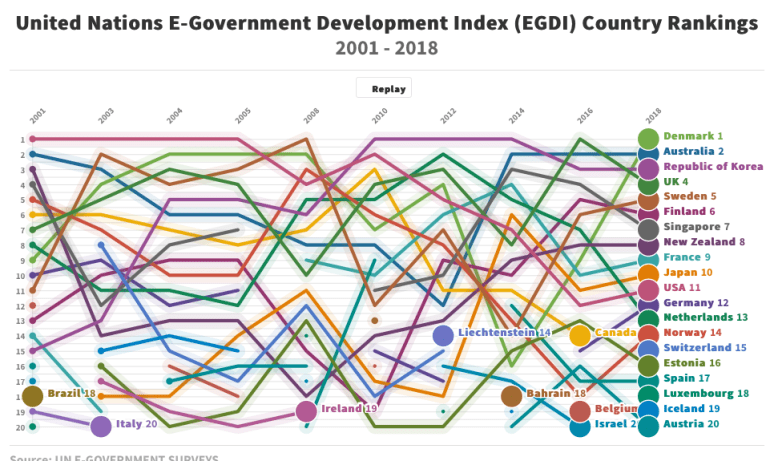
From the above non-exhaustive list, we can see that governments need ICT more than ever to enhance communications and improve operations. This, in turn, means that becoming a Digital Government is not only a nice-to-have but a must-have. The importance of ICT to domestic government operations and international cooperation is such that in 2001 the United Nations (UN) started administering surveys about a country’s e-gov capabilities and then ranking each country through the United Nation’s E-Government Development Index (EGDI). The following chart shows the rankings of the top 20 countries from 2001 to 2018:

As we notice from the above chart, most of the top 20 countries that lead in the Digital Government are democracies in developed nations. Perhaps there are lessons to be learned here for developing and under-developed countries. We need to be cognizant that Digital Government:

  1. Is about keeping the Citizen at the center to create delightful customer experiences
  2. Is about continuous improvement mindset through ICT
  3. Is not about a one-time activity/project
  4. Is not about Citizens who are only online

Keeping all these in mind, in order to start and continue to create societies of the future, countries around the world need to ask the following questions:

Today Tomorrow
Who is your direct and indirect customer?Who should be your direct and indirect customer?
What government services are being provided that are digitized?What government services should be digitized?
Where can citizens get government services? online vs. offlineWhere should citizens get government services? online vs. offline
When are government services considered inefficient?When should government services be considered inefficient?
Why Digital Government is important for your country?Why Digital Government should be important for your country?