In the video below, on CxO Talk, I asked Jay Ferro, Chief Information Officer (CIO) of The American Cancer Society about the relationship between business operations and Information Technology (IT).
In my view, broadly speaking, there are two types of operations:
Business Operations which includes overall organizational operations such as supply chain management but also function-specific operations such as accounting, human resources, marketing and sales.
Technology Operations which includes network support, hardware support, software support, providing services to colleagues inside the organization and to outside customers.
When business operations and technology operations are not in aligment that is where handing off things from one function to another not only creates friction but also creates silos.
Processing…
Success! You're on the list.
Whoops! There was an error and we couldn't process your subscription. Please reload the page and try again.
This article proposes the establishment of a Center for Operations, Research, and Education (CORE) at your university. CORE would be a team of people that proactively and holistically help achieve the university’s business outcomes. Its mission would be to provide comprehensive educational programs in Enterprise Architecture, conduct research and use this research to help transform the university.
For this article, the strategic direction and cultural factors in relation to operations, research and education in Enterprise Architecture are considered. We assume the status quo in regards to your university’s culture for this assessment, specifically the perception of Information Technology. The following table shows what we considered:
Operations
Research
Education
Current State (Observations)
No one is responsible for Enterprise Architecture
No research is being conducted in this field
No comprehensive program in Enterprise Architecture
Future State (Recommendations)
CORE would be independent of your university’s President
Rotating leadership where every school, department and division has the opportunity to lead CORE
Conduct research by partnering with other elite institutions
Begin by providing a graduate certification program
Aim for providing Bachelor’s, Master’s and executive programs in the future
This assessment reveals that currently where Enterprise Architecture is placed in the organization, it will not be able to provide the organizational transformational value that aspires to provide. Additionally, your university should start providing comprehensive programs in this field otherwise they would be left behind other educational institutions that are already moving in this direction.
1. ANALYSIS
This section provides an analysis of standing up CORE from an operational, research and educational perspective.
Assumptions
Your university’s executive management would support this effort
All university communities would help transform it to achieve operational excellence
Perception of IT would not change instantly
1.1 What is the Center of Excellence?
According to Tarek M. Khalil et al. (2001), within an organization, a Center of Excellence may refer to a group of people, a department or a shared facility. It may also be known as a Competency Center or a Capability Center. The term may also refer to a network of institutions collaborating with each other to pursue excellence in a particular area.
1.2 What is Enterprise Architecture?
Due to the evolving nature of this field, there are many academic and practitioner definitions of what is Enterprise Architecture. For our purposes, we will use the one definition from the glossary on Gartner’s website that states Enterprise Architecture as a discipline for proactively and holistically leading enterprise responses to disruptive forces by identifying and analyzing the execution of change toward desired business vision and outcomes. Enterprise Architecture delivers value by presenting business and Information Technology (IT) leaders with signature-ready recommendations for adjusting policies and projects to achieve target business outcomes that capitalize on relevant business disruptions. Enterprise Architecture is used to steer decision-making toward the evolution of future state architecture.
In a nutshell, “Enterprise Architecture bridges the Business and Information Technology via enterprise integration/standardization resulting in people becoming more efficient and effective in achieving their objectives.” Kevin Smith (2010)
It should be noted that Enterprise Architecture is not an Information Technology endeavor but in fact, it sits in between Business and IT and works across organizational silos.
1.3 What is CORE?
If we combine the two definitions above then a definition for the center of excellence in enterprise architecture emerges which is a team of people that proactively and holistically help achieve business outcomes. For your university and breadth of this center’s agenda, it would be called Center for Operations, Research, and Education (CORE).
1.4 What are the Operational Perspectives?
1.4.1 Why should Your University Pay Attention to Enterprise Architecture?
One of the biggest proponents and users of Enterprise Architecture is the most powerful office in the world – The White House. The United States Federal Government has been using Enterprise Architecture for more than a decade and continues to see it as a way to look across organizational silos.
What this means for your university is that huge organizations are trying to improve their operations and they are turning towards Enterprise Architecture to help them do that. Your university can tap into this, apply Enterprise Architecture effectively and perhaps get involved in Enterprise Architecture discussions for organizational improvements. This involvement could also translate into future research grants and job opportunities for students.
1.4.2 Why putting Enterprise Architecture under Information Technology is Not a Good Idea?
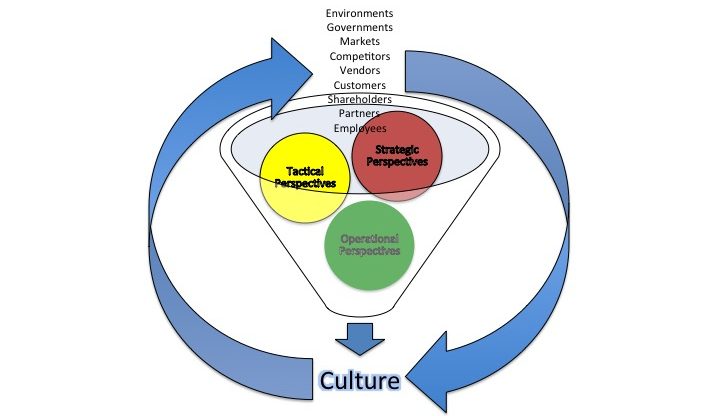
All organizations are a composition of many cultures and subcultures. Some of these cultures develop over time and then become part of the routine mentality of an organization. Your university is not immune to this. In order to understand the perception of Information Technology at your university, look at how the university’s strategic plans were developed. Was Information Technology involved/invited to help in the development of your university’s strategic plan?
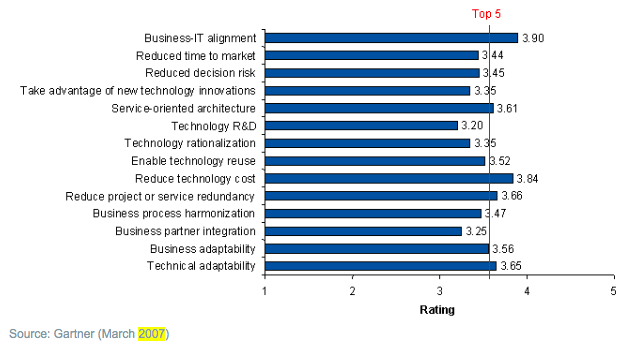
If not, then this is a cultural issue and often the cause of misalignments within organizations. Whenever Information Technology is not involved in strategic planning, it gives the perception that Information Technology is not important, it is just a commodity and it is just back-office activities. This lack of involvement is the reason that according to the 2013 Chief Information Officer ‘State of the CIO’ survey, “63% [of the respondents] say the majority of their time and focus is spent on aligning Information Technology initiatives with business goals.” This shows there are gaps in aligning Business and Information Technology. This alignment can be achieved through Enterprise Architecture. According to a Gartner study (G00146809), Business-Information Technology alignment is the primary driver for Enterprise Architecture as shown below:
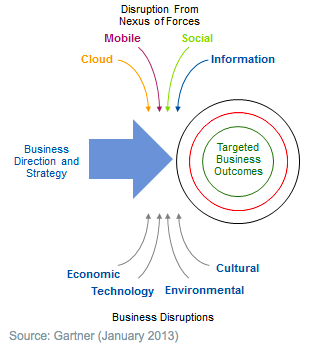
Taking into consideration the current culture at your university, placing Enterprise Architecture under Information Technology would not make sense. If Enterprise Architecture continues to be placed under Information Technology then at your university Enterprise Architecture would be perceived as an “Information Technology thing”. This perception would defeat the overarching purpose of Enterprise Architecture. Enterprise Architecture needs to have a holistic understanding of your university going beyond Information Technology. A Gartner study (G00245986) supports this thought of Enterprise Architecture going beyond Information Technology as shown below:
From the above figure, we can learn that while technology is a consideration in Enterprise Architecture but it is certainly not the only aspect that needs to be considered. A well-run CORE at your university would consistently produce qualitative and quantitative for both Business and IT. Some of the examples of these are:
Qualitative Benefits
Improved Communications Across Organizational Silos
Increased Productivity
Efficient Portfolio Management
Effective Business Intelligence
Quantitative Benefits
Reduced Costs
Revenue Generation
1.4.3 What are the Maturity Levels for Enterprise Architecture?
According to a Gartner study (G00252206), it outlines the five levels of Enterprise Architecture maturity shown below:
What this means is that a lot of work needs to be done in this area and your entire university has to be involved in it so that it can be used effectively across organizational boundaries.
1.4.4 How will CORE Measure its Success?
From an operational perspective, a Gartner study (G00247593) indicates the following ways to align Enterprise Architecture to strategic business initiatives:
At your university, the success of Enterprise Architecture would depend upon how it can help your university transform itself to achieve its strategic visions.
1.5 What are the Educational and Research Perspectives?
1.5.1 Is Enterprise Architecture Taught at Your University?
Are Enterprise Architecture courses taught at your university in various schools (e.g., business school, engineering school, professional studies school, etc.)? If yes, do you know if these schools at your university are talking to each other about Enterprise Architecture? If not, then there is no comprehensive Enterprise Architecture program at your university. From this observation, we can decipher that although Enterprise Architecture might be part of certain programs but overall it is fragmented at your university.
1.5.2 Why Should Your University Teach or Do Research in Enterprise Architecture?
In order to be an elite institution, your university needs to look at what other elite institutions are doing, assess what programs they offer and what kinds of research they are pursuing. Your university should then look at how these programs can be stood up.
For the purpose of this article, we will only focus on the institutions that teach, conduct research and/or have comprehensive programs in Enterprise Architecture. These include:
Institutions Name
Country
1
Harvard University
USA
2
Massachusetts Institute of Technology
USA
3
Dartmouth College
USA
4
Carnegie Mellon
USA
5
Pennsylvania State University
USA
2. Recommendations
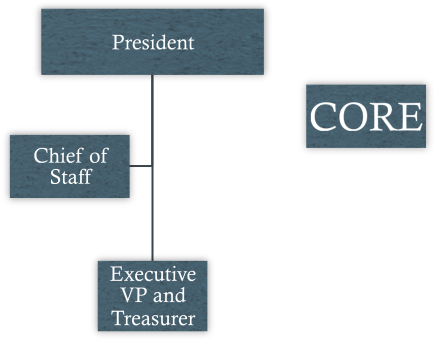
Due to the importance of Enterprise Architecture as a catalyst in organizational transformation, in the current culture at your university, CORE should not be under IT. CORE’s mission is to help your university continuously evolve, conduct/use research and provide comprehensive educational programs. It should be an interdisciplinary entity whose members include all schools, divisions, and departments of your university. Thus, it should be placed where it has the most influence as shown below:
CORE should start as a chartered center initially led by the School of Business and in collaboration with Engineering School, Professional Studies School and IT. Within the first year, this would develop relationships across all the universities.
CORE’s leadership should be on a rotating basis where each school, department, and division of your university has the opportunity to lead CORE for at least 1 year. This will create an atmosphere of collaboration and help break down organizational silos. This governance structure would also encourage participants to be actively involved in CORE’s advancement and they can use it to also enhance their own schools, divisions, and departments.
In regards to education and research, CORE should develop a graduate certificate program with the goal of creating a Bachelor’s, Masters and executive programs in the future.
References:
Tarek M. Khalil; L.A. Lefebvre; Robert McSpadden Mason (2001). Management of Technology: The Key to Prosperity in the Third millennium: Selected Papers from Ninth International Conference on Management of Technology, Emerald Group Publishing, pp.164
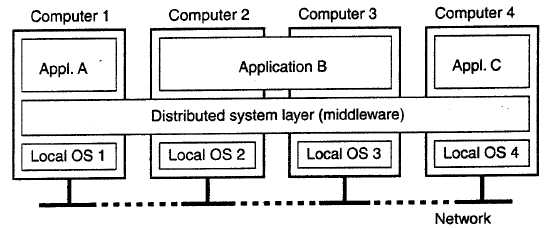
Tanenbaum and Steen describe a distributed system as “a collection of independent computers that appears to its users as a coherent system.” This means that even if there are multiple heterogeneous components within the distributed system communicating with each other, but from a user’s point of view it is a single system. An example of a distributed system would be the World Wide Web (WWW) where there are multiple components under the hood that help browsers display content but from a user’s point of view, all they are doing is accessing the web via a medium (i.e., browsers). The following figure from Tanenbaum and Steen below helps visualize their definition of a distributed system.
From the above figure, we can observe that the distributed systems layer sits in-between the various computer applications and the independent computer operating systems. What the authors are trying to show here is that distributed systems are at a software layer level that acts as the “glue” which helps in sharing of resources across various independent components (i.e., computers) but at the same time seems like a single system to the end-users. The authors call this type of distributed system middleware. Additionally, we notice that these components are connected via a network. While it is not clear what kind of network this is but we can extrapolate that these independent computers are on the same network.
As we can see that the importance of the network cannot be minimized. For if there is no network then it becomes difficult for independent components to talk to each other and share resources hence there is no distributed system. The importance of the network is such that when we look at the 8 fallacies formulated by Peter Deutsch 8 out of the 8 fallacies when developing distributed applications are about the network. Following are these 8 fallacies:
The network is reliable
The network is secure
The network is homogenous
The topology does not change
Latency is zero
Bandwidth is infinite
Transport cost is zero
There is one administrator
Despite the importance of the network for distributed systems, can we truly claim that the Internet, which is a network of networks, is really a distributed system? I would say no since while a network provides the essential connectivity and communication channels for a distributed system but the network itself is not a distributed system. From an end-user perspective, the Internet might appear to be a single system (e.g., email) but in reality, email is not the Internet but a service provided on top of the Internet utilizing existing Internet infrastructure. Vera-Ssmio and Rodrigues agree with the claim that there is a distinction between a network and a distributed system. They emphatically say that “a computer network is not a distributed system.”
Beyond the technological aspects though, should we be looking at distributed systems from a broader lens. Should we be looking at distributed systems from security and privacy perspectives? The answer is of course yes. The reason is that by definition within a distributed system components share resources. Some examples of sharing resources would include memory allocation and computing power optimization to name a few. But the sharing of resources opens up a Pandora’s box of issues related to security and privacy. This is due to the fact that when sharing resources, certain information (e.g., computer IP addresses, open ports, etc.) needs to be shared as well. The exposure of this information can result in unintentional consequences on one end or deliberate attacks on the other end. We need to ask ourselves: How much information sharing is too much? What happens when information is compromised? Should the Internet become a Distributed System? What happens if one computer is exposed and an intruder has gotten onto the network? How do you safeguard other computers on the same network that share resources?
In conclusion, in the 21st century, the Internet has become a necessary tool for businesses and individuals to interact with each other and share information. Some examples of this information sharing include emails, browsing the World Wide Web, conducting a financial transaction, sharing photos, etc. As time progresses, the importance of the Internet will only increase which would result in improvements and the creation of new services and business models. Thus, in order for businesses and individuals who are interested in leveraging the power of the Internet, it is useful to understand what the Internet is and what it is not. So, when we hear that if the Internet is a distributed system, the immediate reaction for some people is of course it is. But if we dig a little deeper, we would realize that the answer is not as simple. The reason is that the Internet itself is a network of networks and does not necessarily fall under the classic definition of a distributed system. Thus, in this paper, we have made the argument about the Internet not being a distributed system and raised some issues that go beyond the technological realm.
References:
Tanenbaum, Andrew S., and Maarten Van. Steen. Distributed Systems: Principles and Paradigms. Harlow: Prentice Hall, 2006. Print.
Veríssimo, Paulo, and Luís Rodrigues. Distributed Systems for System Architects. Boston: Kluwer Academic, 2001. Print.
Processing…
Success! You're on the list.
Whoops! There was an error and we couldn't process your subscription. Please reload the page and try again.
In his article, Nick Carr argues that in the current business environment Information Technology (IT) does not provide any strategic advantage but it is merely an operational necessity. He equates IT to a commodity much like electricity and mainly talks about IT infrastructure becoming a commodity. Let’s explore this in the context of the Internet and Internet technologies:
The Internet:
The Internet is a network of networks that connects varied computers via switches to allow transmission of data across multiple networks using Internet protocols. Some of the popular uses of the Internet include email, instant messaging, browsing the World Wide Web (WWW) to name a few. In today’s society, the Internet has become an important tool for individuals and organizations to conduct their business. It seems like the use of the Internet has become so ubiquitous that individuals and organizations don’t even think about it and assume it to be always available but does that mean the Internet has become a commodity. In this context, I would agree with Nick that the Internet has now become very similar to a commodity since we are all accessing the same Internet despite the mediums by which we access it.
Internet Technologies:
Internet technologies include browsers and search engines that help us navigate the WWW of the Internet. From Nick Carr’s perspective, these Internet Technologies are commodities and do not provide any strategic value. I disagree with this claim and here is why:
Browsers: Currently browsers are used to browse the WWW and used internally by organizations to access their corporate systems such as Enterprise Resource Planning (ERP) and Customer Relation Management (CRM) systems via a web interface. Thus, the security and privacy capabilities of these browsers become paramount in safeguarding the organizations against malicious attacks. While from the surface it may seem that these browser issues are operational in nature but from a closer inspection we can understand their strategic importance. For example, if an organization chooses one browser over another browser that has less security then the organization becomes vulnerable to exploits of that browser. These exploits can entail simple hacking attacks on the siphoning of organizational data. So, the selection of a browser is not just an operational activity but I believe it to be a strategic necessity.
Search: A McKinsey report, The Impact of Internet technologies: Search, indicated that web search provides value that includes the creation of new business models. An example of this would be price comparisons where users can essentially compare prices of what they are buying (e.g., airline tickets, hotel rooms, etc.) from various vendors on one website. This price comparison is not only useful for users but for corporations, this could also be used to determine if they are competitively priced. Since making your organization competitive is also a strategic consideration thus search capabilities are important for the organization’s future.
In conclusion, the oversimplification and lack of understanding of how the nuances of technology can affect organizations strategically are not only unsettling but also ill-informed. IT is not just one thing and by saying it is and cherry-picking the data to show this can lead to unintentional consequences.





 Welcome to Khan's Blog
You must be logged in to post a comment.