EXECUTIVE SUMMARY
This article discusses what is Service Orientated Architecture (SOA), how it is used, what are its benefits and what are the challenges when adopting it for your organization. It explores the business and technology perspectives of where SOA can be applied internally and externally by showing the following benefits of SOA to your organization:
- Enhanced Operational Insights
- Increased Business Agility
- Better Customer Experience
- Reduced Technology Costs
- Creation of New Business Models
Keeping the benefits in mind, your organization has to also assess the following challenges that SOA brings for your organization:
In a nutshell, SOA is a framework that allows business processes to be highlighted to deliver Information Technology (IT) interoperability and rapid delivery of application functionality. Successful adoption of SOA would result in enhanced alignment between Business and IT. So, while there are challenges to overcome by your organization but overcoming these challenges would make your organization aligned from top to bottom and across people, processes and technologies.
1. WHAT IS SOA?
1.1. What is a Service?
In order to understand SOA, lets first explore the concept of a ‘service’. Depending upon the context, Merriam-Webster defines service in 11 different ways. These include a service being “the occupation or function of serving”, “the work performed by one that serves” to many other religious, military, public utilities and organizational definitions (“Service.” Merriam-Webster. Merriam-Webster, n.d. Web.). In economics and marketing, a service is the exchange of non-material equivalent of a good.
In organizations, a service can have business contexts and technological contexts. From a business context, a service can be activities that are performed inside the organization (e.g., Accounts Receivables), outsourced to another organization (e.g., Payroll Processing) and performed for the internal or external customers (e.g., Helpdesk Support). From a technological context, a service can be provided within an operating system (e.g., Windows EventLog), for software (e.g., log service) and where a user exchanges messages with a program to interact with it.
1.2. What is Service-Orientation and Service-Orientated Architecture?
Now that you have an understanding of what a service is, let’s define what is service-orientation and what is service-orientated architecture. Microsoft defines SOA to be “a design philosophy independent of any vendor, product, technology or industry trend” (Linthicum, David. “Chapter 1: Service-Oriented Architecture (SOA).” Chapter 1: Service-Oriented Architecture (SOA). Microsoft, n.d. Web.). Oracle, on the other hand, says SOA “provides a unified approach with a single interface for all of your current and future integration requirements” (“Oracle SOA – Service-Oriented Architecture.” Service-Oriented Architecture. Oracle, n.d. Web.)
In light of the varying definitions from vendors and practitioners, a working group was established in 2009 to remove the confusion. This working group had a mix of practitioners and vendors and came up with the SOA Manifesto that states “service-orientation is a paradigm that frames what you do” and that “SOA is a type of architecture that results from applying service-orientation” This group also prioritized SOA as a business initiative rather than a technological initiative and thus states the importance of (1) business value over technical strategy, (2) strategic goals over project-specific benefits, (3) intrinsic interoperability over custom integration, (4) shared services over specific-purpose implementations, (5) flexibility over-optimization and (6) evolutionary refinement over pursuit of initial refinement. (Erl, Thomas et al. “SOA Manifesto.” SOA Manifesto. N.p., Oct. 2009. Web.)
As you can see, SOA is an organizational journey that spans across business and technology. From a business perspective, business objectives drive the integration of applications within the organization and between business partners. From a technological perspective, integration of applications is modeled using loosely coupled services that can be combined and orchestrated to achieve business objectives. Thus, you can say that SOA is a framework that allows business processes to be highlighted to deliver interoperability and rapid delivery of functionality.
1.3. How does SOA work?
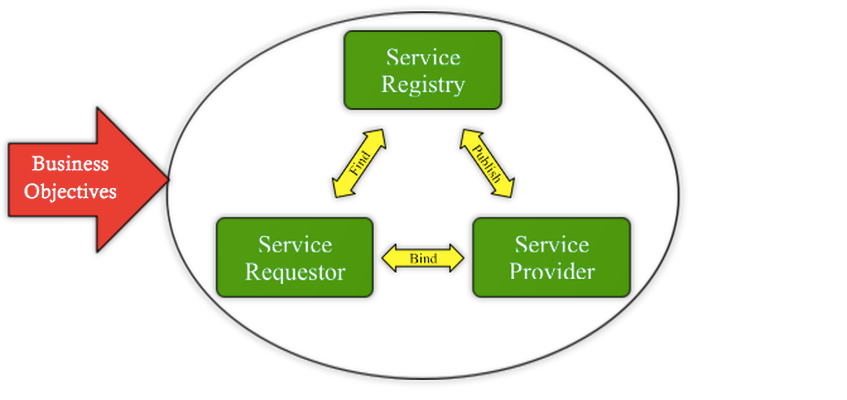
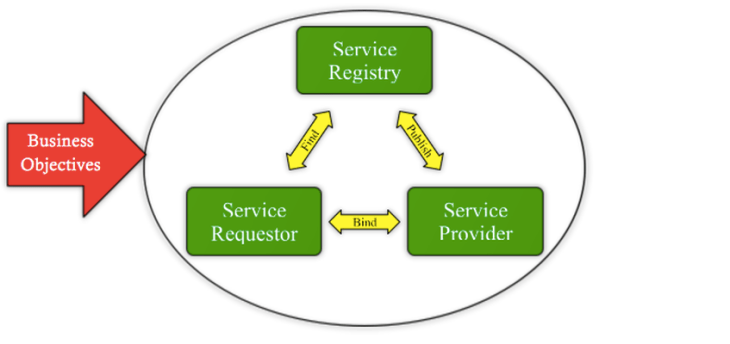
In SOA, you have three roles that include the Service Provider, the Service Requester, and the Service Registry. The Service Provider role (1) describes what the service does, (2) deploys the service over the network and (3) publishes service in a service registry. The Service Requester role (1) finds service in a service registry and (2) uses the service description to invoke the service. The Service Registry advertises the availability of a service that is published by the Service Provider. The interaction between Service Provider, Service Requester and Service Registry is shown below:
From the above figure, you can see that business objectives are the drivers for SOA within an organization. While the main idea behind SOA is the reuse of generalized software components modeled as services, but due to its ability to encourage collaboration between business and IT, it can create alignment and can help the organization respond to the rapidly changing business environments.
2. WHAT ARE THE BENEFITS OF SOA?
In order to understand how SOA can help your organization, you have to explore some of its benefits and how other organizations were able to use SOA for their strategic advantage. Following are some of the benefits of SOA:
2.1 Enhanced Operational Insights:
It is often observed in organizations that the left hand is unaware of what the right hand is doing. This type of disconnects causes organizational silos where the approach to developing business processes and the technologies that support it have a very narrow focus. Due to this, the business processes and technologies are tightly coupled with the functional needs at the time when they were created. While this gets the job done for a particular functional need but now if you multiple this scenario across the entire organization and its various functions then you start to see a spaghetti of business processes and its enabling technologies (“Why Enterprise Architecture?” YouTube. Mastering ArchiMate, 19 Apr. 2013.)
The ‘spaghetti architecture’ can result in duplicative business processes and technologies across different organizational divisions. These business processes and enabling technologies are rarely documented which increases the risk of costly mistakes when these business processes change and when the underlying technologies that support these business processes become outdated. In spaghetti architecture, there is also rarely any thought put into the future needs of the organization as a whole, this can also result in using technologies that might become obsolete for future needs.
SOA addresses the spaghetti architecture head-on by creating operational insights into the different organizational processes of the organization. Since the main driver of SOA is business objectives that encompass business processes, your organization can start to view the various unique, duplicative and interdependent business processes holistically across the entire company. This holistic view gives your organization the ability to see which business processes can be completely eliminated, which ones can be combined and which ones can be used to make rapid decisions. An example of an organization that used SOA to address its spaghetti architecture is FedEx, a $32 billion multinational organization. By overhauling FedEx’s entire spaghetti architecture to SOA, within 3 years it was able to better manage acquisitions and process changes (Ganesan, Suresh et al. “What Business Executives Must Know About SOA.” Cognizant White Paper (2007): n. pag. Bloom Group, 2007. b.)
2.2 Increased Business Agility:
In today’s competitive business environment, business agility is the ‘holy grail’ that organizations strive to achieve. This business agility can entail many things and can range from bringing a product/solution quicker to the market to providing efficient troubleshooting support for customers. This also implies that business agility is a moving target and can be achieved partially and holistically depending upon the business objectives. The underlying thought behind business agility is the idea of continuous improvement to get better and better at what the organization does.
As your organization looks to be agile, SOA provides the foundation to do this. Due to operational insights and an understanding of the shared services within your organization, SOA can help accelerate what you are trying to achieve. An example of an organization that used SOA to become agile was Wachovia Bank. Using SOA, Wachovia was able to promote a product engineering mentality and make IT an advisor to the business (Ganesan, Suresh et al. “What Business Executives Must Know About SOA.” Cognizant White Paper (2007): n. pag. Bloom Group, 2007. Web.). In 2008, Wells Fargo bought Wachovia for $15.4 billion and when in 2014 Wells Fargo became the highest-earning bank in the United States, its CEO gave credit to their smooth acquisition of Wachovia due their cultural similarities (Raice, Shayndi. “As Wells Fargo Hits Profit Milestone, CEO Gives Credit to Wachovia.” MoneyBeat RSS. The Wall Street Journal, 14 Jan. 2014. Web.). You can extrapolate that Wachovia’s SOA might also have been a factor in the smooth acquisition since most acquisitions fail due to cultural and technological differences.
2.3 Better Customer Experience:
If the customer is king, then customer experience must be the only priority. Traditionally, organizations have considered customer experience to be the point of the transaction when a purchase is made. But a more holistic view of customer experience entails the pre-sales and post-sale processes as well. Due to the many touchpoints (e.g., physical, website, mobile, social media, etc.) of the customers with business; customer experience is not a point of transaction anymore. Forrester® goes on to say that in today’s era of empowered and always-connected customers, organizations need customers more than the customers need organizations. [9] Forrester® goes on and talks about creating a “customer experience ecosystem” that entails the people, processes, policies, and technologies. (Fenwick, Nigel. “Nigel Fenwick’s Blog.” Why Customer Experience Will Become The #1 CIO Priority. Forrester Research, 27 June 2013. Web.)
When you talk about customers, you have to take into account both the internal customers and external customers. The ease by which internal customers can provide customized and quick services to external customers can increase productivity and improve the bottom line for your organization. An example of an organization where SOA was used to improve customer experience was The Hartfort Group, a $26 billion organization. By implementing SOA, The Hartfort Group was able to enable its agents to create, assemble and complete transactions with the external customers (Ganesan, Suresh et al., “What Business Executives Must Know About SOA”).
2.4 Reduced Technology Costs:
As discussed earlier, “spaghetti architecture” can prove to be costly to the organization due to duplicative business processes and the underlying technologies. These costs can quickly add up and start to affect the bottom line of your organization. On the flip side, since SOA allows reuse of services across many functional domains, this can free up money for other endeavors that your organization might be interested in pursuing. An example of this would be Starwood Hotels who are on their way to saving $20 million per year simply by moving from tightly coupled mainframe applications to loosely-coupled SOA services (Ganesan, Suresh et al. “What Business Executives Must Know About SOA.” Cognizant White Paper (2007): n. pag. Bloom Group, 2007. Web.).
2.5 Creation of New Business Models:
In today’s competitive business landscape, organizations are continuously looking for ways to differentiate themselves from their competitors. This differentiation can also come in the form of determining new business models enabled by SOA services that would not have been possible in the past. Due to SOA, your organization can look across the various services and make intelligent decisions on what services can be combined to create additional value for the customer that in turn can increase the bottom line. An example of where SOA is best used and enforced is that of Amazon, a $74 billion online retailer (“Amazon Booms in 2013 With $74.45 Billion in Revenue.” Digital Book World. Digital Book World, 30 Jan. 2013. Web.). In 2002, Jeff Bezos of Amazon issued a mandate that stated, “All teams will henceforth expose their data and functionality through service interfaces” and “anyone who doesn’t do this will be fired” “The Secret to Amazons Success Internal APIs.” The Secret to Amazons Success Internal APIs. API Evangelist, 12 Jan. 2012. Web.). Bezos’s commitment to SOA and betting the entire future of the company speaks volumes about what SOA can do for an organization.
3. WHAT ARE THE CHALLENGES OF SOA?
So, while SOA provides great promise for your organization, it is by no means a panacea. Thus, you have to also carefully assess the following challenges that SOA brings to your organization:
3.1. Governance & Organizational Maturity:
Governance in a way is the policy of how things ought to be done. It provides a framework in which business processes can operate under regulatory, time and other constraints. Thus, governance is an organizational responsibility even for SOA and not only an IT activity. In order to accomplish this, your organization should set up a governance board that consists of a cross-functional team from both business and IT. Additionally, governance should not only include the overall organization and management of SOA activities but also the creation of success and failure measurements. These measurements should be used to actually determine the state of SOA within your organization instead of people doing vaporware measurements that have no grounds in reality.
3.2 Not Only an IT thing:
If the burden of implementing SOA across your entire organization is on IT then it takes away the business side’s responsibility and involvement. While IT is responsible for creating SOA services but the business has to work collaboratively with IT to define what those services are. Additionally, the business-side has to understand how did the current state of misalignment between business and IT came into being and how this can be avoided in the future. Thus, SOA is not an IT issue but an organizational endeavor that affects all parts of your organization.
3.3. Organizational Processes Need Reevaluation:
While the presence of too many point-to-point integrations in your organization can reduce your ability to be agile but there is a bigger perspective that you also have to consider. This perspective revolves around your organizational processes that led to misalignment in the first place. These organizational processes not only entail IT but also the business side. Typically, IT does what business asks but then there has to be some mutual understanding that the requests for services have to be understood holistically. Even after SOA migrations, if your organizational processes are not optimized they might still result in ad-hoc requests from the business leading back to point-to-point tightly couple services that you try to avoid in SOA.
3.4. Long-Term View of Legacy Systems is Needed:
In the short term, it may seem like a good idea to not replace your organizational legacy systems but in the long term, there are issues when you do this. These issues entail the constant “patching” to upgrade underlying hardware and software in addition to overburdening legacy systems where new services are being added on top of systems that should be replaced rather than being continued to extend their life. While it may not be possible to replace legacy systems altogether but you should have a plan to retire these systems with new systems eventually.
3.5. No Measurement Means No ROI:
If your organization does not measure pre-SOA activities then how would you know if what SOA promised for your organization is what you really wanted to achieve. So, since SOA often requires a long-term commitment from both business and IT, you have to develop performance metrics upfront before you embark on your journey towards SOA-fication.
4. CONCLUSION
Due to your organization’s desire to compete in today’s competitive business landscape, you have to carefully weigh the benefits of SOA’s value in terms of operational efficiencies and organizational improvements. Based on the information provided above, using SOA will help your organization have enhanced operational insights which can increase your organization’s agility to provide better customer experiences, reduce technology costs and explore new business models. Also, you need to keep in mind that SOA presents the challenges of honestly looking at yourselves in terms of maturity and business-IT collaboration by having a long-term view of what you want your systems to accomplish and how you measure what success looks like. Consequently, if you lack foresight into how SOA can be used as a business transformation effort then your desire to be the best would just be a pipedream.
References:
- “Service.” Merriam-Webster. Merriam-Webster, n.d. Web. <http://www.merriam-webster.com/dictionary/service>.
- Linthicum, David. “Chapter 1: Service Oriented Architecture (SOA).” Chapter 1: Service Oriented Architecture (SOA). Microsoft, n.d. Web. <http://msdn.microsoft.com/en-us/library/bb833022.aspx>.
- “Oracle SOA – Service-Oriented Architecture.” Service Oriented Architecture. Oracle, n.d. Web. <http://www.oracle.com/ca-en/products/middleware/soa/overview/index.html>.
- Erl, Thomas et al. “SOA Manifesto.” SOA Manifesto. N.p., Oct. 2009. Web. <http://www.soa-manifesto.org/>.
- “Why Enterprise Architecture?” YouTube. Mastering ArchiMate, 19 Apr. 2013. Web. <http://www.youtube.com/watch?v=qDI2oF1bASk>.
- Ganesan, Suresh et al. “What Business Executives Must Know About SOA.” Cognizant White Paper (2007): n. pag. Bloom Group, 2007. Web. <http://bloomgroup.com/sites/all/files/Cognizant%20SOA%20paper.pdf>.
- Raice, Shayndi. “As Wells Fargo Hits Profit Milestone, CEO Gives Credit to Wachovia.” MoneyBeat RSS. The Wall Street Journal, 14 Jan. 2014. Web. <http://blogs.wsj.com/moneybeat/2014/01/14/as-wells-fargo-hits-profit-milestone-ceo-gives-credit-to-wachovia/>.
- Fenwick, Nigel. “Nigel Fenwick’s Blog.” Why Customer Experience Will Become The #1 CIO Priority. Forrester Research, 27 June 2013. Web. <http://blogs.forrester.com/nigel_fenwick/13-06-27-why_customer_experience_will_become_the_1_cio_priority>.
- “Amazon Booms in 2013 With $74.45 Billion in Revenue.” Digital Book World. Digital Book World, 30 Jan. 2013. Web. <http://www.digitalbookworld.com/2014/amazon-booms-in-2013-with-74-45-billion-in-revenue/>.
- “The Secret to Amazon’s Success Internal APIs.” The Secret to Amazon’s Success Internal APIs. API Evangelist, 12 Jan. 2012. Web. <http://apievangelist.com/2012/01/12/the-secret-to-amazons-success-internal-apis/>.
Processing…
Success! You're on the list.
Whoops! There was an error and we couldn't process your subscription. Please reload the page and try again.




 Welcome to Khan's Blog
You must be logged in to post a comment.