Author: Khan

  • 5 Questions to Ask About Synthetic Data

    Synthetic data refers to artificially generated data that mimics the statistical properties and characteristics of real data without containing any actual personally identifiable information (PII) or sensitive data. It is created using various statistical and machine learning techniques and can be used as a privacy-preserving alternative for sensitive datasets in research, analysis, and model training.

    How Synthetic Data is Generated

    1. Statistical Methods: Synthetic data can be generated using statistical methods, such as random sampling, probability distributions, and data interpolation.
    2. Machine Learning Techniques: Advanced machine learning algorithms, like Generative Adversarial Networks (GANs) and Variational Autoencoders (VAEs), can create synthetic data that closely resembles the original data distribution.
    3. Preserving Privacy: Synthetic data generation techniques ensure that individual records in the synthetic dataset cannot be linked back to real individuals.

    The Pros of Synthetic Data

    1. Privacy Protection: Synthetic data allows organizations to perform data analysis and share data externally without risking the exposure of sensitive information.
    2. Data Sharing: Researchers and organizations can freely share synthetic datasets without legal or ethical concerns, fostering collaboration.
    3. Cost Savings: Generating synthetic data eliminates the need to manage and secure large volumes of real data, reducing storage and compliance costs.
    4. Data Augmentation: Synthetic data can be used to augment real datasets, boosting the size and diversity of data for better model training.
    5. Preserving Data Utility: High-quality synthetic data retains the statistical patterns and correlations of real data, making it valuable for accurate analysis.

    The Cons of Synthetic Data

    1. Loss of Granularity: Synthetic data may not capture the exact nuances and granular details present in real data.
    2. Model Bias: If the synthetic data is not representative of the entire dataset, it may introduce bias into the analysis or model training.
    3. Complexity in Generation: Generating high-quality synthetic data can be complex and require expertise in statistical and machine learning techniques.
    4. Data Validation: Ensuring the quality and validity of synthetic data is challenging, especially when validating against real-world scenarios.
    5. Limited Applicability: Synthetic data may not be suitable for certain applications that require real-world interactions and scenarios.

    Intriguing Questions about Synthetic Data

    1. Who: Who benefits the most from using synthetic data – data scientists, researchers, or organizations dealing with sensitive data?
    2. What: What are the most innovative techniques for generating synthetic data, and how do they compare in terms of data utility and privacy protection?
    3. Where: Where is the adoption of synthetic data most prominent – in healthcare, finance, or other industries with stringent data privacy regulations?
    4. When: When is synthetic data preferred over other privacy-preserving techniques, like data masking or differential privacy?
    5. Why: Why is synthetic data gaining traction as a privacy solution, and what are the limitations that researchers are currently trying to overcome?

    Conclusion

    Synthetic data presents a promising solution for data privacy and security concerns, allowing organizations and researchers to perform analysis and model training without exposing sensitive information. By leveraging statistical and machine learning techniques, synthetic data can retain data utility while ensuring privacy protection. However, careful consideration should be given to its generation process and validation to ensure its accuracy and usefulness in various applications. As synthetic data techniques continue to advance, they will likely play a crucial role in striking a balance between data privacy and data-driven insights in the future.
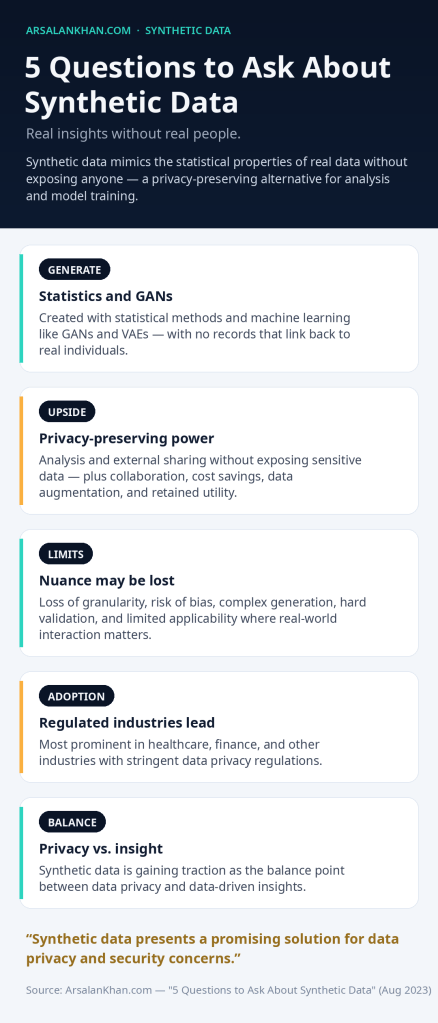
    Infographic: 5 Questions to Ask About Synthetic Data
  • 5 Questions to Ask About Data Lifespan

    Data lifespan refers to the period during which data remains relevant, accurate, and valuable for analysis, decision-making, and other business purposes. In the constantly evolving digital landscape, data is subject to temporal constraints, and its relevance and usefulness may diminish over time. Understanding the data lifespan is crucial for organizations to effectively manage data, make informed decisions, and ensure data-driven strategies align with the most current information available.

    The Pros of Understanding Data Lifespan

    1. Informed Decision-Making: Understanding data lifespan helps organizations make decisions based on the most relevant and current data.
    2. Data Maintenance Efficiency: Identifying the data’s useful life allows organizations to prioritize data maintenance efforts.
    3. Resource Optimization: By focusing on data that retains value, organizations can optimize resources spent on data storage and management.
    4. Regulatory Compliance: Knowing data lifespan helps organizations comply with data protection and retention regulations.
    5. Data Accuracy: Recognizing the temporal nature of data reduces the risk of using outdated or irrelevant information.

    The Cons of Understanding Data Lifespan

    1. Complexity: Determining the precise data lifespan can be complex, especially for data with dynamic, non-linear patterns.
    2. Data Synchronization: Aligning various data sources with different lifespans can be challenging.
    3. Lost Insights: Overly strict data culling policies may lead to the loss of historical data and valuable insights.
    4. Data Retention Costs: Balancing data retention policies to retain relevant data without incurring unnecessary storage costs.
    5. Unpredictable Events: Unexpected events or changes in business needs may alter the perceived lifespan of certain data.

    Intriguing Questions about Data Lifespan

    1. Who: Who within the organization is responsible for determining and managing the data lifespan – data managers, data analysts, or data governance teams?
    2. What: What are the factors that influence the lifespan of data in different industries and business domains?
    3. Where: Where do we see the most significant impact of data lifespan management – in industries with rapidly evolving markets or regulatory landscapes?
    4. When: When is the optimal time to reassess the data lifespan – periodically, based on events, or in response to changing business needs?
    5. Why: Why is understanding data lifespan essential for organizations seeking to maintain data relevance and make agile data-driven decisions?

    Conclusion

    Understanding the data lifespan is a critical aspect of data management and decision-making for organizations in the digital age. It enables organizations to prioritize data maintenance efforts, optimize resources, and comply with regulatory requirements. While it may pose challenges in determining the precise lifespan and balancing data retention policies, the benefits of informed decision-making, efficient data management, and compliance make it a crucial endeavor. By adopting data management practices that consider the temporal nature of data, organizations can stay agile, make data-driven decisions, and leverage the full potential of their data assets to drive success and growth in a rapidly evolving business landscape.

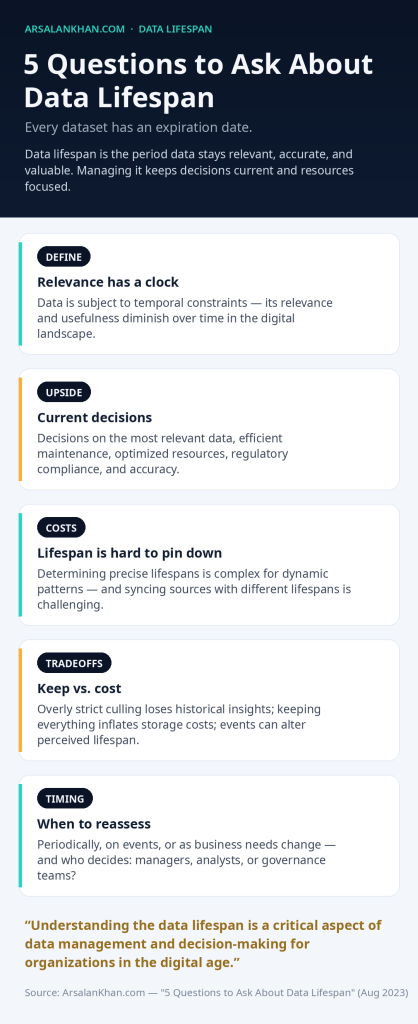
    Infographic: 5 Questions to Ask About Data Lifespan
  • 5 Questions to Ask About Data Accuracy

    Data accuracy is a critical aspect of data quality and refers to the degree to which data correctly represents the real-world events or objects it is intended to capture. In today’s data-driven world, organizations heavily rely on data to make informed decisions, identify trends, and drive business strategies. Data accuracy ensures that the insights and conclusions drawn from data analysis are reliable and trustworthy, forming the foundation of successful data-driven initiatives.

    The Pros of Data Accuracy

    1. Informed Decision-Making: Accurate data enables organizations to make informed decisions based on reliable information.
    2. Business Insights: Data accuracy allows organizations to gain valuable and trustworthy insights into business trends and customer behaviors.
    3. Operational Efficiency: Reliable data minimizes errors and inefficiencies in business processes.
    4. Customer Trust: Accurate data fosters trust with customers, as it ensures that their information is treated with care and precision.
    5. Compliance and Regulation: Data accuracy is crucial for organizations that need to comply with data protection laws and industry regulations.

    The Cons of Data Accuracy

    1. Data Complexity: Ensuring data accuracy can be challenging due to the diverse sources, formats, and structures of data.
    2. Data Cleaning and Validation: Data cleaning and validation can be time-consuming and resource-intensive processes.
    3. Data Integration Challenges: Data accuracy may suffer during the integration of data from different systems.
    4. Human Error: Human errors in data entry and processing can impact data accuracy.
    5. Data Decay: Data accuracy can degrade over time if not continuously monitored and maintained.

    Intriguing Questions about Data Accuracy

    1. Who: Who within an organization is responsible for ensuring data accuracy – data analysts, data stewards, or cross-functional teams?
    2. What: What are the best practices and technologies used to validate and maintain data accuracy in large and complex datasets?
    3. Where: Where do we see the most significant impact of data accuracy – in industries like finance, healthcare, or e-commerce?
    4. When: When is the optimal time to validate data accuracy – during data collection, data processing, or data analysis stages?
    5. Why: Why is data accuracy crucial for organizations seeking to gain a competitive edge and make data-driven decisions with confidence?

    Conclusion

    Data accuracy is a fundamental requirement for organizations leveraging data to make informed decisions and achieve business success. While challenges exist in ensuring data accuracy across diverse data sources, the benefits of informed decision-making, enhanced operational efficiency, and customer trust outweigh the efforts involved. By implementing robust data cleaning, validation, and quality assurance practices, organizations can build trust in their data assets, harness the power of accurate insights, and remain competitive in today’s data-driven business landscape.

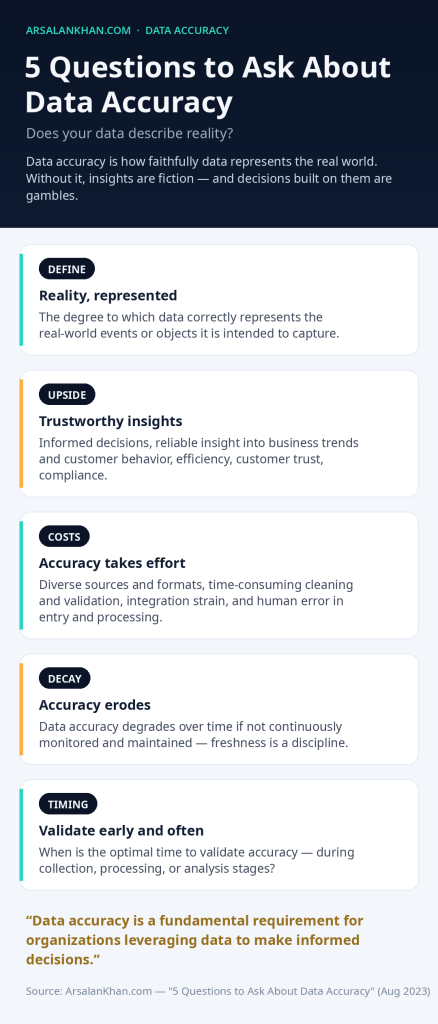
    Infographic: 5 Questions to Ask About Data Accuracy
  • 5 Questions to Ask About IT Strategy

    IT strategy refers to a comprehensive plan that aligns an organization’s information technology initiatives with its overall business objectives and goals. In the digital age, IT strategy plays a crucial role in shaping the organization’s technology infrastructure, driving innovation, and enabling business transformation. It involves defining the organization’s IT vision, identifying technology priorities, and charting a roadmap for leveraging technology to gain a competitive edge and meet future challenges.

    The Pros of IT Strategy

    1. Alignment with Business Objectives: IT strategy ensures that technology investments are closely aligned with the organization’s business objectives, fostering a cohesive approach to achieving goals.
    2. Enhanced Efficiency and Productivity: A well-defined IT strategy streamlines operations, automates processes, and enhances overall efficiency and productivity.
    3. Innovation and Competitive Advantage: IT strategy enables organizations to leverage emerging technologies, fostering innovation and gaining a competitive advantage in the market.
    4. Cost Optimization: Strategic planning helps organizations optimize technology spending, ensuring that resources are allocated to initiatives that deliver the most value.
    5. Scalability and Adaptability: IT strategy allows organizations to build a technology infrastructure that is scalable and adaptable to accommodate future growth and changes.

    The Cons of IT Strategy

    1. Complexity: Crafting and implementing an IT strategy can be complex, especially in large organizations with diverse technology needs.
    2. Resource Intensive: Developing and executing an IT strategy requires significant time, effort, and financial investment.
    3. Rapidly Changing Technology: Keeping pace with rapidly evolving technologies and market trends can pose challenges for long-term strategic planning.
    4. Resistance to Change: The implementation of IT strategy may face resistance from stakeholders accustomed to existing technology practices.
    5. Risk Management: IT strategies must carefully consider cybersecurity and data privacy to mitigate potential risks.

    Intriguing Questions about IT Strategy

    1. Who: Who within the organization is responsible for developing and executing the IT strategy – CIOs, IT leaders, or cross-functional teams?
    2. What: What are the key factors that organizations must consider when formulating an effective IT strategy to achieve their business objectives?
    3. Where: Where do we see the most significant impact of IT strategy – in industries like finance, healthcare, or e-commerce?
    4. When: When is the optimal time for organizations to review and update their IT strategy – annually, in response to market shifts, or as business needs change?
    5. Why: Why is IT strategy critical for organizations to stay competitive, innovate, and adapt to digital disruptions?

    Conclusion

    IT strategy is a fundamental pillar for organizations seeking to harness the power of technology to drive innovation, optimize operations, and achieve business success. Though it presents challenges, such as complexity and rapid technology changes, the benefits of alignment with business objectives, enhanced efficiency, and competitive advantage make it a strategic investment. By embracing IT strategy as a core guiding principle, organizations can create a technology roadmap that aligns with their vision, enables transformative initiatives, and positions them to thrive in the ever-evolving digital landscape.

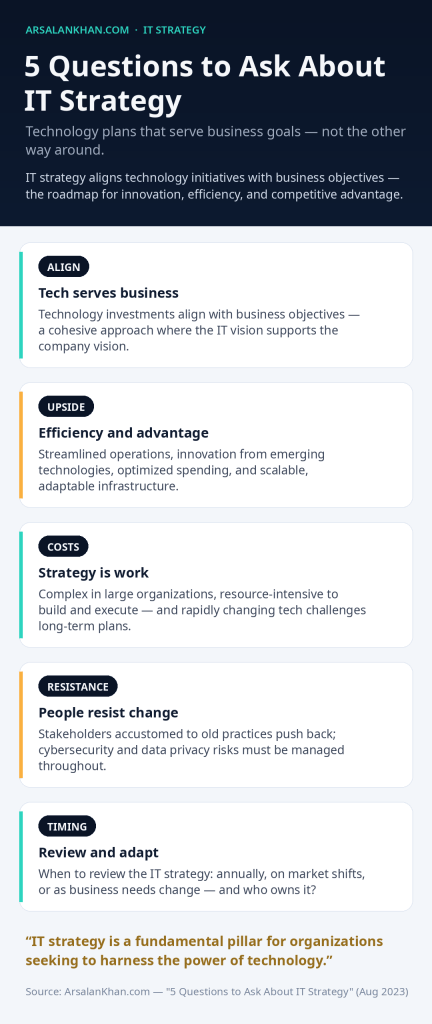
    Infographic: 5 Questions to Ask About IT Strategy
  • 5 Questions to Ask About Systems Integration

    Systems integration is the process of connecting and harmonizing diverse software, applications, and technologies to function as a unified ecosystem. In today’s digitally-driven world, organizations rely on a multitude of systems to manage various aspects of their operations. Systems integration enables these disparate systems to share data, communicate efficiently, and work collaboratively, leading to streamlined processes, improved decision-making, and enhanced productivity.

    The Pros of Systems Integration

    1. Enhanced Efficiency: Systems integration streamlines business processes, reducing manual efforts and improving operational efficiency.
    2. Real-time Insights: Integrated systems provide real-time access to critical data, empowering organizations to make data-driven decisions.
    3. Better Collaboration: Integrated systems facilitate seamless communication and information sharing between different teams and departments.
    4. Adaptability to Change: Integrated systems are more adaptable to changes, enabling organizations to respond to evolving business needs.
    5. Cost Savings: By eliminating duplication of efforts and reducing manual data entry, systems integration leads to cost savings.

    The Cons of Systems Integration

    1. Complexity: Integrating diverse systems with different technologies and protocols can be complex and time-consuming.
    2. Security Concerns: Systems integration must be done securely to protect data during data exchanges and prevent potential vulnerabilities.
    3. Data Mapping Challenges: Ensuring data compatibility and consistent formats across systems may require data mapping and transformation.
    4. Legacy System Compatibility: Integrating with legacy systems can be challenging due to outdated technologies and data formats.
    5. Testing and Validation: Thorough testing and validation are essential to identify and resolve integration issues.

    Intriguing Questions about Systems Integration

    1. Who: Who are the key stakeholders responsible for systems integration – IT departments, data architects, or third-party integration specialists?
    2. What: What are the cutting-edge technologies and methodologies for successful systems integration in today’s dynamic digital landscape?
    3. Where: Where do we see the most significant impact of systems integration – in industries such as healthcare, finance, or manufacturing?
    4. When: When is the optimal time to initiate systems integration – during the development phase or after the systems are complete?
    5. Why: Why is systems integration crucial for organizations seeking to optimize their operations, gain a competitive edge, and future-proof their technology infrastructure?

    Conclusion

    Systems integration is a transformative process that brings together the power of various systems to create a cohesive and interconnected digital ecosystem. By integrating diverse technologies, organizations can unlock new levels of efficiency, collaboration, and data-driven insights. While challenges such as complexity and security concerns exist, the benefits of enhanced efficiency, real-time insights, and cost savings make systems integration a strategic investment for any forward-thinking organization. Embracing systems integration as a core strategy empowers organizations to harness the full potential of their technology infrastructure, driving innovation, agility, and growth in today’s rapidly evolving digital landscape.

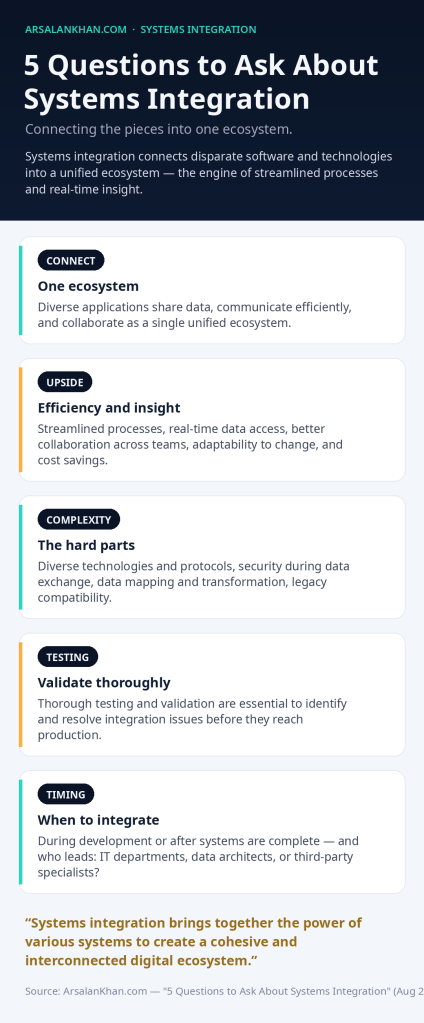
    Infographic: 5 Questions to Ask About Systems Integration