Blog

How transformation-ready is your organization?

Take the free 5-minute SPICE assessment — a scored readout across Strategy, Politics, Innovation, Culture, and Execution, plus reading recommendations.

  • Who’s Accountable When AI Adoption Outruns Governance?

    Here's a number that should end meetings: 91%. That's the share of organizations that now admit AI adoption is outpacing their governance — fresh data from October 7, 2026. And here's the one that should start them: a third of leaders say they're personally accountable for AI outcomes they can't actually control.

    Read that again. Accountable for outcomes they can't control. There is a name for that condition in every organization I've ever worked in, and it isn't "a governance gap." It's politics — the purest kind. Responsibility without authority is the oldest power game in the enterprise, and AI just gave it a faster engine.

    We've spent three years writing AI governance as paperwork: principles, committees, policy PDFs that nobody reads until something breaks. Then something breaks, and everyone discovers the paperwork named no one. Governance theater produces exactly what theater produces — a good show and no change in the outcome. Accountability is a different thing entirely. It's a name, a signature, and a person who agreed in advance to own the result. If you can't point to that person before deployment, you don't have governance. You have hope with a compliance stamp on it.

    Run it through SPICE:

    Strategy. Accountability is designed, not assigned. It gets decided before the system goes live — in the same meeting where you approve the budget and the timeline — not in the incident review afterward. For every AI system that touches a real decision, write down three names: who approved its deployment, who owns its outputs, and who can stop it. Not teams. Not committees. Names. Strategy here isn't a framework; it's the refusal to let "everyone owns it" mean "no one owns it." The organizations getting this right treat accountability the way they treat architecture — decided up front, documented, and reviewed when conditions change.

    Politics. This is where it actually lives, so let's name it plainly. In most enterprises, accountability flows downhill while authority stays uphill. The vendor chose the model. A team deployed it under deadline pressure. An executive signed a one-line approval between meetings. And when it fails, the person answering for it is whoever is closest to the blast radius — rarely the person who had the power to prevent it. A third of leaders holding accountability they can't control isn't a data point; it's a diagnosis. The fix is political before it's procedural: give the accountable person real authority — over the data, the deployment decision, and the kill switch — or stop pretending they're accountable and name whoever actually holds the power.

    Innovation. The most useful governance innovation of the last two years isn't a policy — it's machinery. Evals that run before every release. Audit trails that record what the system did and why. A kill switch with a named human on the other end of it. None of this is glamorous, which is exactly why it works: it moves accountability out of the slide deck and into the system itself. An agent you can interrogate, halt, and roll back is governable. An agent you can only describe in a risk register is a liability with good documentation.

    Culture. Here's what determines whether any of the above survives contact with reality: what happens to the person who reports that the AI got it wrong? In a blame culture, accountability means punishment — so failures get buried, near-misses go unreported, and the same failure repeats at larger scale. In a learning culture, accountability means ownership of the fix — so the bad output becomes a ticket, the ticket becomes an eval, and the system gets better. Your governance posture is downstream of that answer. People don't hide AI failures because they're dishonest; they hide them because they've watched what happens to messengers.

    Execution. Make it boring and make it routine. Name one accountable human per AI system, in writing, before go-live — and re-confirm it when the system changes, because it will. Run pre-mortems: "it's six months from now and this system failed publicly — what happened, and who saw it coming?" Audit AI-influenced decisions the way you'd audit expenses — sampling, documentation, a human appeal path that actually functions. And publish the accountability map internally. Sunlight doesn't just deter corner-cutting; it tells every employee exactly whose judgment stands behind the machine's.

    Today, 91% of organizations admit adoption has outrun governance, and a third of their leaders are holding accountability without authority. Tomorrow, the serious operators won't have better policies — they'll have shorter lists. Fewer systems, each with a name attached, each with someone who can stop it and the power to mean it.

    Ask yourself: if your highest-stakes AI system failed spectacularly tomorrow morning, whose desk does the call land on — and did that person agree to it, or did they just get cc'd?
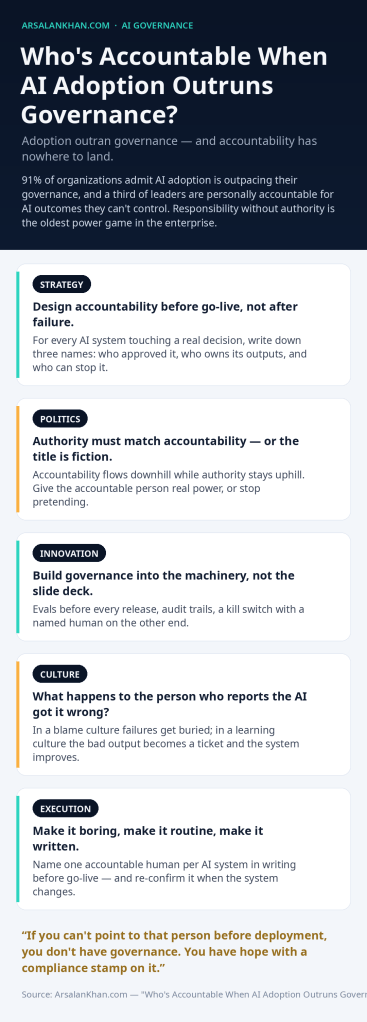
    Infographic: Who's Accountable When AI Adoption Outruns Governance?
  • 5 Questions to Ask About AI Agents

    5 Questions to Ask About AI Agents

    Yesterday I made the case that AI agents need job descriptions — a defined role, authority limits, escalation triggers, an audit trail. Several of you asked where to start. Start here, with five questions. Not about the technology. About the accountability around it.

    In this series I’ve always framed the questions the same way: where you are today, and where you should be tomorrow. Agents are no exception.

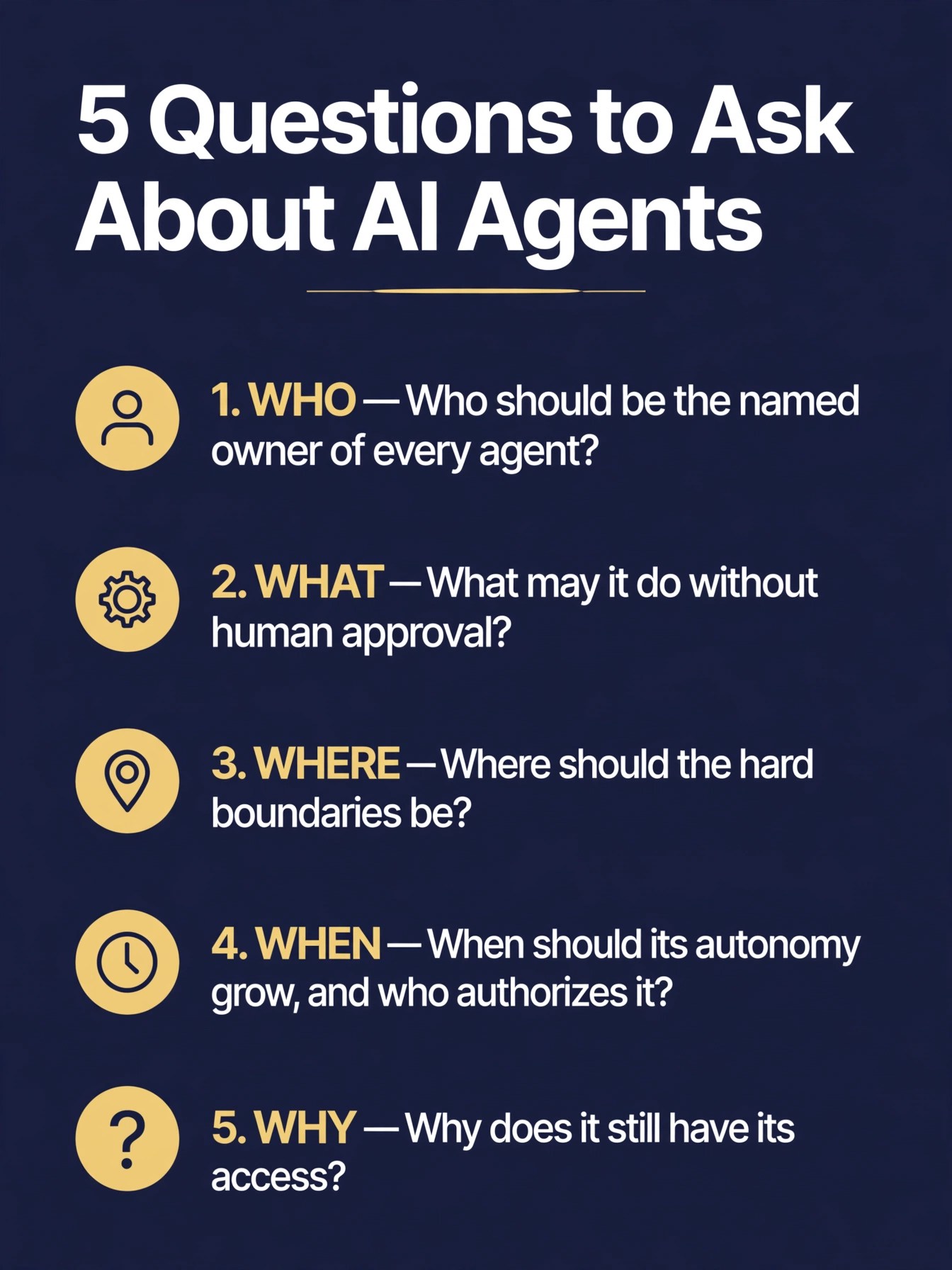
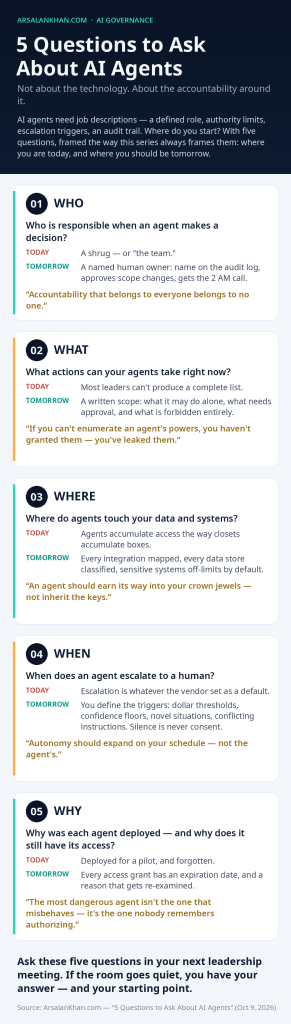
    Infographic: 5 Questions to Ask About AI Agents — WHO, WHAT, WHERE, WHEN, WHY

    1. Who — Who is responsible when an agent makes a decision? Today, the answer in most organizations is a shrug, or “the team.” Tomorrow, every agent has a named human owner — someone whose name is on the audit log, who approves scope changes, and who gets the call at 2 AM. Accountability that belongs to everyone belongs to no one.

    2. What — What actions can your agents take right now? Today, most leaders can’t produce a complete list. Tomorrow, every agent operates from a written scope: what it may do alone, what needs approval, and what is forbidden entirely. If you can’t enumerate an agent’s powers, you haven’t granted them — you’ve leaked them.

    3. Where — Where do agents touch your data and systems? Today, agents accumulate access the way closets accumulate boxes. Tomorrow, every integration is mapped, every data store is classified, and sensitive systems are off-limits by default. An agent should have to earn its way into your crown jewels, not inherit the keys.

    4. When — When does an agent escalate to a human? Today, escalation is whatever the vendor set as a default. Tomorrow, you define the triggers: dollar thresholds, confidence floors, novel situations, conflicting instructions — and a rule that silence is never consent. Autonomy should expand on your schedule, not the agent’s.

    5. Why — Why was each agent deployed, and why does it still have its access? Today, agents are deployed for a pilot and forgotten. Tomorrow, every agent’s access has an expiration date and a reason that gets re-examined. The most dangerous agent in your organization isn’t the one that misbehaves — it’s the one nobody remembers authorizing.

    Infographic: 5 Questions to Ask About AI Agents — WHO, WHAT, WHERE, WHEN, WHY

    Ask these five questions in your next leadership meeting. If the room goes quiet, you have your a

    nswer — and your starting point.

    Watch the explainer

  • Should AI Agents Have Job Descriptions?

    Should AI Agents Have Job Descriptions?

    When a new employee joins your organization, nobody just hands them a laptop and says “go figure it out.” They get a job description — what they’re responsible for, what decisions they can make on their own, what needs approval, who they report to. We invented all of that because we learned the hard way what happens when authority is ambiguous.

    So why are we onboarding AI agents with none of it?

    Agents aren’t chatbots anymore. A chatbot answers a question. An agent does something — books the flight, approves the expense, messages the customer, moves the data. The moment a system can act, it has crossed from tool to worker. And yet we govern it like a tool: deployed with default permissions, no defined role, no supervisor, no audit trail anyone reads until something breaks.

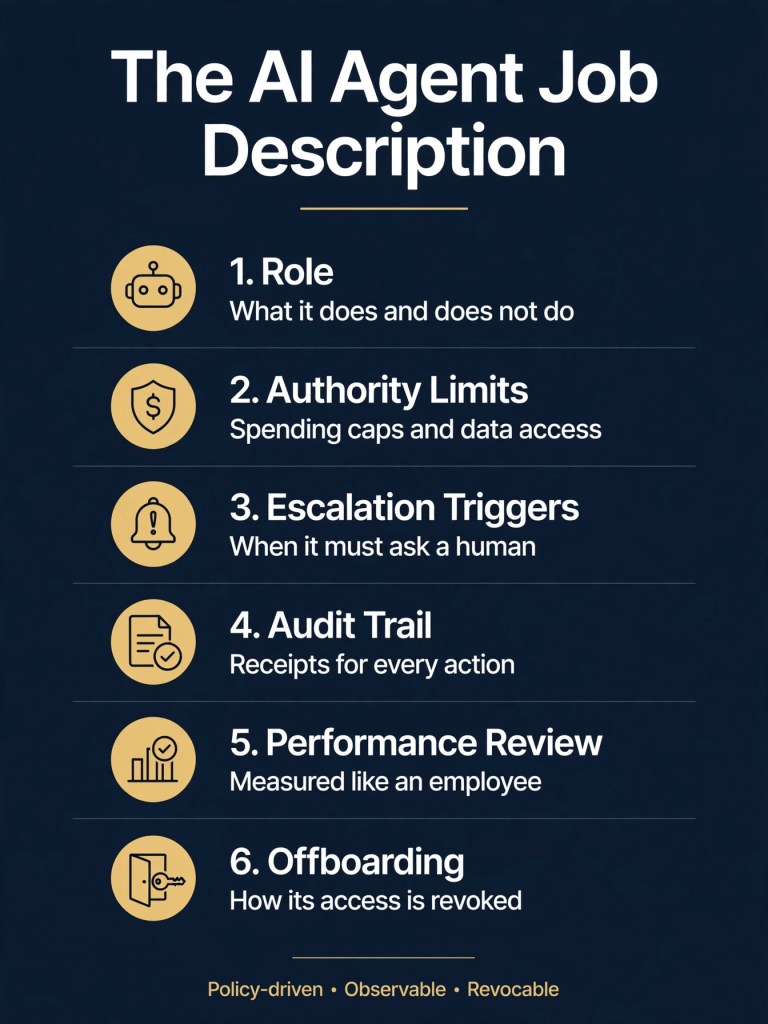
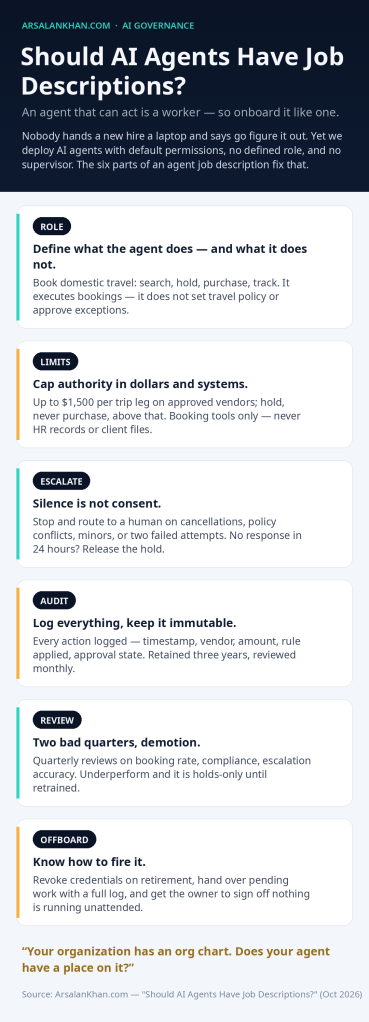
    An agent job description has six parts. Same machinery we already use for every junior hire:

    Infographic titled The AI Agent Job Description with six numbered rows

    This isn’t abstract. Here’s what one actually looks like — a travel booking agent, the kind any consulting firm or government contractor could deploy tomorrow:

    Position: Travel Booking Agent (AI) — reports to the Office Manager (human).

    Role. Book domestic travel: search flights, hotels, and rental cars; hold or purchase reservations; track confirmations and receipts; flag itinerary changes. It executes bookings — it does not set travel policy or approve exceptions to it.

    Authority limits. May purchase economy airfare and standard hotel rooms up to $1,500 per trip leg, only on the approved vendor list. May hold (not purchase) above that for 48 hours pending review. May touch only the booking tools and the corporate card profile — never personal card data, HR records, or client files. May not email travelers’ personal addresses or modify a booking once a human has confirmed it.

    Escalation triggers. The agent stops and routes to the manager when: the cheapest compliant option exceeds its limits; the traveler is a minor; a flight is cancelled, delayed 4+ hours, or rebooked to another airline; firm policy and the traveler conflict; or the same booking fails twice — no third attempt without a human. And silence is not consent: no response within 24 hours of a hold confirmation, and the agent releases the hold instead of purchasing.

    Audit trail. Every action logged — timestamp, traveler, vendor, amount, policy rule applied, approval state. Immutable, retained three years, reviewed monthly. Any escalated action carries the approving human’s name.

    Performance review. Quarterly: on-time booking rate, policy compliance, escalation accuracy — did it escalate the right things, not everything. Two bad quarters and it’s demoted to holds-only until retrained.

    Offboarding. Credentials revoked on retirement, pending work handed over with a full log, the owner signs off that nothing is left running unattended.

    Notice: nothing in there is exotic. It’s what we already do for a junior hire — define the job, cap the authority, say when to ask for help, keep receipts, know how to fire them. The only novelty is doing it for software that works at machine speed and never sleeps.

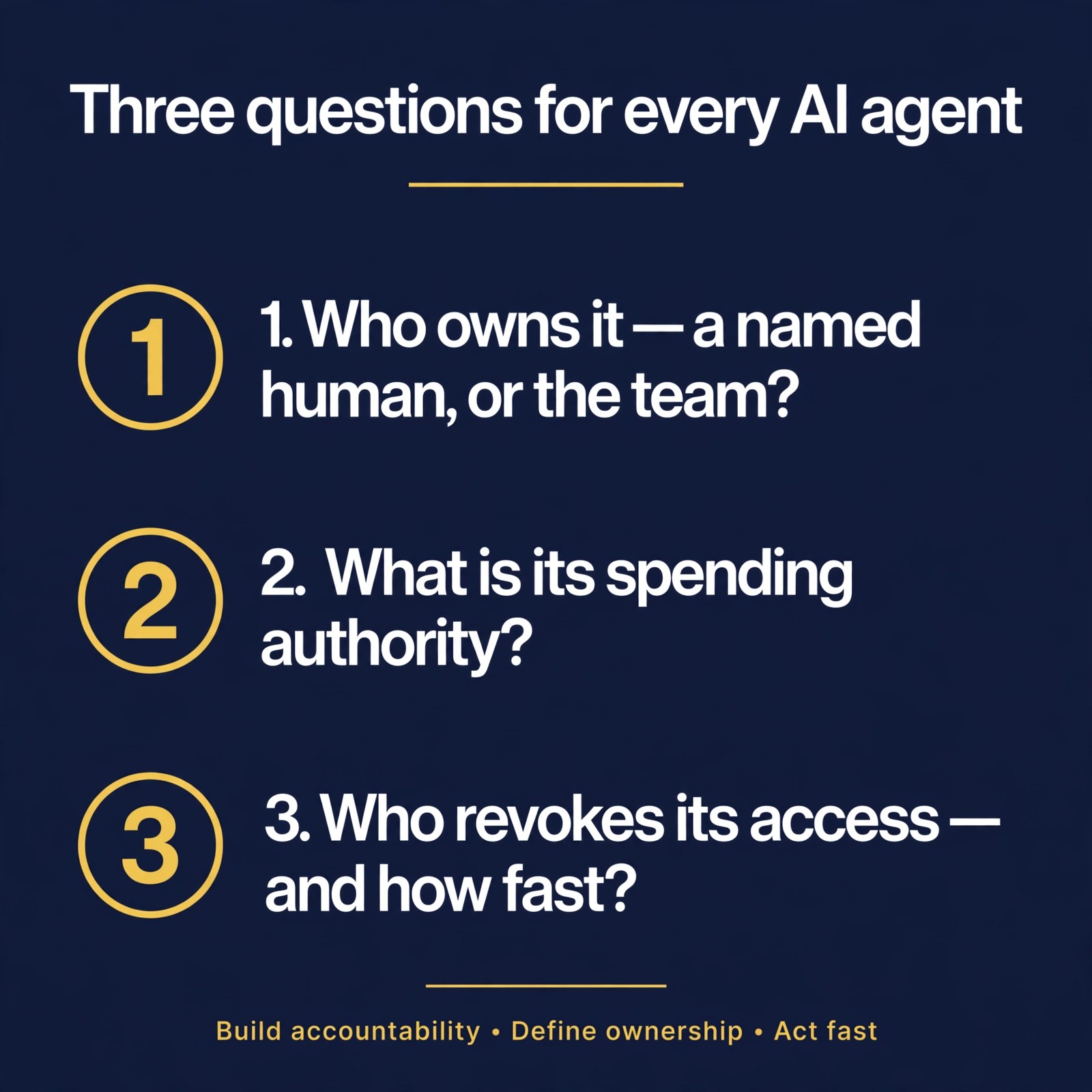
    Ask yourself the three questions about any agent running in your organization today:

    Graphic titled Three questions for every AI agent

    If you can’t answer all three, your agent doesn’t have a job description. It has a hall pass.

    Government agencies have written position descriptions and delegations of authority for decades — the exact machinery agents now need. The organizations that get agentic AI right won’t be the ones with the best models. They’ll be the ones that treat agents like employees from day one. The rest will discover, one incident at a time, that an unmanaged agent is just an employee you can’t fire — because you never hired it properly in the first place.

    Your organization has an org chart. Does your agent have a place on it?

    Infographic: Should AI Agents Have Job Descriptions?

    Watch the explainer