Today’s competitive business landscape requires that you have a solid understanding of what technology is doing and what it can do for your organization. This understanding of technology can make the difference between surviving and thriving. Organizations that merely want to survive will eventually be replaced. Organizations that want to thrive will need to do Digital Transformation. But, if someone convinced you that Digital Transformation is only about technology then you will struggle with it as stated in Business Agility and Digital Transformation, 5 Questions to Ask About Your Digital Transformation, and 5 Myths About Digital Transformation.
Digital Transformation requires the entire organization to have a culture that motivates and incentivizes to improve things. Since most functional departments operate in silos, motivations and incentives are limited to functional departments and not to the entire organization. What this means is that even before you begin your Digital Transformation journies, you should have a good understanding of what roadblocks these silos create and how you can move beyond them. While there are many ways to assess your organization’s readiness, today I am going to use the SWOT Analysis combined with SPICE to identify gaps and use it as a communications tool to address those gaps.
What is the SWOT Analysis?
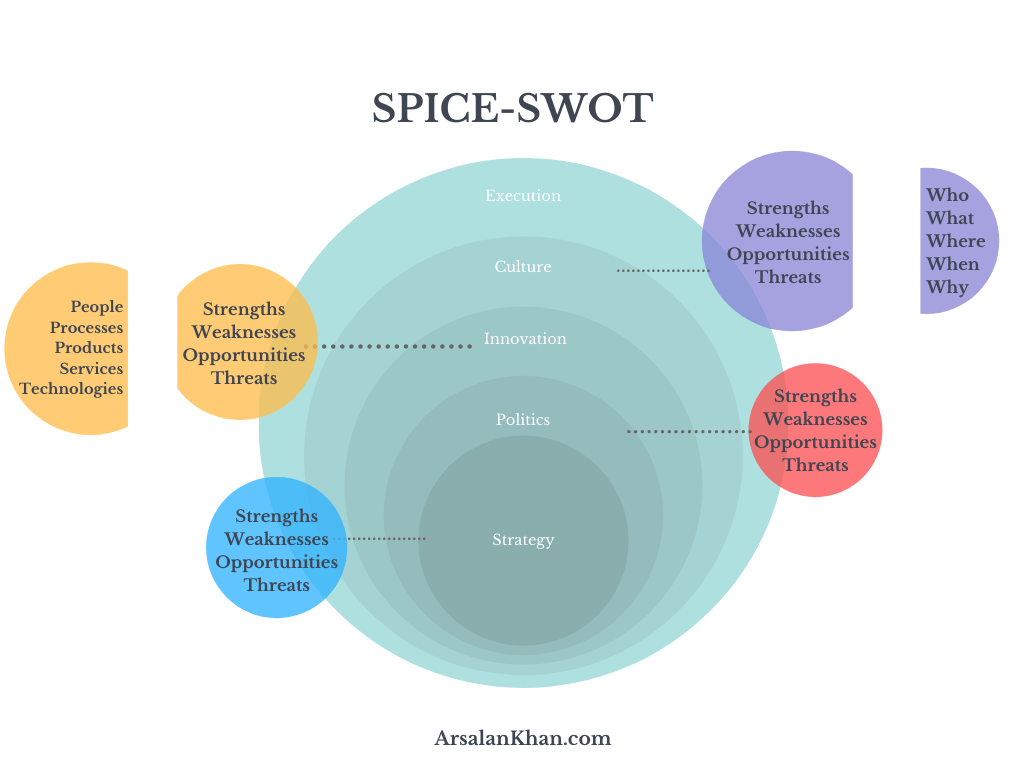
The SWOT Analysis is a way for organizations to understand their Strengths, Weaknesses, Opportunities, and Threats when it comes to operations and future planning. Strengths and Weaknesses look at the organization internally for self-assessment while the Opportunities and Threats look outside the organization.
What is the SPICE Framework?
SPICE is a way for organizations to understand its Strategy, Politics, Innovation, Culture, and Execution of today and tomorrow. SPICE looks at the Who, What, Where, When, Why for People, Processes, Products, Services, and Technologies.
Combining SPICE and SWOT
By combining SPICE and SWOT, we can get a deeper understanding of what is needed at organizations to move the needle. We can this SPICE-SWOT. Here’s how it works and specifically what questions you can ask:
Organizations develop strategies for short-term and long-term. The strategy development process can be either exclusive or inclusive. In most organizations, we have an exclusive strategy development process that involves a few key executives such as the Chief Executive Officer (CEO), Chief Financial Officer (CFO), and the Chief Operations Officer (COO). In some organizations, an inclusive strategy development process will involve executives, middle management, and front-line employees. Another way of developing an organization’s strategy is by outsourcing it to outside consulting firms. Each of the strategy development processes has its pros and cons.
Ideally, your organization’s strategy development process should have manual and digital feedbacks loops going from the front-line employees all the way to the executives and must include Chief Information Officer (CIO), Chief Marketing Officer (CMO), Chief Compliance Officer (CCO), Chief Human Resources Manager (CHRM), Chief Security Officer (CSO) and Chief Data Officer (CDO). If your organization is going to use a consulting firm then the consulting firm must:
- Take feedback from all stakeholders including customers, partners, and vendors
- Look at industry trends and cross-industry pollination opportunities
- Not develop pie-in-the-sky ideas that are not implementable
- Not merely be a mouthpiece for the CEO or the Board of Directors
Your organization’s strategy should look at how your organization can grow and how organizational operations can be improved. With this in mind, let’s ask a few questions:
- Strategic Strengths
- Who is able to develop a strategy and execute it?
- What products and/or services provide you the tools to create effective strategy?
- Where do your products and/or services specifically help in reaching strategic goals?
- When conditions change, how quickly can your strategy adapt?
- Why no one can match your strategy and strategy development processes?
- Strategic Weaknesses
- Who is always slacking on executing your strategy?
- What products and/services do not result in effective strategy?
- Where do your products and/or services specifically harm in reaching strategic goals?
- When conditions change, how often do you ignore them?
- Why others can match your strategy and strategy development processes?
- Strategic Opportunities
- Who can you partner with that understands and helps your strategy?
- What products and/or services you forsee that can help create effective strategy?
- Where do your products and/or services can benefit other organization’s in their strategy?
- When conditions change, who have you partnered up that can help you navigate them?
- Why no one can match your partner’s strategy and strategy development processes?
- Strategic Threats
- Who have you partnered up with that does not care about your strategy?
- What products and/or services from your partners can harm your strategy?
- Where do your products and/or services can hamper another organization’s strategy?
- When conditions change, who have you partnered up that are oblivious to it?
- Why anyone can match your partner’s strategy and strategy develop processes?
Wherever there are humans, there is politics. Sometimes this politics is visible and sometimes it is hidden but it is still there. In organizations, politics plays a key role in determining who gets promoted, what happens in governance boards, what vendors should be trusted, what kind of assistance should be provided, whose ideas are listened to, and who gets to give requirements to create something new for the organization.
Ideally, your organization’s politics should be addressed head-on by creating an open-door policy, ability to submit ideas/feedback/concerns anonymously both manually and digitally, and training for employees to understand how their own biases can affect the organization at various levels. Politics does not have to be a dirty work in your organization. With this in mind, let’s ask a few questions:
- Political Strengths
- Who are the go-to people at front-line, middle management and executive levels?
- What products and/or services came about due to political influence and proved to be a strength?
- Where did political influence change the culture for the better?
- When does your internal politics keeps you focused on the future?
- Why your orgnizational politics is a positive thing for the organization?
- Political Weaknesses
- Who are the people that play bad politics at front-line, middle management and executive levels?
- What products and/or services came about due to political influence and proved to be a weakness?
- Where did political influence change the culture for the worse?
- When does you internal politics distracts from what you can achieve in the future?
- Why your orgnizational politics is a negative thing for the organization?
- Political Opportunities
- Who are your go-to partners that are influencing various industries which will provide opportunities for you?
- What products and/or services that can come about due to political influence?
- Where can you use your political influence to make your customers, partners, vendors go a certain direction?
- When does you competitor’s political influence threaten their own existence?
- Why your political influence matters to others?
- Political Threats
- Who you did not partner up with who politcal influence
- What products and/or services might never be developed due to political influence?
- Where can your competitors’ use of political influence make your customers, partners, vendors go a certain direction?
- When does your competitor’s political influence threaten your existence?
- Why you have no political influence?
Innovation is the lifeblood of your organization. It energizes or demoralizes your organization. It can positively affect your organization or it can make it hollow. There are many levels of innovation that come from front-line employees (e.g., doing some tasks more efficiently), middle-management (e.g., becoming curators of innovative ideas and creating synergies) to executive management (e.g., ability to extrapolate and connect the dots at the highest levels). Innovation does not have to be disruptive, it can be incremental but it needs to happen and your organization should have a mindset to think about constantly. With this in mind, let’s ask a few questions:
- Innovation Strengths
- Who in your organization is the most innovative at the front-line, middle management, and executive levels?
- What products and/or services do you provide that no one can match?
- Where does innovation take place in your organization?
- When you have problems with products and/or services, how quickly do you fix them?
- Why do you think you can maintain a competitive advantage?
- Innovation Weaknesses
- Who in your organization is the least innovative at the front-line, middle management, and executive levels?
- What products and/or services do you provide that everyone can as well?
- Where does innovation create a bottleneck in your organization?
- When you have problems with products and/or services, how slowly do you fix them?
- Why do you think you will lose a competitive advantage?
- Innovation Opportunities
- Who can you partner with inside and/or outside your industry to be innovative?
- What products and/or services can benefit your organization in the future?
- Where are the next products and/or services coming from that you can take advantage of?
- When do you think it would the right time to launch new products and/or services?
- Why do you think you are better positioned to take advantage of new products and/or services?
- Innovation Threats
- Who might have been a good partner but now it is too late?
- What products and/or services can harm your organization in the future?
- Where are the next products and/or services coming from that might leave you behind?
- When was the right time to launch new products and/or services?
- Why do you think your competitor is better positioned to take advantage of new products and/or services?
Your culture determines your future. With this in mind, let’s ask a few questions:
- Cultural Strengths
- Who in your organization represents what your organization stands for at the front-line, middle management, and executive levels?
- What products and/or services that you provide to others that you use yourself?
- Where does your culture compliment your business objectives?
- When someone portrays complacent culture, how quickly do you fix it?
- Why is your culture better?
- Cultural Weaknesses
- Who in your organization takes your culture for granted at the front-line, middle management, and executive levels?
- What products and/or services that you provide to others but never use yourself?
- Where is your culture an obstacle to your business objectives?
- When someone portrays great initiative, how often do you ignore it?
- Why is your culture worse?
- Cultural Opportunities
- Who can you partner with that represents your cultural values?
- What products and/or services that you provide can enhance another organization’s culture?
- Where can your culture open up partnerships that might not seem obvious?
- When can your cultural values provide societal benefits?
- Why your culture is better in bringing societal change?
- Cultural Threats
- Who should your organization avoid partnering up that eats away at your culture?
- What products and/or services can make your culture useless?
- Where can your culture destroy potential long-term partnerships?
- When can your cultural values negatively affect society?
- Why a competitors’ culture might win over yours?
The ability to bring together all the capabilities of your organization to achieve business objectives is execution. Execution is hard since it requires people, products, processes, services and technologies have to be in-sync. Execution creates rythem in the organization and eventually momentum. But we always have to take time to reassess this momentum and see of the orginial underlying assumptions and conditions for execution have changed. Even today there is a big gap between what the organization whats strategically and what it is able to achieve operationally. With this in mind, let’s ask the following questions:
- Execution Strengths
- Who is incentivized at the front-line, middle management, and executive levels to produce a positive return-on-investment?
- What products and/or services help you execute your business objectives?
- Where is the sweet spot when business objectives meet execution?
- When is your execution is effective and efficient?
- Why no one can copy your execution?
- Execution Weaknesses
- Who is disincentivized at the front-line, middle management, and executive levels to produce a positive return-on-investment?
- What products and/or services create obastacles in executing your business objectives?
- Where do your business objectives and execution have gaps?
- When is your execution incompetent and wasteful?
- Why your execution can be easily copied?
- Execution Opportunities
- Who is incentivized at your partners to help you executive positively?
- What products and/or services you foresee that can increase your execution speed?
- Where can your products and/or service increase your customer’s execution speed?
- When can your execution speed provide benefit to your partners?
- Why your execution speed creates opportunity beyond your industry?
- Execution Threats
- What partners can derail your execution speed and accuracy?
- What products and/or services you forsee that can decrease your execution speed?
- Where do your products and/or services decrease your customer’s execution speed?
- When can your execution speed harm your partners?
- Why your execution speed and accuracy implode your industry?
Phew! Now that we have asked our 100 questions. Let’s get back to the question, Can the Information Technology (IT) Team do Digital Transformation. If it is not evident by now, the IT team is just one part of the entire organization. In order to do Digital Transformation, you need to make changes at all levels of the organizations. These changes are not the responsibility of the IT team only but in fact these changes occur by collaboration of IT with Accounting, Administration, Business Development, Customer Service, Finance, Human Resources, Management, Manufacturing, Marketing, Operations, Production, Research and Development, Sales and others.
Use the SPICE-SWOT to identify gaps and as a communications tool to address those gaps. For Digital Transformation, do SPICE-SWOT two times:
- IT team should self-assess their current capabilities to do Digital Transformation
- Non-IT teams should self-assess their own readiness to contribute to Digital Transformation


 Welcome to Khan's Blog
You must be logged in to post a comment.