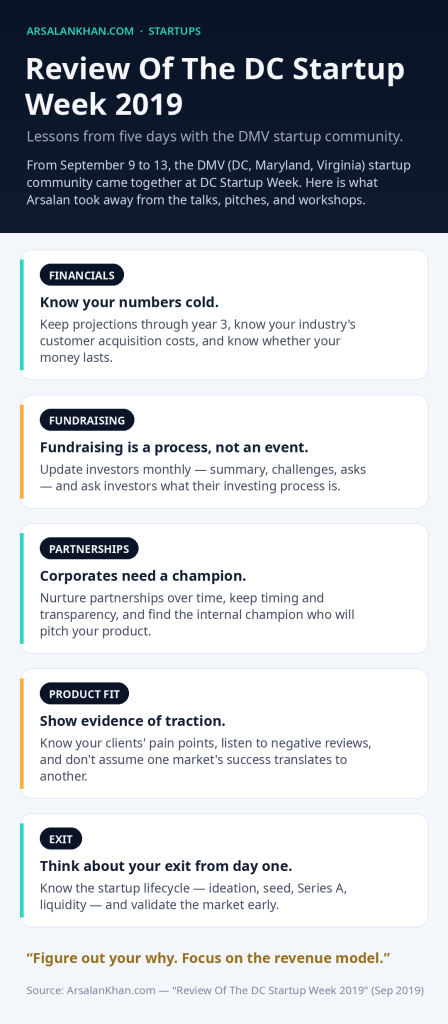
Last week, I had the opportunity to attend the Washington DC Startup Week 2019 which was from September 9th to the 13th. During this week, the DMV (DC, Maryland, and Virginia) startup community came together to learn and grow from each other and from experts around the world. Following are some of the things I learned as I attended the various talks, pitches, and workshops:
Financial Projections for SaaS Companies from GSP
Most SaaS companies charge the client(s) everything upfront for the services
Freemium model should be used only to figure out what the actual pricing might be
Customer services should be a cost so gross profits look good
15% of base salary is a good measure to determine employee benefits
When you add customers then you need to add employee (Sales and Marketing) too
Sales and Marketing projections should not be constant over the years
To get Venture Capitalist (VC) funding:
Keep financial projections until year 3
Determine if money will last for what you want to build
Know your industry’s Customer Aquisition Costs (CAC)
My Thoughts:
Determine the likely cost (money, reputation) of a data breach
Create a checklist of what to do and not to do when making projections
Accounting Procedures for Startups
Investors look at accrual accounting
Investors will compare your gross profits to your industry
Projects should be positive and show a real picture
My Thoughts:
Except googling there seems to be no place to look at various industry gross profits for various industries at one centralized location
Fundraising
There are three major main sources of funding:
Government Grants
Angel Investors
Venture Capitalists
Keep in mind what you are building towards and the specific milestones
Provide monthly (or sooner when needed) updates to investors:
Summary of what happened
Challenges
List of Ask(s)
Ask investors what is their investing process
Pay yourself minimum (initially) to enough (when a company becomes self-sustaining)
Avoid these common mistakes:
Asking for more money isn’t always better
Don’t be afraid to negotiate
Focus on product/service and customer service
Show the landscape of the market, trends and where you fit in
Best Practices for Corporate and Startup Partnerships
Startups bring freshness to the organization
3 things corporations care about when looking at startups:
A problem needs to solve
See something incidental
If this scales up, we will have problems
Nurture partnerships overtime
Transparency and timing is important
Always do due diligence before taking on a partner
Help people think outside the box
Corporations need mechanisms to speed things up
Figure out corporations pain points
Have a champion internally in the corporation that can pitch for your product or service
Corporations look at their internal capabilities vs. external capabilities of startups
75% of USD $100B Venture Capitalist money goes to California, New York, and Massachusetts
Using Design Thinking for Products and Services
Design for simplicity
Design to make things easier
Finding Product/Market Fit
Have a focus on who your client is going to be
Sometimes your products/services might be ahead of its time
Don’t lie
Don’t assume success in one market will translate into another
It is best when the majority of the sales are inbound
Show/have evidence of traction
The lifecycle of a Startup Funds:
Ideation – friends and family, crowdfunding, bootstrapping
Seed Stage – minimum viable product (MVP)
Series A – real revenue
Liquidity – exit
To iterate on your MVP go to different groups to see what works and why it works
Be self-aware
Show repeatable product/service and then figure out how to get customers
Customer Aquisition Costs (CAC) strategy is very important
Think about your exit strategy and who would buy your company
Validate the market
Have a conversation with your competitors
Develop relationships with potential acquirers
Always have a domain experience
Watch a customer go through the product
To get a product/service market fit:
Who are you trying to help
Make it your priority to know pain points
Listen to negative reviews
As investors, they care more about the numbers (money) than the story
Figure out your why
Focus on the revenue model
Give real-world examples of pain points
Startup Pitches
1. Guardian Savings – a digital savings bank for children
2. JSkills – providing career transition skills training for journalists
3. Forget me not AI – personalized automated customer interaction
4. Akku – portable battery pack pickup and drop-off
5. Tabitha – Restaurant payment processing app for customers
6. Mully Lingua – Language and culture immersion app
7. Co-Tripper – Single mom group travel
8. Koin Street – A place to manage digital assets
9. Please Assist Me – Chores completion services when you are out of the house
Processing…
Success! You're on the list.
Whoops! There was an error and we couldn't process your subscription. Please reload the page and try again.


You must be logged in to post a comment.