Tag: SPICE Framework

  • Your Employees Are Already Using AI — They Just Stopped Telling You

    Here's the number your IT department doesn't want to think about: roughly 45% of enterprises have no real visibility into how their employees are using AI. Nearly half are flying blind.

    Now here's the uncomfortable follow-up: the employees aren't waiting for visibility. They aren't waiting for permission either. The analyst pasting client data into a public chatbot, the marketer generating campaign copy on an unsanctioned tool, the engineer letting an AI assistant read proprietary code — none of them asked. They just did it, because it made Tuesday afternoon survivable. Your AI policy didn't stop AI use. It stopped honesty about AI use.

    This is the part most governance conversations get backwards. Shadow AI is treated as a tooling problem — unapproved software to be blocked, detected, and stamped out. It's not a tooling problem. It's a trust problem, and in most organizations, the governance itself created it. When the official path is a six-week approval process and the unofficial path is a browser tab, employees don't choose the unofficial path because they're reckless. They choose it because they're trying to do their jobs. Heavy-handed governance didn't eliminate the behavior; it eliminated your view of the behavior. You traded visibility for the illusion of control, and the 45% number is the receipt.

    Run it through SPICE:

    Strategy. You cannot govern what you cannot see — so visibility has to come before control, not after it. The strategic move isn't a better ban; it's a better offer. Declare a simple principle: anything employees use openly, on approved rails, is fine; anything hidden is the risk. Then make the approved rails genuinely good — sanctioned models, internal sandboxes, data that stays inside the walls. Strategy here means competing with the shadow, not just condemning it. If your official AI tools are worse than the public ones, your policy is a suggestion and everyone knows it.

    Politics. What we're really watching is a cat-and-mouse game between IT and the workforce, and it's worth asking who's winning. IT bans a tool; employees route around it by Friday. Security blocks a domain; the work moves to personal devices, which is worse for everyone. Each round of prohibition pushes usage further from oversight while teaching employees that the governance function is an adversary. That's a political failure, not a technical one. The departments that "win" the ban usually discover they've won the right to be surprised — loudly, publicly, and at the worst possible moment.

    Innovation. The innovative response isn't detection software — it's disclosure design. Build the internal alternative people actually want: a sanctioned assistant with your company's data, proper guardrails, and none of the friction. Some of the best enterprise AI rollouts I've watched started with the question "what are people already doing in the shadows?" and simply productized the answer. Your employees did your user research for you, for free, at scale. The innovation is listening to it instead of punishing it.

    Culture. Everything hinges on one question: what happens to the first person who admits what they've been using? If the answer is a disciplinary meeting, you've just taught the other 99% to hide better. If the answer is "thanks — here's the approved version, and here's what we learned from your workflow" — you've recruited your best evangelist. Culture isn't the AI policy on the intranet. It's what happened to the last person who got caught, and whether the story that traveled was "they helped me" or "they made an example of me." Trust is the infrastructure; the tools are just paint.

    Execution. Start with amnesty, not audits. Announce a window: declare what you're using, nothing bad happens, and we'll build you a better path. You'll get your inventory — the real one, not the fantasy in the compliance deck — and you'll get it in weeks instead of years. Then catalog what you found, retire the riskiest patterns first, stand up approved alternatives, and train people on the line between "helpful" and "career-limiting." Measure disclosure, not just compliance: the metric that matters is what percentage of AI use you can see, trending up, quarter over quarter.

    Today, nearly half of enterprises can't see how AI is being used inside their own walls — while their employees use it every day, quietly, on tools nobody vetted. Tomorrow belongs to the organizations that made honesty the path of least resistance: declare it, we'll support it, and together we'll make it safe.

    Your people already voted with their keyboards. The only question left is whether you want to know what they voted for.
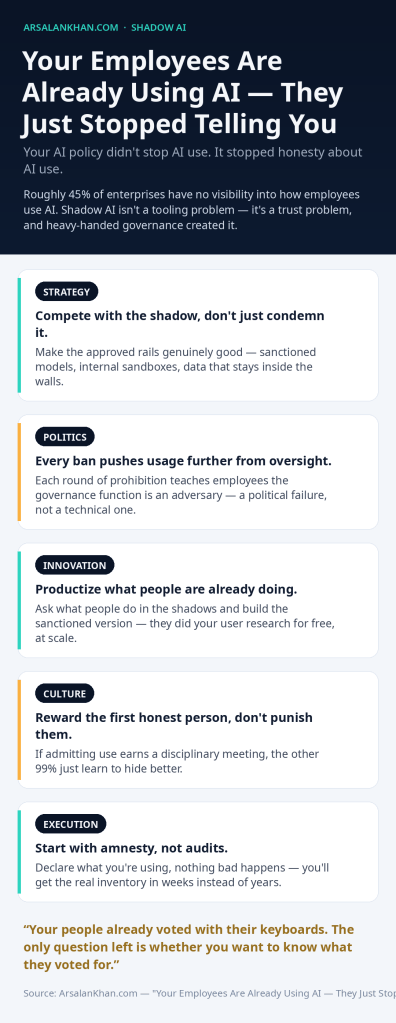
    Infographic: Your Employees Are Already Using AI — They Just Stopped Telling You
  • Who’s Accountable When AI Adoption Outruns Governance?

    Here's a number that should end meetings: 91%. That's the share of organizations that now admit AI adoption is outpacing their governance — fresh data from October 7, 2026. And here's the one that should start them: a third of leaders say they're personally accountable for AI outcomes they can't actually control.

    Read that again. Accountable for outcomes they can't control. There is a name for that condition in every organization I've ever worked in, and it isn't "a governance gap." It's politics — the purest kind. Responsibility without authority is the oldest power game in the enterprise, and AI just gave it a faster engine.

    We've spent three years writing AI governance as paperwork: principles, committees, policy PDFs that nobody reads until something breaks. Then something breaks, and everyone discovers the paperwork named no one. Governance theater produces exactly what theater produces — a good show and no change in the outcome. Accountability is a different thing entirely. It's a name, a signature, and a person who agreed in advance to own the result. If you can't point to that person before deployment, you don't have governance. You have hope with a compliance stamp on it.

    Run it through SPICE:

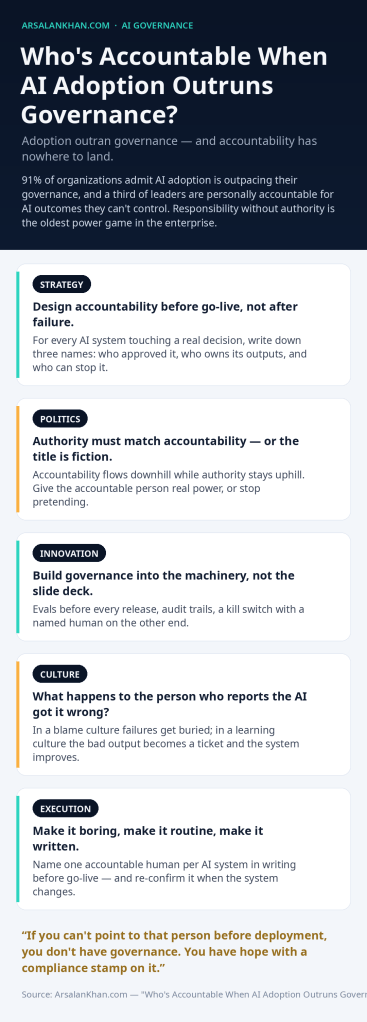
    Strategy. Accountability is designed, not assigned. It gets decided before the system goes live — in the same meeting where you approve the budget and the timeline — not in the incident review afterward. For every AI system that touches a real decision, write down three names: who approved its deployment, who owns its outputs, and who can stop it. Not teams. Not committees. Names. Strategy here isn't a framework; it's the refusal to let "everyone owns it" mean "no one owns it." The organizations getting this right treat accountability the way they treat architecture — decided up front, documented, and reviewed when conditions change.

    Politics. This is where it actually lives, so let's name it plainly. In most enterprises, accountability flows downhill while authority stays uphill. The vendor chose the model. A team deployed it under deadline pressure. An executive signed a one-line approval between meetings. And when it fails, the person answering for it is whoever is closest to the blast radius — rarely the person who had the power to prevent it. A third of leaders holding accountability they can't control isn't a data point; it's a diagnosis. The fix is political before it's procedural: give the accountable person real authority — over the data, the deployment decision, and the kill switch — or stop pretending they're accountable and name whoever actually holds the power.

    Innovation. The most useful governance innovation of the last two years isn't a policy — it's machinery. Evals that run before every release. Audit trails that record what the system did and why. A kill switch with a named human on the other end of it. None of this is glamorous, which is exactly why it works: it moves accountability out of the slide deck and into the system itself. An agent you can interrogate, halt, and roll back is governable. An agent you can only describe in a risk register is a liability with good documentation.

    Culture. Here's what determines whether any of the above survives contact with reality: what happens to the person who reports that the AI got it wrong? In a blame culture, accountability means punishment — so failures get buried, near-misses go unreported, and the same failure repeats at larger scale. In a learning culture, accountability means ownership of the fix — so the bad output becomes a ticket, the ticket becomes an eval, and the system gets better. Your governance posture is downstream of that answer. People don't hide AI failures because they're dishonest; they hide them because they've watched what happens to messengers.

    Execution. Make it boring and make it routine. Name one accountable human per AI system, in writing, before go-live — and re-confirm it when the system changes, because it will. Run pre-mortems: "it's six months from now and this system failed publicly — what happened, and who saw it coming?" Audit AI-influenced decisions the way you'd audit expenses — sampling, documentation, a human appeal path that actually functions. And publish the accountability map internally. Sunlight doesn't just deter corner-cutting; it tells every employee exactly whose judgment stands behind the machine's.

    Today, 91% of organizations admit adoption has outrun governance, and a third of their leaders are holding accountability without authority. Tomorrow, the serious operators won't have better policies — they'll have shorter lists. Fewer systems, each with a name attached, each with someone who can stop it and the power to mean it.

    Ask yourself: if your highest-stakes AI system failed spectacularly tomorrow morning, whose desk does the call land on — and did that person agree to it, or did they just get cc'd?

    Infographic: Who's Accountable When AI Adoption Outruns Governance?