Category: Business Improvement and Transformation

Business Improvement and Transformation

  • Fueling Innovation Through Enterprise Architecture: A Symbiotic Relationship

    Introduction

    Innovation is the lifeblood of progress, and in today’s rapidly evolving business landscape, organizations are increasingly turning to Enterprise Architecture (EA) to foster and streamline innovation. EA, traditionally seen as a framework for optimizing operations, is emerging as a catalyst for innovation. This article delves into the dynamic relationship between Enterprise Architecture and innovation, demonstrating how the two work in synergy to drive growth and competitiveness.

    Understanding Enterprise Architecture (EA)

    Enterprise Architecture is a strategic framework that aligns an organization’s processes, data, technology, and resources with its goals and objectives. It provides a structured view of an organization’s current state, desired future state, and a roadmap to bridge the gap between them. EA acts as a blueprint, ensuring that all components of the organization operate cohesively and efficiently.

    Unraveling the Essence of Innovation

    Innovation is the process of creating novel solutions, products, or services that address emerging challenges or fulfill unmet needs. It thrives on creativity, agility, and a willingness to explore new avenues. Innovation can manifest in various forms, from incremental improvements to disruptive breakthroughs, all of which have the potential to reshape industries.

    The Symbiotic Nature of EA and Innovation

    1. Strategic Alignment: Enterprise Architecture provides a strategic perspective on how an organization functions. It ensures that innovation efforts align with the broader goals of the organization, avoiding disjointed initiatives. EA acts as a compass, guiding innovation toward areas that have the most significant impact on the business.
    2. Efficiency and Resource Optimization: EA’s core principles include optimizing processes and resource utilization. By streamlining operations and reducing redundancy, EA frees up resources that can be reinvested in innovation endeavors, whether that means R&D, new technology adoption, or creative projects.
    3. Data-Driven Innovation: EA’s focus on data management and governance supports data-driven innovation. It enables organizations to harness the power of data analytics, uncover insights, and make informed decisions that lead to innovative solutions or products.
    4. Technology Enablement: EA helps organizations make informed decisions about technology adoption and integration. This ensures that innovation initiatives are not hindered by outdated or incompatible technology systems and can leverage the latest tools and platforms.
    5. Agility and Adaptability: Innovation often requires the ability to adapt to change quickly. EA frameworks emphasize agility and flexibility, allowing organizations to pivot when necessary and respond to emerging opportunities or threats in the market.
    6. Collaboration and Communication: Effective communication and collaboration are critical for innovation. EA’s emphasis on aligning processes and teams can foster a culture of cross-functional collaboration, where ideas flow more freely and innovation thrives.

    Challenges and Considerations

    While EA can catalyze innovation, several challenges and considerations exist:

    1. Cultural Shift: Innovation often requires a cultural shift within organizations. EA can facilitate this shift by emphasizing the importance of change and innovation in achieving strategic goals.
    2. Balancing Efficiency and Creativity: Striking the right balance between efficiency (a focus of EA) and creativity (a driver of innovation) can be challenging. Organizations must find a harmonious coexistence.
    3. Resource Allocation: Allocating resources to both EA and innovation initiatives may require careful planning and prioritization.

    Conclusion

    The synergy between Enterprise Architecture and innovation is a testament to the adaptability and resilience of modern organizations. EA’s structured approach, data-driven insights, and strategic alignment provide a fertile ground for innovation to flourish. In an era where innovation is a competitive necessity, organizations that harness the power of both EA and innovation are poised to thrive, adapt, and lead in their respective industries. The partnership between EA and innovation isn’t just about optimizing operations; it’s about shaping the future of successful, forward-thinking organizations.
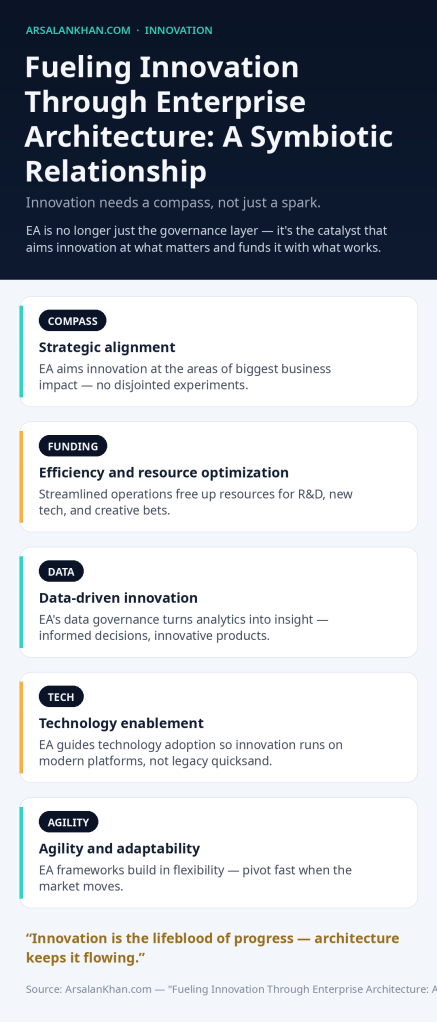
    Infographic: Fueling Innovation Through Enterprise Architecture: A Symbiotic Relationship
  • Bridging the Gap: How Enterprise Architecture Empowers Startups

    Introduction

    The startup ecosystem is synonymous with innovation, agility, and rapid growth. In contrast, Enterprise Architecture (EA) is often associated with established, large organizations. However, the relationship between EA and startups is far from incongruous. In this article, we explore how Enterprise Architecture can be a valuable asset for startups, empowering them to scale efficiently, maintain long-term viability, and navigate the complexities of growth.

    Understanding Enterprise Architecture (EA)

    Enterprise Architecture is a strategic framework that aligns an organization’s processes, data, technology, and resources with its goals and objectives. It provides a structured view of an organization’s current state, desired future state, and a roadmap to bridge the gap between them. EA serves as a blueprint, ensuring that all components of the organization operate cohesively and efficiently.

    Demystifying Startups

    Startups are entrepreneurial ventures characterized by their innovative ideas, agility, and potential for rapid growth. While startups often begin with a lean and flexible approach, as they scale, they face challenges related to scalability, efficiency, and long-term sustainability.

    The Synergy of EA and Startups

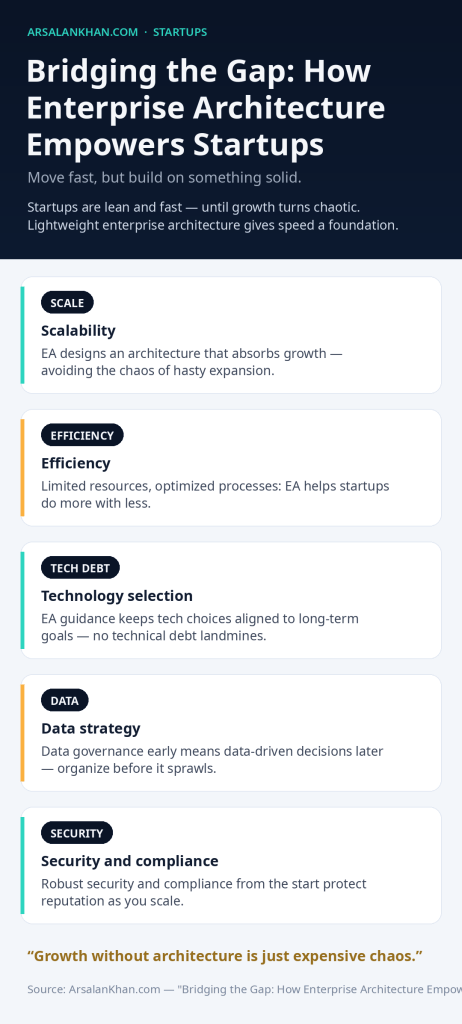
    1. Scalability: Startups aspire to grow quickly, and this growth can be chaotic without a solid foundation. EA provides the scalability framework needed to support rapid growth. By designing an architecture that can adapt to increased demands, startups can avoid pitfalls associated with hasty expansion.
    2. Efficiency: Startups often operate with limited resources, making operational efficiency crucial. EA’s focus on process optimization can help startups streamline their operations, reduce costs, and make the most of their resources.
    3. Technology Selection: Startups frequently adopt new technologies, but the choice can be overwhelming. EA’s guidance can ensure that technology decisions align with long-term goals and don’t create technical debt that hinders growth.
    4. Data Strategy: Data is a valuable asset for startups, but managing it can be challenging. EA’s emphasis on data governance and management helps startups organize and utilize data effectively, facilitating data-driven decision-making.
    5. Security and Compliance: As startups expand, they often encounter security and compliance requirements. EA can help startups implement robust security measures and ensure compliance with industry regulations, safeguarding their reputation and operations.
    6. Long-Term Viability: Many startups aim for sustainable growth and long-term viability. EA’s holistic approach to strategy and architecture can support this goal by aligning startup activities with their vision and ensuring they remain adaptable and competitive in the long run.

    Challenges and Considerations

    While the integration of Enterprise Architecture can benefit startups, there are some considerations:

    1. Resource Constraints: Startups may have limited resources to dedicate to EA initiatives. It’s essential to strike a balance between adopting EA practices and maintaining agility.
    2. Timeliness: Startups often operate in fast-paced environments, and the implementation of EA processes may need to be tailored to accommodate shorter timelines.
    3. Customization: Startups may require custom-tailored EA solutions that fit their unique needs rather than adopting complex enterprise-level frameworks.

    Conclusion

    The synergy between Enterprise Architecture and startups might not be immediately apparent, but it is undeniably powerful. By incorporating EA principles and practices into their growth strategies, startups can build a solid foundation for scalability, efficiency, and long-term success. In an ecosystem where innovation meets the demand for sustainable growth, EA can be the bridge that empowers startups to navigate the complexities of the business world while staying true to their entrepreneurial spirit. It’s not a matter of whether startups need Enterprise Architecture, but rather how they can leverage it to thrive in their journey toward success.

    Infographic: Bridging the Gap: How Enterprise Architecture Empowers Startups
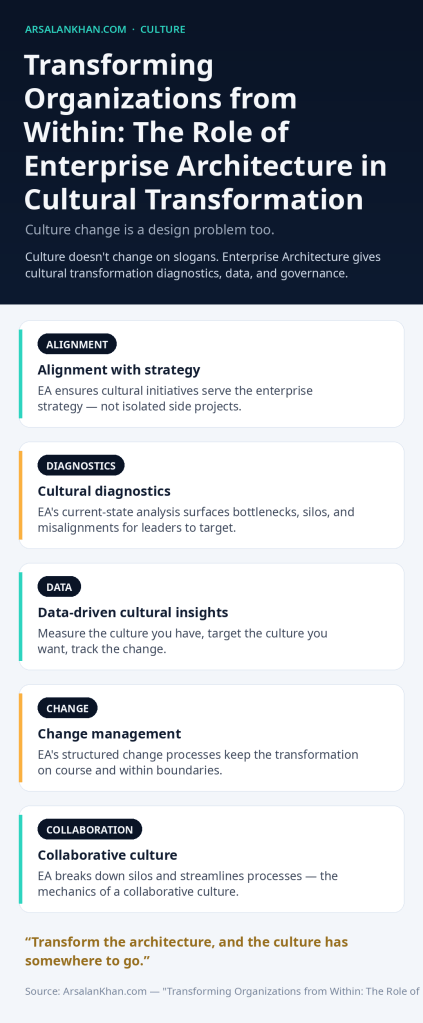
  • Transforming Organizations from Within: The Role of Enterprise Architecture in Cultural Transformation

    Introduction

    In the fast-paced world of business, where adaptability and innovation are essential, organizations are increasingly recognizing the significance of Cultural Transformation (CT). Simultaneously, Enterprise Architecture (EA) has established itself as a critical framework for managing an organization’s structure and processes. This article explores the dynamic relationship between Enterprise Architecture and Cultural Transformation, highlighting how EA can serve as a catalyst for reshaping an organization’s culture.

    Understanding Enterprise Architecture (EA)

    Enterprise Architecture is a holistic framework that focuses on aligning an organization’s processes, data, technology, and people to achieve strategic objectives. It provides a structured view of an organization’s current state, desired future state, and a roadmap to bridge the gap between them. EA serves as a blueprint, ensuring that every component of the organization operates cohesively and efficiently.

    Demystifying Cultural Transformation (CT)

    Cultural Transformation, on the other hand, is the deliberate and systematic shift in an organization’s values, beliefs, behaviors, and norms. It aims to foster an environment that promotes innovation, agility, collaboration, and customer-centricity. CT recognizes that an organization’s culture plays a pivotal role in determining its ability to adapt to change and remain competitive.

    The Symbiosis of EA and CT

    1. Alignment with Strategic Objectives: Enterprise Architecture provides a strategic perspective on how an organization functions. It ensures that Cultural Transformation initiatives are in harmony with the broader strategic goals and objectives of the organization. EA acts as a guiding light, ensuring that cultural changes are not isolated but integrated into the overarching architectural plan.
    2. Cultural Diagnostics: EA can be used to perform cultural diagnostics. By analyzing the organization’s current state through the lens of EA, leaders can identify cultural bottlenecks, silos, or misalignments. These insights become invaluable when designing CT initiatives.
    3. Data-Driven Cultural Insights: EA’s emphasis on data and information management can be leveraged to gather data about the existing culture. This data-driven approach helps leaders make informed decisions about which cultural aspects need transformation and how progress can be measured.
    4. Change Management: EA’s structured approach to change management aligns with CT’s goals of shifting organizational culture. EA’s governance processes can help guide and oversee the transformation, ensuring it remains on course and within established boundaries.
    5. Collaborative Culture: CT often emphasizes collaboration and cross-functional teamwork. EA’s role in breaking down organizational silos and streamlining processes can facilitate a more collaborative culture, which is essential for successful CT.
    6. Communication and Transparency: EA emphasizes clear documentation and communication of architectural principles and strategies. This practice can be extended to CT initiatives, ensuring that employees understand the rationale behind cultural changes and the benefits they bring.

    Challenges and Considerations

    While EA can significantly contribute to Cultural Transformation, several challenges must be considered:

    1. Resistance to Change: Cultural Transformation often faces resistance from employees accustomed to existing norms. EA’s communication and change management strategies can help mitigate this resistance.
    2. Time and Patience: Cultural Transformation is a long-term endeavor. EA’s structured approach ensures that organizations stay committed to the transformation journey even in the face of challenges.
    3. Leadership Commitment: CT and EA both require strong leadership commitment. Leaders must champion the cultural change and support it with actions that align with the transformation goals.

    Conclusion

    The relationship between Enterprise Architecture and Cultural Transformation is one of mutual reinforcement. EA provides the structure, strategy, and governance required to initiate and sustain cultural shifts within organizations. By integrating CT into the architectural vision, organizations can strategically shape their culture to be more adaptive, innovative, and customer-centric. In an era where organizational culture plays a pivotal role in competitive advantage, the symbiotic partnership between EA and CT offers a pathway for organizations to thrive and evolve in the ever-changing business landscape.

    Infographic: Transforming Organizations from Within: The Role of Enterprise Architecture in Cultural Transformation
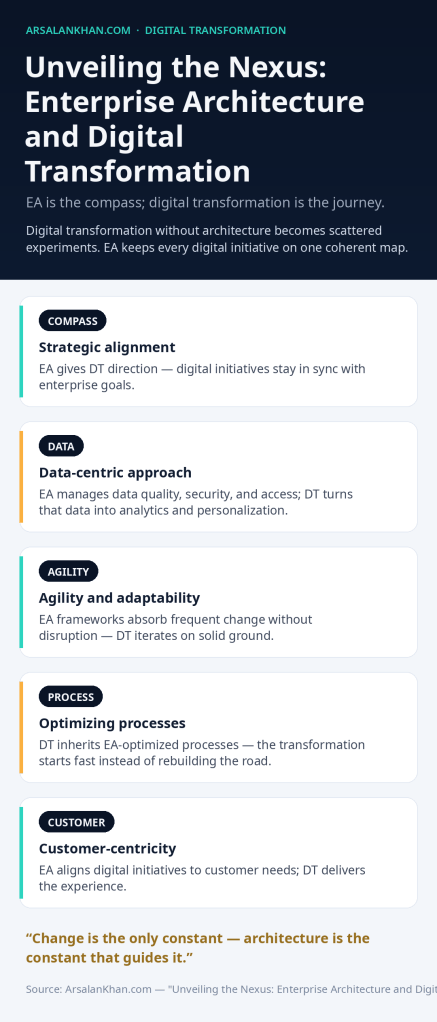
  • Unveiling the Nexus: Enterprise Architecture and Digital Transformation

    Introduction

    In the digital era, where change is the only constant, organizations are compelled to undergo radical shifts to remain competitive. Enter two powerful forces: Enterprise Architecture (EA) and Digital Transformation (DT). While EA is an established framework for managing organizational structures and processes, DT is the strategic response to the ever-evolving digital landscape. This article explores the symbiotic relationship between Enterprise Architecture and Digital Transformation, highlighting how they converge to reshape businesses for the future.

    Understanding Enterprise Architecture (EA)

    Enterprise Architecture is a strategic framework that orchestrates an organization’s processes, data, technology, and human resources to align with its goals and objectives. It serves as a blueprint, offering a holistic view of an organization’s current state, future aspirations, and the roadmap to bridge the gap between them. EA is about ensuring that every component of the organization works in harmony to achieve optimal efficiency and effectiveness.

    Decoding Digital Transformation (DT)

    Digital Transformation, on the other hand, is the systematic overhaul of an organization’s business models, processes, and technologies to leverage digital advancements fully. DT is not just about adopting the latest technologies; it’s about fundamentally altering how businesses operate, engage with customers, and create value. It’s a response to the changing expectations of customers, the emergence of new technologies, and the need for agility in a rapidly evolving market.

    The Symbiosis of EA and DT

    1. Strategic Alignment: Enterprise Architecture serves as the compass for Digital Transformation. It provides the strategic direction, ensuring that DT initiatives are in sync with the overall organizational goals. EA acts as the guiding force, making certain that digital initiatives don’t become isolated experiments but are part of a coherent, well-structured plan.
    2. Data-Centric Approach: Data is the lifeblood of Digital Transformation. EA helps in managing and organizing data across the enterprise, ensuring its quality, security, and accessibility. DT, in return, leverages this data for analytics, personalization, and decision-making, driving innovation and customer-centricity.
    3. Agility and Adaptability: DT demands agility, and EA provides the foundation for it. EA frameworks enable organizations to embrace change without disruption. As DT initiatives often involve frequent updates and iterations, EA ensures that these changes align with the overarching architectural principles.
    4. Optimizing Processes: EA meticulously analyzes and optimizes existing processes. When DT initiatives kick in, they inherit these well-optimized processes, which can significantly expedite the transformation journey. DT, in turn, highlights areas where EA might need further refinement to accommodate digital strategies.
    5. Customer-Centricity: Both EA and DT share a focus on customers. EA ensures that digital initiatives align with customer needs and expectations, while DT empowers organizations to leverage digital tools and insights to create exceptional customer experiences.
    6. Innovation Engine: DT thrives on innovation, and EA provides the framework for controlled innovation. EA’s governance structures ensure that DT initiatives are aligned with business strategies while maintaining compliance and risk management.

    Challenges and Considerations

    While the synergy between Enterprise Architecture and Digital Transformation is powerful, it’s not without its challenges:

    1. Cultural Shift: Implementing DT often requires a cultural shift within organizations. EA can assist in driving this shift by emphasizing the importance of embracing change as part of the architectural vision.
    2. Skills and Talent: Both EA and DT require skilled professionals. Organizations may need to invest in training and talent acquisition to bridge skill gaps.
    3. Legacy Systems: Legacy systems can pose a hurdle in DT initiatives. EA can help in devising a strategy to modernize or integrate legacy systems seamlessly.

    Conclusion

    In the journey of Digital Transformation, Enterprise Architecture is the compass and the foundation upon which organizations build their future. EA ensures that DT initiatives are strategically aligned, data-driven, and capable of delivering customer-centric, innovative solutions. Together, EA and DT create a powerful partnership that enables organizations not just to adapt to the digital age but to thrive in it. As businesses continue to evolve in the dynamic digital landscape, this symbiotic relationship becomes increasingly essential for their success and relevance.

    Infographic: Unveiling the Nexus: Enterprise Architecture and Digital Transformation
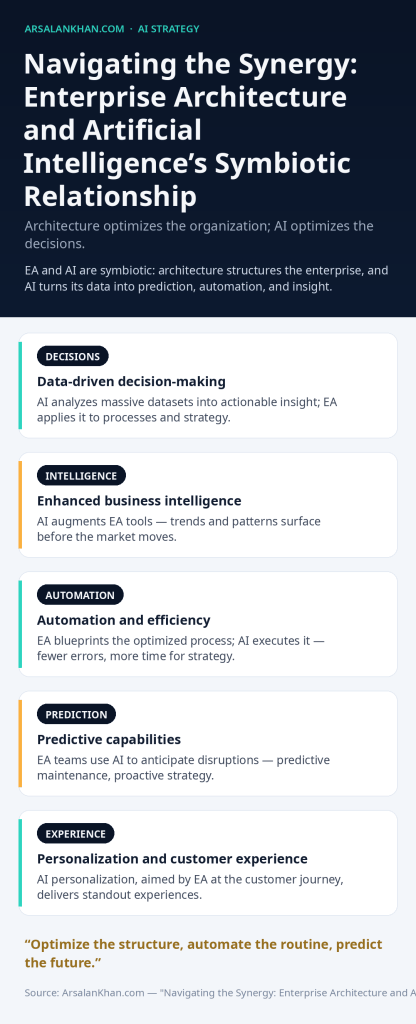
  • Navigating the Synergy: Enterprise Architecture and Artificial Intelligence’s Symbiotic Relationship

    Introduction

    In the ever-evolving landscape of modern business, two distinct but interrelated fields have risen to prominence: Enterprise Architecture (EA) and Artificial Intelligence (AI). While each has its own unique domain and focus, their relationship is increasingly becoming a symbiotic one. Enterprise Architecture, as a discipline, seeks to optimize the structure and operation of organizations, whereas Artificial Intelligence leverages data and algorithms to make predictions and automate tasks. In this article, we delve into the intricate interplay between Enterprise Architecture and AI, exploring how they complement and enhance each other to drive innovation, efficiency, and competitiveness in the contemporary business world.

    Understanding Enterprise Architecture (EA)

    Enterprise Architecture is a comprehensive approach to managing and aligning an organization’s processes, information, technology, and people to achieve strategic objectives. It provides a holistic view of an organization, capturing its current state, defining the target state, and bridging the gap between the two. EA is characterized by its framework, which includes the documentation of business processes, data models, technology landscapes, and governance structures.

    The Role of Artificial Intelligence (AI)

    AI, on the other hand, refers to the simulation of human intelligence in machines, allowing them to perform tasks that typically require human intelligence, such as learning from data, reasoning, problem-solving, and language understanding. AI encompasses various technologies, including machine learning, deep learning, natural language processing, and computer vision, which enable systems to analyze vast datasets and extract valuable insights.

    The Symbiosis of EA and AI

    1. Data-Driven Decision-Making: One of the fundamental principles of Enterprise Architecture is informed decision-making. AI plays a pivotal role in this aspect by analyzing massive datasets and providing actionable insights. EA professionals can harness AI-powered analytics to make data-driven decisions about optimizing business processes, identifying bottlenecks, and aligning IT strategies with organizational goals.
    2. Enhanced Business Intelligence: AI augments the capabilities of EA tools by enhancing their ability to gather, process, and visualize data. AI-driven analytics tools can identify trends and patterns in data, helping organizations adapt quickly to changing market conditions and customer preferences.
    3. Automation and Efficiency: AI and EA share a common goal of improving operational efficiency. Enterprise Architecture provides the blueprint for optimizing processes, and AI, through automation, can help execute these processes more efficiently. From robotic process automation (RPA) to chatbots, AI-driven automation solutions can streamline repetitive tasks, reduce errors, and free up human resources for more strategic endeavors.
    4. Predictive Capabilities: Predictive analytics is a powerful tool in both Enterprise Architecture and AI. EA teams can use AI to predict future trends and potential disruptions, allowing them to proactively adjust strategies and architectures. For example, predictive maintenance powered by AI can help organizations optimize their asset management.
    5. Personalization and Customer Experience: In the age of digital transformation, personalization is key to delivering an exceptional customer experience. AI enables organizations to analyze customer behavior and preferences in real-time, allowing them to tailor products, services, and interactions to individual needs. Enterprise Architects can collaborate with AI teams to ensure that these personalization efforts align with the organization’s overall architecture.
    6. Risk Management: Enterprise Architecture is concerned with managing risks associated with IT investments and changes. AI-powered risk management tools can assess the potential impact of changes and help organizations make informed decisions to mitigate risks.

    Challenges and Considerations

    While the symbiotic relationship between Enterprise Architecture and AI offers tremendous potential, it is not without its challenges. These challenges include:

    1. Data Quality and Governance: AI relies heavily on data, and ensuring the quality, integrity, and security of data is paramount. Enterprise Architects must work closely with data scientists and AI specialists to establish robust data governance frameworks.
    2. Alignment with Organizational Goals: The integration of AI should align with an organization’s strategic objectives and Enterprise Architecture. Misaligned AI initiatives can lead to wasted resources and conflicting priorities.
    3. Skills Gap: The implementation of AI often requires specialized skills. Organizations must invest in training and development to bridge the skills gap and ensure that AI and EA teams can collaborate effectively.

    Conclusion

    The relationship between Enterprise Architecture and Artificial Intelligence is a dynamic and evolving one, driven by the need for organizations to adapt and thrive in a rapidly changing business landscape. EA provides the structure and strategy, while AI offers the data-driven insights and automation capabilities needed to execute that strategy effectively. By fostering collaboration between EA and AI teams, organizations can harness the full potential of this symbiotic relationship to innovate, enhance efficiency, and maintain competitiveness in the digital age. Embracing this partnership will be key to shaping the future of successful, data-driven enterprises.

    Infographic: Navigating the Synergy: Enterprise Architecture and Artificial Intelligence's Symbiotic Relationship