
Processing…
Success! You're on the list.
Whoops! There was an error and we couldn't process your subscription. Please reload the page and try again.
Business Improvement and Transformation
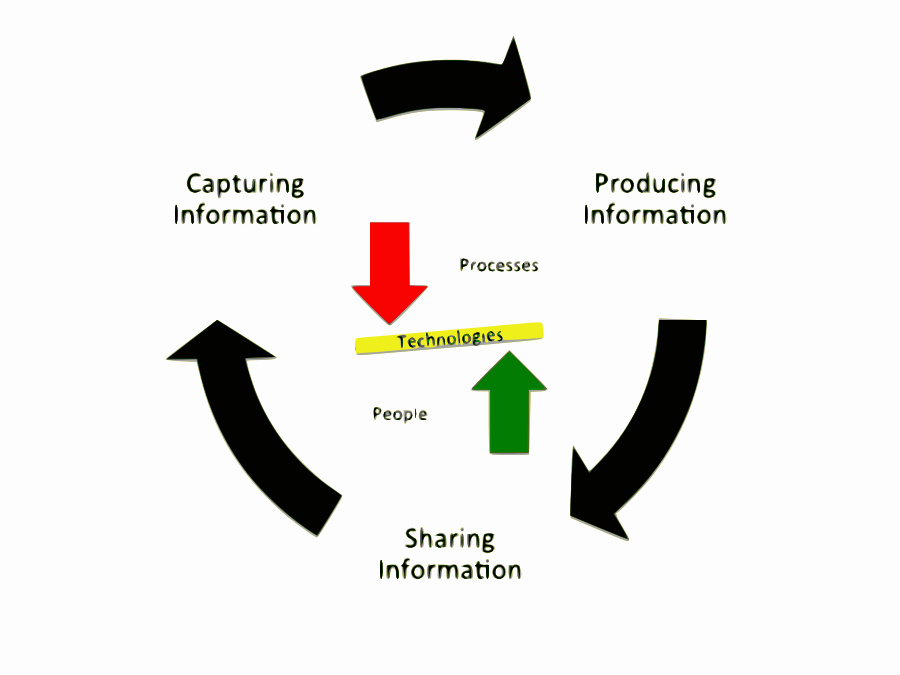
The term Enterprise Content Management (ECM) is used to describe the strategies, methods, and tools to produce, share and capture information in organizations. Humans and/or computer systems use this structured (e.g., data in databases), semi-structured (e.g., social media) and unstructured (e.g., emails) information to make decisions that can improve the organization. Since every individual/team/group/unit/department produces and consumes information thus it becomes imperative that organizations start thinking about how to provide the right information to the right audience at the right time by taking into account how information flows holistically across the organization.
Organizations need to create the right balance between humans and/or computer systems to leverage information from internal and external sources. This balance comes from the understanding that humans and computer systems are both influenced by experiences and biases. The experiences and biases in computer systems emerge when humans decide (1) which data should be used, (2) how algorithms should use the data and (3) when to accept or reject the recommendations of the computer systems.
In today’s world, Big Data has captured the imagination of most organizations and how it can help improve them. Organizations are collecting more and more data every day, writing algorithms and mining for patterns to use this data for descriptive analytics, predictive analytics, prescriptive analytics, and even Artificial Intelligence. However, if an organization’s Big Data strategy lacks an ECM mindset and does not have mature data management governance processes in place then organizations would not be able to fully release the true potential of the information they continue to produce, share and capture.
To start having an ECM mindset for Big Data, organizations need to (1) identify the different structured, semi-structured and unstructured internal/external information sources consumed and produced by the organization, (2) identify all the obstacles in the smooth flow of information and (3) train all individuals to see all data as assets to be leveraged.
First, let’s identify some of the internal and external information sources. Here is a non-exhaustive list to get started:
Second, let’s look at some of the obstacles to smooth information flows across organizations:
Lastly, to help individuals in considering the importance of data, (1) a culture of data as leverage needs to be created, (2) individuals should be empowered to use data to enhance and challenge the business models, (3) every individuals’ data success and failures should be encouraged and shared so that lessons can be learned and (4) there should be quicker and easier ways for individuals to sift through historical and new incoming data.
For an ECM mindset lets understand the complexities, intricacies, and subtleties of data –> information –> knowledge by asking the following questions:
|
Today |
Tomorrow |
|
Who is incentivized at the executive, middle management and frontline individuals’ levels for making information-based decisions? | Who should be incentivized at the executive, middle management and frontline individuals’ levels for making information-based decisions? |
| What happens to information when it is produced and consumed? | What should happen to information when it is produced and consumed? |
| Where are the entry and exit points of data? | Where should be the entry and exit points of data? |
| When does information become irrelevant? | When should information become irrelevant? |
| Why all information is important? |
Why all the information should be important? |
When you are asking yourself the above questions, keep in mind a survey of data scientists that revealed that 80% of the time in data is spent on collecting data sets, cleaning the data and organizing data. The reason for this is (1) there are no comprehensive lists of all the relevant data sets available inside and/or outside organizations, (2) there are no agreed-upon consistent international standards on how data sets should be published and/or obtained, (3) there are no substantially automated ways (yet) of how to get rid of all junk data and (4) holistic global data exchange standards across industries don’t exist. Now, imagine if your organization had an ECM mindset, what benefits would you reveal?
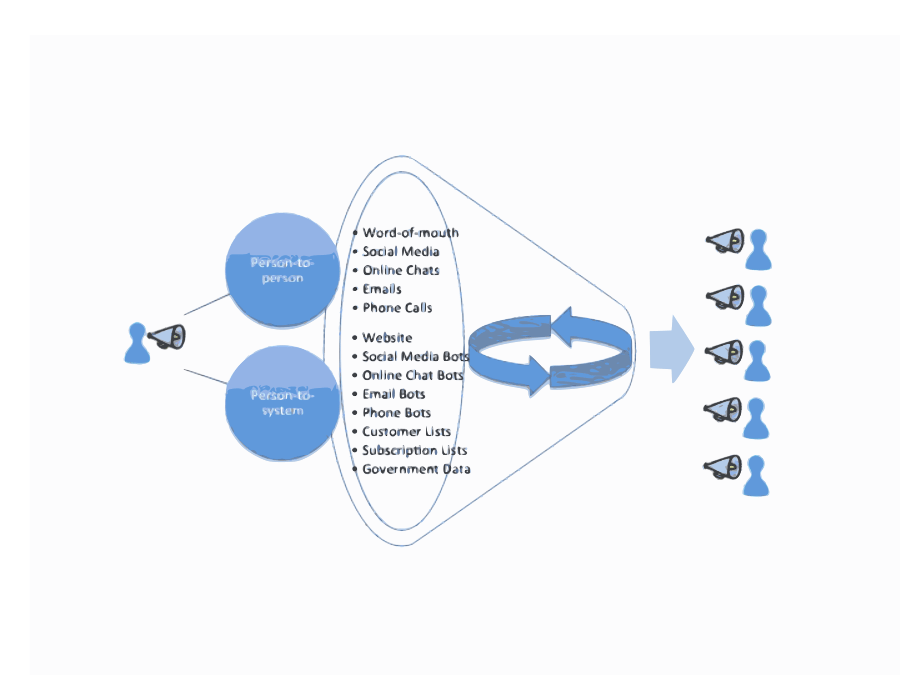
Customers are the lifeblood of any organization. In order to capture and track customer information (e.g., demographics, buying habits, satisfaction, and loyalty, etc.), organizations use information systems called Customer Relationship Management (CRM). CRM is utilized by sales, marketing, customer support services, and other organizational functions to capture new and potential customer information from multiple sources (e.g., websites, email, phone calls, chats, customer lists, social media, government data, etc.) into a single source of reference.
CRM provides the organization to have “one voice” when addressing customer-related activities and provide internal organizational consistency. However, a standalone CRM is useless unless it is augmented with the right people, efficient processes and effective technologies. From a people’s perspective, customer relationship development becomes the responsibility of any individual who interacts with the customer at any level. From a process perspective, enhanced customer experiences should be the goal. From a technology perspective, information systems should be able to quickly capture customer information, be easy to use and always be available anytime anywhere.
In order to understand if CRM is helping or hurting your customers, ask the following questions to assess what is happening and what should be happening within your organization:
|
Today |
Tomorrow |
| Who is responsible for customer relationships? | Who should be responsible for customer relationships? |
| What happens when customer relationships do not pan out? | What should happen when customer relationships do not pan out? |
| Where does customer relationships take place? | Where should customer relationships take place? |
| When are customer relationships developed? | When should customer relationships be developed? |
| Why customer relationships are important? | Why customer relationships should be important? |
When you are asking the above questions across all levels of the organization, take into consideration the direct and indirect (e.g., word of mouth, organizational reputation, (ex) employee feedback, etc.) ways of developing customer relationships. Keep in mind that customers are there to buy into your ideas, products, and services and thus they need to trust you at some level. Customers should be able to:

 Welcome to Khan's Blog
You must be logged in to post a comment.