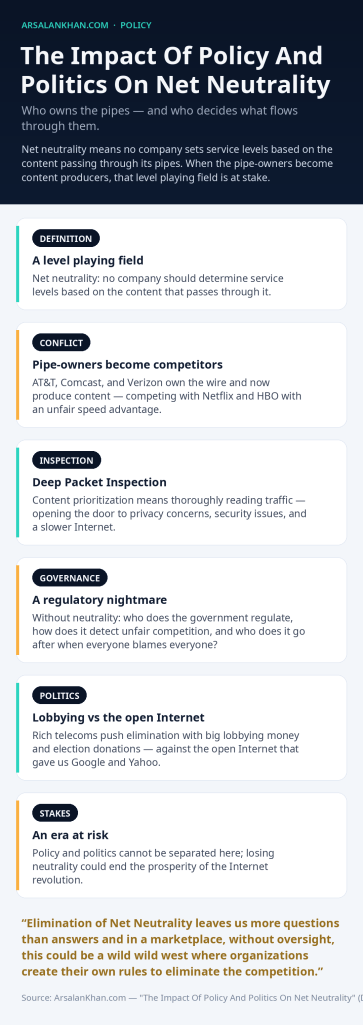
Net Neutrality is the concept that no company should be able to determine what level of services it can provide based on the content that passes through it. In other words, this means that there should be a level playing field for everyone to use the Internet and its content.
Companies like AT&T, Comcast, and Verizon that provide the underlying Internet “pipes” as cable companies and Internet Service Providers (ISP) are now interested in producing content. From their corporate standpoint, this makes sense since these companies are exploring new areas for revenue generation to maximize profits. At the same time, this new direction also puts these companies in direct competition with content providers such as Netflix and HBO. While competition is good in the marketplace but this new direction gives the cable companies and ISPs an unfair advantage of delivering their own content faster than their competition since they own the “wire”.
For Internet technologies, the policy and political perspectives revolve around the issues of governance. These perspectives are discussed below:
Impact of Policy on Internet Technologies:
Based on the content, cable companies and ISPs will be able to prioritize which content should load faster. This content prioritization will typically entail conducting Deep Packet Inspections (DPI) where content will be thoroughly read by these corporations. As we can imagine, DPI opens the door for privacy concerns, security issues and slowing down of the Internet.
If Net Neutrality is eliminated and the wire owners are given the capability to direct the network traffic as they please based on their own criterions then this would become a governance nightmare for the government. How would the government be able to regulate this unfair competition? How would the government be even able to find out about this unfair competition? How would the government manage the processes of net neutrality? How would the government know if security policies have been violated and private information has been compromised? How would the government even know who to go after since there could be a point where the content providers could blame the wire owners of slow traffic while wire owners could blame content providers for creating content that is not “optimized”. These are questions that the government has to consider to have effective governance that everyone can adhere to.
For governments, the elimination of Net Neutrality will entail developing policies, regulations, and technologies that monitor cable companies and ISPs to reduce the unfair advantage. Where would this authority come from? Where would the budget come from to create effective monitoring tools? Elimination of Net Neutrality leaves us more questions than answers and in a marketplace, without oversight, this could be a wild wild west where organizations create their own rules to eliminate the competition.
Impact of Politics on Internet Technologies:
The impact of Internet Technologies from a political perspective is noteworthy. The corporations that are pushing for the elimination of Net Neutrality are rich telecom organizations with big lobbying money and election donations. While I am not suggesting that lawmakers have been bought outright but something does not fit well. Why would lawmakers oppose an open Internet that has given us companies like Google and Yahoo! that created numerous job opportunities for US citizens?
For governments that are responsible for governing wire owners can be affected by the political maneuvering of lawmakers. This can produce challenges for effective governance. How can effective governance happen when the lawmaker wants more business in the state where these big corporations are located and provide campaign funding. For Internet technologies, this means that these technologies might not only have to comply with existing standards of packet deliveries and their flows but also might need to adhere to rules set by wire owners which might play politics and set in motion even that would be difficult to recover from.
As we can see that the policy and political perspectives are highly related and cannot be seen separately. For government, corporations, and individuals the lack of neutrality will mean an end of an era of prosperity that we saw from the Internet revolution.
Processing…
Success! You're on the list.
Whoops! There was an error and we couldn't process your subscription. Please reload the page and try again.
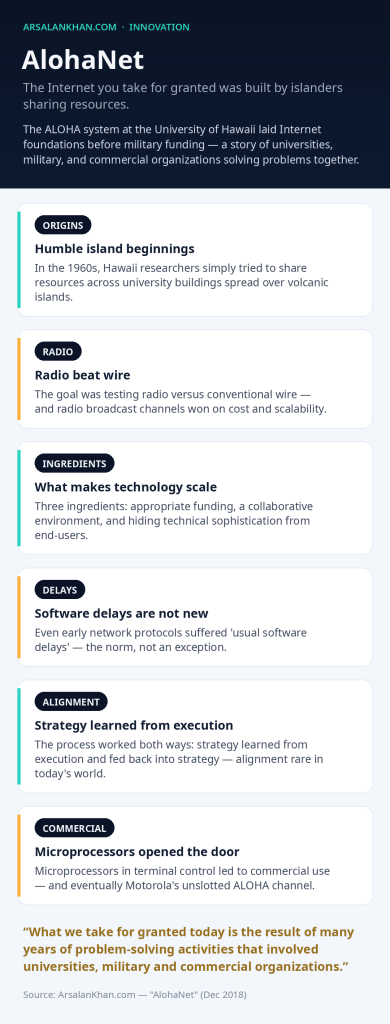
As an Enterprise Architect, I help organizations transform through people, processes, and technologies where I have had my fair share of dealing with technology infrastructure issues. However, in dealing with technology infrastructure, I have not paid that much attention to the underlying networks since I have always assumed that they will be there and always available. But after reading this article about Alohanet, I have come to realize that what we take for granted today is the result of many years of problem-solving activities that involved universities, military and commercial organizations. Thus, I now have a greater appreciation for the importance of networks for individuals and organizations.
Typically in conversations with others, I have often indicated that the Internet came from ARPANET, which was a military-funded project. While this is correct but it diminishes the role the University of Hawaii played in laying the foundations of the Internet before it was even funded by the military. Prior to this article, I was not aware of the University of Hawaii’s contributions. What is interesting is that the Internet started with some humble beginnings in the 1960s where some people in the university were just trying to figure out how to share resources across the various university buildings that were spread across the various Hawaiian Islands. To think that the foundations of the Internet came from islands that were created by volcanic activity in the middle of the ocean millions of years ago is truly awe-inspiring.
The author does a great job of beginning with a story and then getting into the technical details of network communications. There are a couple of interesting points that the author talks about which I will relay below:
Firstly, the original goal of the ALOHA system was not to create this robust network of networks (i.e., the Internet) that every individual and organization can use but it was simply to see if radio communications could be used as opposed to conventional wire communications when needed. Interestingly, this was uncharted territory even for the experts who at the beginning did not realize the importance of radio broadcast channels versus multiple access capabilities and conventional point-to-point wire channels. In hindsight, going with radio broadcast channels was the right choice because otherwise a point-to-point wire channel would have cost too much from an infrastructure standpoint and would not scale as rapidly due to the time it would take to establish various point-to-point channels. In my experience, technologies that do scale quickly have three main ingredients (1) appropriate funding (2) a collaborative environment and (3) the level of too much technical sophistication is hidden from the end-users. This is how I see the evolution of networks from its resource sharing to now the use of the Internet.
Secondly, the author refers to the “usual software delays” even when developing network protocols. To me, this seems to indicate that software delays are nothing new and although we pay a lot of attention to them today, they have been the ‘norm’ for a while. From a broader lens, this comment also illustrates the reliance on networking on the underlying software that is used to handle data packets. From this, we can decipher that the relationship between network and networking software is a very close one.
Thirdly, the international efforts that involved research facilities and universities to show the potential of data networks are noteworthy. It shows the combined resolve of humans to test and solve problems collaboratively. I am not sure if this still happens today where instead of being protectionists about technologies, it is used by and for everyone. From a broader perspective, this also means that the military, research facilities, and universities were looking at the exchange of data through broadcasted data packets going beyond just the national boundaries.
Fourthly, the advent of the microprocessors and its incorporation into terminal control was an important achievement that opened up the doors for commercial usage. One thing led to another, first a paper, then a book, then looking at various mediums for packet broadcasts and then the tipping point where Motorola introduced its unslotted ALOHA channel in the personal computer. Interestingly, all of these events happened in a decade and thus opened up new possibilities for not only the people involved but for everyone else.
Lastly, the alignment of strategy and theoretical realities is I believe to be the key to all of what was going on. It seems like the process of learning went both ways where strategy learned from execution that fed back into strategy. In today’s world, this alignment is difficult to come by for many reasons. From a problem-solving perspective, this misalignment can result in delays, overruns, and frustrations. I am sure the data packet broadcast journey had its own issues as well but that did not deter people from keeping the eye on the big picture. Where would we have been today if the misalignment continued and there was no resolution? I would argue that the Internet would still be developed, networks would be incrementally improved but perhaps the Internet revolution would at least be delayed.
In conclusion, this article showcases the human resolve to pile through uncharted technical territories, figuring things out as they went along and the resolve to accomplish the desired objectives. It also illustrates the happenstance of putting the ALOHA system on the list for Interface Message Processors (IMP). There were numerous moving parts but at the end sending of data packets through the broadcast channel was a success that paved the way for future innovations.
Processing…
Success! You're on the list.
Whoops! There was an error and we couldn't process your subscription. Please reload the page and try again.
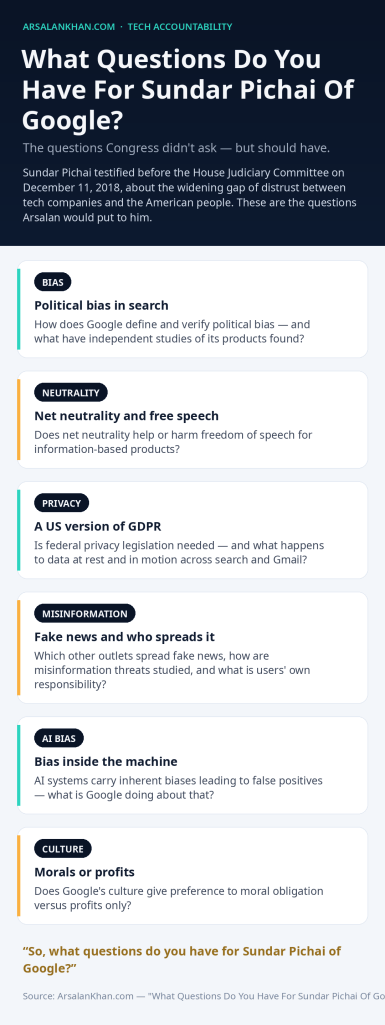
Sundar Pichai, the CEO of Google, testified before the House Judiciary Committee on December 11, 2018, to discuss “the widening gap of distrust between technology companies and the American people.” Prior to the hearings, Sundar Pichai’s prepared statement was released to the public.
Following is the prepared written statement of Sundar Pichai, along with a list of my own questions at the end:
HEARING BEFORE THE UNITED STATES HOUSE JUDICIARY COMMITTEE ON “TRANSPARENCY & ACCOUNTABILITY: EXAMINING GOOGLE AND ITS DATA COLLECTION, USE, AND FILTERING PRACTICES”
December 11, 2018
Chairman Goodlatte, Ranking Member Nadler, distinguished members of the Committee: Thank you for the opportunity to be here today.
I joined Google 15 years ago and have been privileged to serve as CEO for the past three years—though my love for information and technology began long before that. It’s been 25 years since I made the US my home. Growing up in India, I have distinct memories of when my family got its first phone and our first television. Each new technology made a profound difference in our lives. Getting the phone meant that I could call ahead to the hospital to check that the blood results were in before I traveled 2 hours by bus to get them. The television, well, it only had one channel, but I couldn’t have been more thrilled by its arrival! Those experiences made me a technology optimist, and I remain one today. Not only because I believe in technology, but because I believe in people and their ability to use technology to improve their lives. I ’m incredibly proud of what Google does to empower people around the world, especially here in the US.
I’d like to take a moment to share a bit of background on that. 20 years ago, two students—one from Michigan and one from Maryland— came together at Stanford with a big idea: to provide users with access to the world’s information. That mission still drives everything we do, whether that’s saving you a few minutes on your morning commute or helping doctors detect disease and save lives. Today, Google is more than a search engine. We are a global company that is committed to building products for everyone. That means working with many industries, from education and healthcare to manufacturing and entertainment.
Even as we expand into new markets we never forget our American roots. It’s no coincidence that a company dedicated to the free flow of information was founded right here in the US. As an American company, we cherish the values and freedoms that have allowed us to grow and serve so many users. I am proud to say we do work, and we will continue to work, with the government to keep our country safe and secure. Over the years our footprint has expanded far beyond California to states such as Texas, Virginia, Oklahoma and Alabama. Today in the US, we’re growing faster outside of the Bay Area than within it. I’ve had the opportunity to travel across the country and see all the places that are powering our digital economy—from Clarksville, to Pittsburgh, to San Diego, where we recently launched a partnership with the USO to help veterans and military families. Along the way, I’ve met many people who depend on Google to learn new skills, find jobs, or build new businesses. Over the past year, we have supported more than 1.5 million American businesses. Over the past three, we have made direct contributions of $150 billion to the US economy, added more than 24,000 employees, and paid over $43 billion to US partners across Search, YouTube, and Android. These investments strengthen our communities and support thousands of American jobs.
They also allow us to provide great services to our users to help them through the day. It’s an honor to play this role in people’s lives, and it’s one we know comes with great responsibility. Protecting the privacy and security of our users has long been an essential part of our mission. We have invested an enormous amount of work over the years to bring choice, transparency, and control to our users. These values are built into every product we make.
We recognize the important role of governments, including this Committee, in setting rules for the development and use of technology. To that end, we support federal privacy legislation and proposed a legislative framework for privacy earlier this year.
Users also look to us to provide accurate, trusted information. We work hard to ensure the integrity of our products, and we’ve put a number of checks and balances in place to ensure they continue to live up to our standards. I lead this company without political bias and work to ensure that our products continue to operate that way. To do otherwise would go against our core principles and our business interests. We are a company that provides platforms for diverse perspectives and opinions—and we have no shortage of them among our own employees. Some of our Googlers are former servicemen and women who have risked much in defense of our country. Some are civil libertarians who fiercely defend freedom of expression. Some are parents who worry about the role technology plays in our households. Some—like me—are immigrants to this country, profoundly grateful for the freedoms and opportunities it offers. Some of us are many of these things.
Let me close by saying that leading Google has been the greatest professional honor of my life. It’s a challenging moment for our industry, but I’m privileged to be here today. I greatly appreciate you letting me share the story of Google and our work to build products worthy of the trust users place in us.
Thank you for your attention. I look forward to answering your questions.
The committee members asked questions on behalf of the Google users in general and the American public in particular. Along the same lines, I have compiled the following questions that might help:
What do you define as political bias?
How would you verify/account for political biases in your search results?
Do you think Net Neutrality hurts or harms freedom of speech for your information-based products?
Will you be censoring search results and other information products based on the origination of the inquiry?
Do you have tools to make sure and verify countries aren’t blocking information?
Do you think a US version of GDPR is needed? How will this affect your business?
What recourse do you have for those whose data was breached under your company?
Can you share the report of the independent study related to political bias and what steps have you taken from that study to improve your search results and other information products?
What steps are you taking or plan to take to reduce information bias at Google?
Can you walk through what happens to data at rest and in motion across search, Gmail and Google’s other information products?
What is the lowest threshold in term of money for anyone to advertise on Google and how is the validity/reality of these ads done?
What processes and tools you have in place that makes every employee and business conscious of their responsibility for safeguarding Google users’ data?
Which other social media outlets are also responsible for the spreading of fake news?
How is Google going to work with governments, United Nations (UN) and other international entities? What data are you going to be sharing with these entities?
How will Google strike a balance between free speech and censorship (intentional and unintentional)?
What background investigations would you be doing on businesses that are on Google?
How are you proactively looks at threats at all levels from a broader prospective?
Does Google’s culture give preference to moral obligation versus profits only?
How many independent studies have occurred across all of Google’s information products to check for misinformation threats?
How much do you think is the personal responsibility of Google users’ biases when it comes to sharing fake news on purpose or by accident? What would happen to these users?
As you utilize Artificial Intelligence, these systems can also have inherent biases leading to false positives. What are you doing to address this?
What would Google do if asked by friendly governments to interfere with what information other countries’ get across all information products?
If your user’s data is stored outside the country whose laws would you abide by, the users’ country or the country where data resides or where data is in motion?
Since Google is the most used search engine in the world along with its active participation in many industries, it is your right to ask your questions through your senators and representatives. Feel free to ask questions below as well.
So, what questions do you have for Sundar Pichai of Google?
Processing…
Success! You're on the list.
Whoops! There was an error and we couldn't process your subscription. Please reload the page and try again.
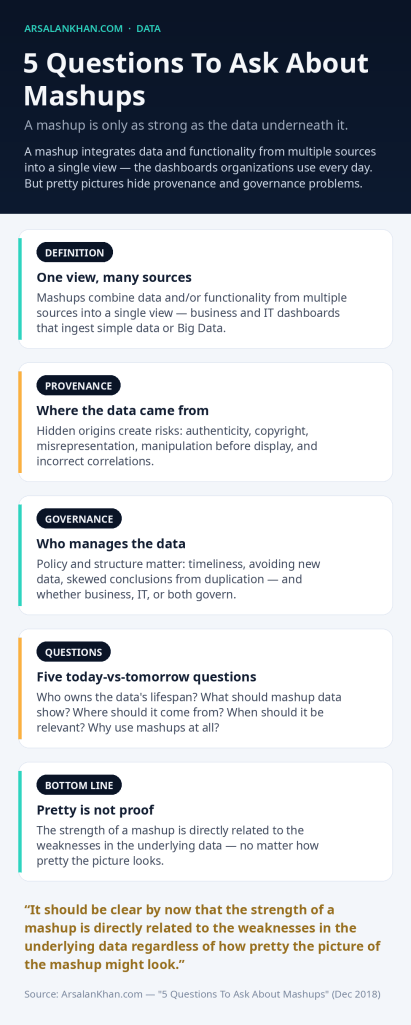
In computing, a mashup integrates/combines data and/or functionality from multiple sources and presents it in a single view. In organizations, mashups are used every day in the form of business (accounting, administration, business development, customer service, engineering, finance, human resources, management, manufacturing, marketing, operations, production, research and development and sales) dashboards and Information Technology (IT) dashboards. These dashboards can ingest simple data and/or even Big Data and then show an overall summarized visualization of what is going on.
In order for mashups to work, there are business processes and data management procedures that need to be followed. By consistently providing relevant data, mashups can reveal great insights and also help in strategizing. At its core, mashups “gather” data from multiple sources where data might have been manually or automatically (e.g., IoT) entered. Since the data is being pulled from various sources, it can create issues in terms of provenance and governance.
Provenance of Mashups
For provenance, since the origin of the data is not always displayed, this can create problems in terms of:
For governance, since policy, organization, and structuring of the data matters, this can create problems in terms of:
Timeliness of data
Unintentional avoidance of new data
Skewed conclusions due to duplication of data
Deciding if/when data governance should be done by Business or IT or both
In light of the above issues, let’s ask the following questions about mashups in your organization:
Today
Tomorrow
1.
Who is responsible for defining and managing data’s lifespan in mashups?
Who should be responsible for defining and managing data’s lifespan in mashups?
2.
What does your mashups data show you?
What should your mashup data show you?
3.
Where does the data come from in mashups?
Where should the data come from in mashups?
4.
When data is relevant?
When should data become relevant?
5.
Why mashups are used?
Why mashups should be used?
It should be clear by now that the strength of a mashup is directly related to the weaknesses in the underlying data regardless of how pretty the picture of the mashup might look.
Processing…
Success! You're on the list.
Whoops! There was an error and we couldn't process your subscription. Please reload the page and try again.












You must be logged in to post a comment.