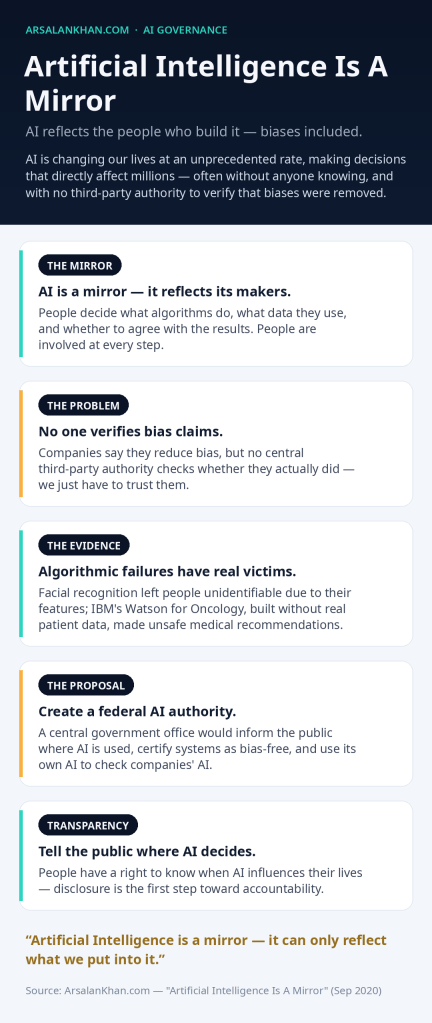
Artificial Intelligence (AI) is changing our lives at an unprecedented rate. Artificial Intelligence is being used to make decisions that directly affect millions of people. Most of the time people are not aware that Artificial Intelligence is being used. For the few people who know that Artificial Intelligence is being used to influence their lives, they have no way of knowing if biases have been removed from the Artificial Intelligence. People just have to trust the companies will do their best to reduce biases in Artificial Intelligence. Depending upon the motivations and the resources available in companies, eliminating biases in Artificial Intelligence might not be at the top of their list.
So, what is the problem? There is no central third-party authority to verify if companies have actually reduced biases in their Artificial Intelligence.
At its core, Artificial Intelligence is a set of instructions (aka algorithms) that use data to make decisions. There are three issues here: 1. People determine what the algorithms should do 2. People determine what data to use 3. People determine if they agree or disagree with the decisions made by Artificial Intelligence
As we can see, there are people involved in every aspect of creating and using Artificial Intelligence. Algorithms can intentionally or unintentionally create a disadvantage for people. In one example, algorithmic failures in facial recognition have resulted in people becoming unidentifiable due to their facial features. In another example, by not using real cancer patient data IBM’s Watson for Oncology made unsafe medical recommendations. These are just a few examples but they will continue to grow as AI becomes an essential part of our lives.
So, what can be done? I think we can solve these issues by creating a central authority/office at the Federal government level. The purpose of this central authority/office would be to inform the public if and where Artificial Intelligence is being used and if the Artificial Intelligence being used has any biases. Companies would inform this central authority/office about their uses of Artificial Intelligence and this central authority/office would certify if these Artificial Intelligence are bias-free. This central authority/office will have its own Artificial Intelligence to check other Artificial Intelligence created by companies.
In 2011, Marc Andreessen said that “software is eating the world.” Today, this is more truer that ever. Technology has become an essential part of the our daily lives. Modern life is inconceivable without technology and in particular software that powers these technologies. Software continues to create tremendous opportunities around the world. Software can range from making the Internet function, what software application you use at work, your cell phone to Artificial Intelligence and smart devices. Software is created and maintained everyday. Software can be purchased and is also available for free. Software can be built from scratch or bought pre-built. But before software is created, before the wonderful things that software can do, we have to gather requirements about what we want the software to do.
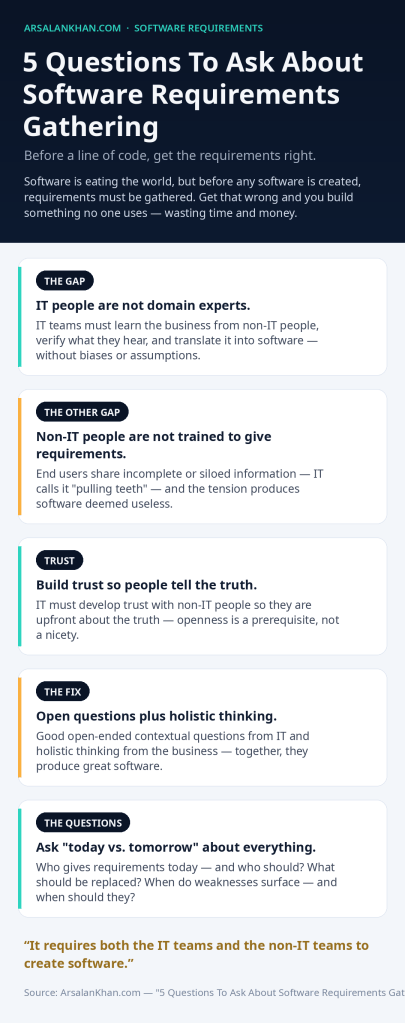
Software requirements gathering is one of the most important aspects of creating software. It is cumbersome, manual and detailed-orientated work but it has to be done. Incorrect requirements gathering can result in software being created that no one will use or ever know how to use thus wasting a lot of time and money. In organizations, software requirements gathering is typically done by people from or affiliated with the Information Technology (IT) Department and/or external IT vendors. The level of complexity in software requirements gathering various depending if the software is being bought off-the-shelf or being custom built. In either case, there are two main issues:
IT People Are Not Domain Experts
While most IT people are ‘trained’ in gathering requirements, they are not domain experts. This means that IT people have to talk to non-IT people in the organization to understand what is needed. Depending upon who the IT people talk to, the information has to be verified by other non-IT people and any available (updated) documentation. Additionally, IT people have to translate what they have learned from non-IT people with the idea of developing a software solution. The non-IT people are the end-users of the software and thus it becomes imperative that correct and timely information is collected without any biases and preconceived notions. The IT people have to develop trust with non-IT people so that it is easier for them to be upfront about the truth.
Non-IT People Are Not Trained In Giving Requirements
While most non-IT people are willing to help in answering questions from the IT people, they are not trained in giving requirements. This means information that non-IT people share might be siloed and unintentionally incomplete because they didn’t think it was ‘useful’ or ‘relevant’. When IT people encounter this, they refer to it as “pulling teeth”. This creates tension that leads to software which is deemed ‘useless’.
The reality is that it requires both the IT teams and the non-IT teams to create software. With good open-ended contextual questions from the IT teams and with holistic thinking from the non-IT teams, any organization can create great software. To get started here are a few self-reflecting questions to ask:
Today
Tomorrow
Who is going to give software requirements?
Who should be giving software requirements?
What has been replaced by software?
What should be replaced by software?
Where are the current roadblocks to software requirements gathering?
Where would the future roadblocks to software requirements gathering come from?
When do software requirements gathering reveals organizational weaknesses?
When should software requirements gathering reveal organizational weaknesses?
Why is software important for your organization?
Why should software be important for your organization?
5 Questions to Ask About Software Requirements Gathering
DevOps is a software development methodology that aims to increase the communications and collaboration between software developers and other IT professionals.
Software Architecture is a high level structure for developing software.
Information Technology (IT) Architecture is the process of developing IT specifications that includes software and systems.
Enterprise Architecture (EA) sits in between the Business and IT that captures the capabilities across the organization. EA helps determine strategy and intends to create alignment. This alignment may or may not result in the creation of system integration, system of systems, systems and/or software but if done correctly always results in business transformation across people, processes, products/ services and technologies.
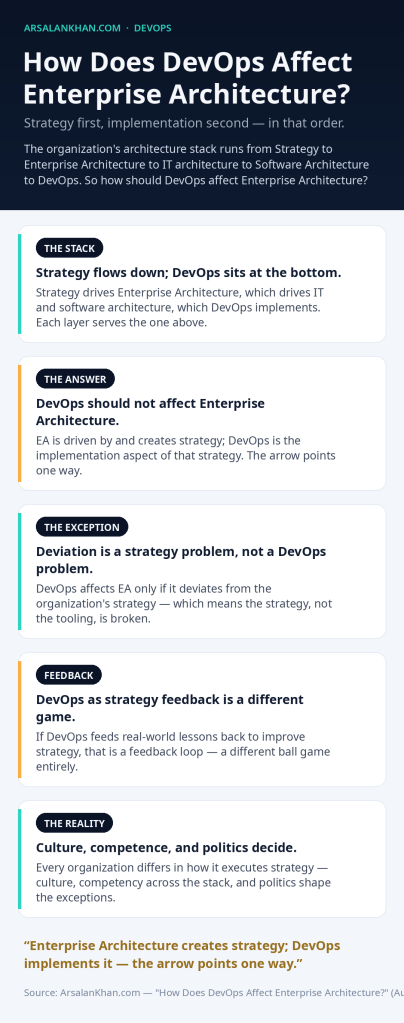
As we can see from these descriptions, an “organization’s architecture stack” would start from
From this understanding, following are the ways how DevOps affects EA:
It shouldn’t. EA is driven by and creates strategy while DevOps is the software/system implementation aspect of the strategy
DevOps affects EA if it deviates from the organization’s strategy
If DevOps is being used as a feedback mechanism to improve the strategy then that’s a totally different ball game
However, nothing is written in stone and there are exceptions in every organization based on how they execute the strategy, the feedback loop, their culture, competency of people across the organization’s architectural stack and of course politics.
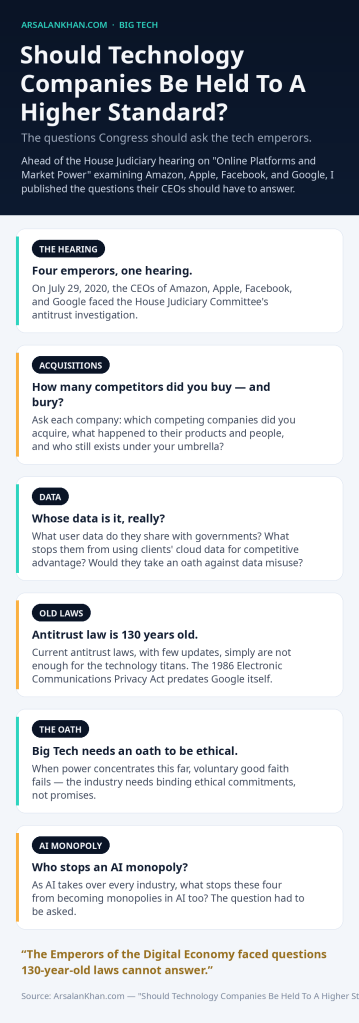
How many companies has your company (Amazon, Apple, Facebook and Google) acquired that were in direct competition with your company?
What did your company (Amazon, Apple, Facebook and Google) do with the existing products, processes, people, services and technologies of the companies that you acquired?
Can your company (Amazon, Apple, Facebook and Google) provide a list of companies that still exist under your umbrella after acquisition?
What procedures do you have in place to strike a balance between anti-poaching and people’s right to apply to any job that they want?
What is your company’s (Amazon, Apple, Facebook and Google) business relationships with each other?
What user information do your companies (Amazon, Apple, Facebook and Google) share with federal, state and local governments?
What antitrust laws should be in the books for your company (Amazon, Apple, Facebook and Google)?
As companies move into your cloud enviroments, what specific steps is your company (Amazon, Apple, Facebook and Google) taking to safeguard against using your client’s cloud data for your own competitive advantage?
What is your company (Amazon, Apple, Facebook and Google) doing to safeguard against internal and external data breaches for the purpose of corporate espionage?
As Artificial Intelligence (AI), takes over almost every industry, what steps is your company (Amazon, Apple, Facebook and Google) taking to not be a monoply in this area?
Would your company (Amazon, Apple, Facebook and Google) take an oath aganist misuse of data?
So, what questions do you have for Jeff Bezos of Amazon, Tim Cook of Apple, Mark Zuckerberg of Facebook and Sundar Pichai of Google?
Here are some of my comments as the hearing continues:
Current antitrust laws are simply not enough for the technology titians simply because these laws are 130 years old with few occasional updates here and there. #HouseJudiciaryCommittee
So, they want #BigTech to compete against other global companies but when they try to be in countries they dont agree with they object? #BigTechHearing
Companies grow by acquisition. But when that acquisition is to specifically dismantle competition then it becomes questionable. #BigTechOnBlast#BigTechHearing
No company should directly, indirect or in thier supply chain use forced/slaved labor. The question is how would they verify it independently. #BigTechHearing
A doctor's opinion is different than a doctor's medical advice. An opinion does not have to be supported by facts. A medical advice has to be supported by verifiable facts. #BigTechHearing
While Big Tech companies have a lot of users and a lot power, that does not imply that users are so gullible that they will believe anything they see. And would they? If yes, then this is bigger issue. #BigTechHearing




You must be logged in to post a comment.