
There’s a quiet truth in digital transformation that many leaders overlook:
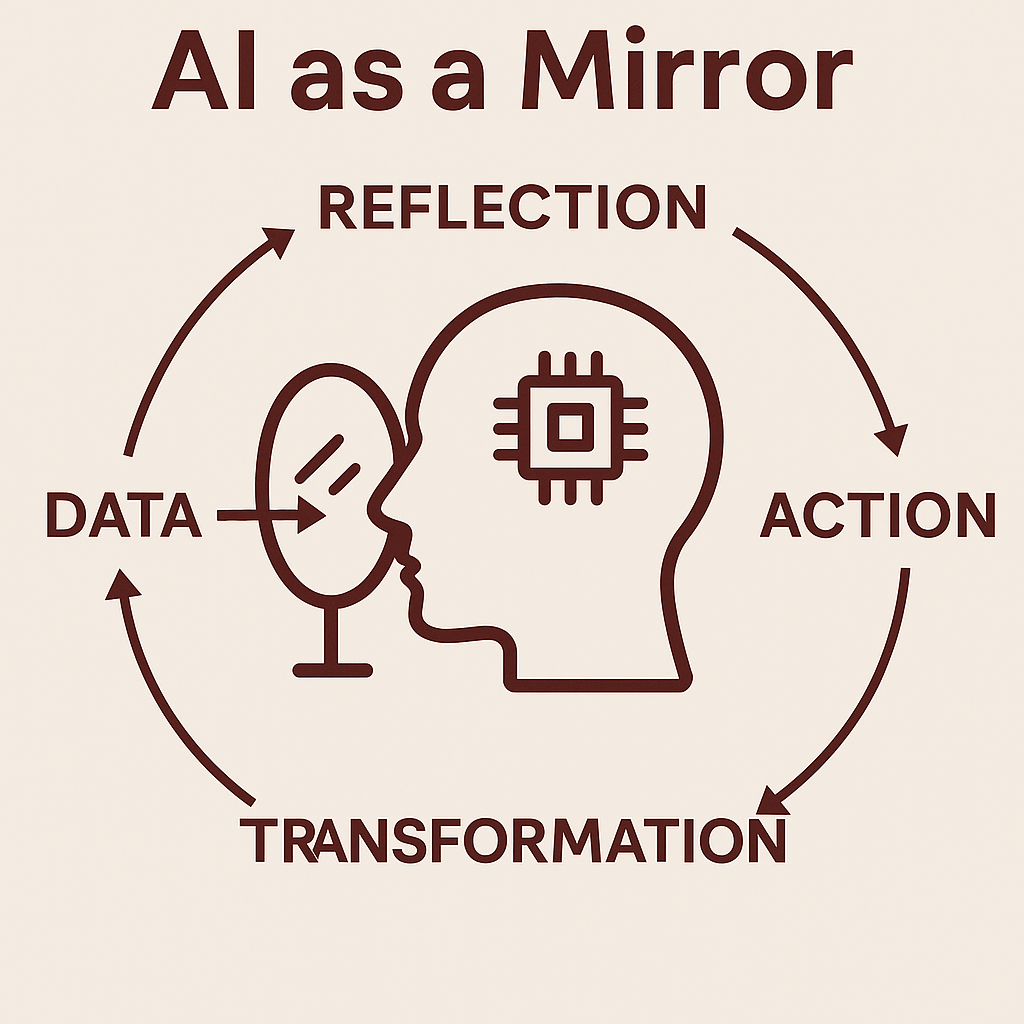
Artificial Intelligence doesn’t just analyze your business — it reflects it.
Every algorithm, every insight, every “surprising” pattern AI uncovers… is just a mirror showing the truth that’s already there. Sometimes it’s flattering. Sometimes it’s not.
The question is: are you ready to see what’s really in the mirror?
Who needs to pay attention to the mirror effect?
- Executives seeking to lead with transparency and accountability.
- Data scientists and AI teams who must ensure algorithms don’t just optimize — but tell the truth.
- Transformation leaders using AI to assess readiness and culture.
- Middle managers whose teams’ performance will soon be quantified in ways no dashboard ever has before.
What is the mirror effect in AI?
It’s the reality that AI learns from the data you feed it.
If your data is siloed, biased, outdated, or incomplete, AI will amplify those flaws.
If your processes are efficient, customer-centric, and aligned, AI will reveal that too — and accelerate it.
Example:
If AI recommends hiring fewer women in technical roles, that’s not “AI bias” out of nowhere. It’s the historical hiring data you gave it. The mirror is simply showing your past decisions.
Where does the mirror show up most?
- Recruitment systems reflecting past hiring patterns.
- Customer sentiment analysis exposing where you’re delighting customers — or letting them down.
- Operational analytics revealing bottlenecks you’ve normalized.
- Sales predictions that quietly expose overreliance on a handful of clients.
AI’s mirror isn’t just in the lab — it’s embedded in every decision-support tool you deploy.
When does the mirror matter most?
- Before a major transformation initiative, to establish a reality baseline.
- During AI pilot projects, when leadership wants to understand not just the tool — but the organization’s readiness.
- After cultural or structural changes, to see if reality matches the PowerPoint slides.
The mirror effect is most powerful at inflection points — when leaders are deciding where to invest, pivot, or double down.
Why is the mirror uncomfortable?
Because AI removes the comforting fog of “assumptions.”
It confronts leadership with patterns that may:
- Challenge the corporate narrative.
- Expose cultural or process weaknesses.
- Reveal the gap between stated values and actual behavior.
And here’s the kicker — once you’ve seen it, you can’t unsee it.
How to use the mirror to your advantage
- Audit your data before you use it.
Bad data isn’t just a technical issue — it’s a reputational one. - Invite cross-functional interpretation.
AI insights mean little without context from business, operations, and HR leaders. - Don’t shoot the messenger.
If AI reveals uncomfortable truths, resist the urge to blame the tech. The patterns existed before the mirror. - Act quickly on what you see.
The faster you address the issues, the faster your AI becomes a tool for acceleration — not just reflection. - Make transparency part of the transformation narrative.
Share “mirror moments” with your teams to build trust and alignment.
Final Thought
AI isn’t magic. It’s a lens.
And like any mirror, it will only reflect what’s in front of it.
If you don’t like what you see, the answer isn’t to smash the mirror — it’s to change the reality it reflects.

 Welcome to Khan's Blog
You must be logged in to post a comment.