
Business transformation is never just about technology. It’s about how strategy, culture, and execution align — and now, how artificial intelligence fits into that equation.
Many organizations adopt AI in isolated projects — a chatbot here, a forecasting tool there — without aligning it to a holistic transformation framework. That’s why so many AI pilots fail to scale.
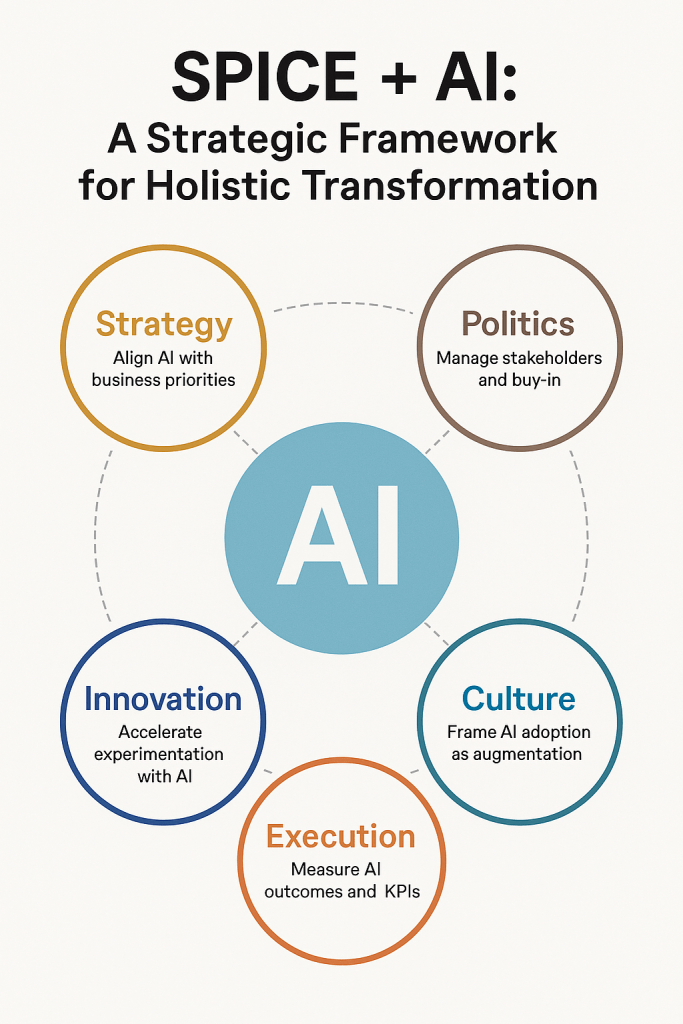
The SPICE model — Strategy, Politics, Innovation, Culture, Execution — already provides a clear lens for transformation. When integrated with AI adoption principles, SPICE becomes an even more powerful guide for leaders.
Who should use the SPICE + AI framework?
- C-suite executives driving enterprise-wide transformation.
- Digital strategy teams tasked with aligning AI initiatives to corporate goals.
- IT leaders who want AI adoption to succeed beyond technical deployment.
- Middle managers responsible for embedding AI into workflows.
What is the SPICE + AI approach?
SPICE is a leadership and transformation model that ensures all critical dimensions of change are addressed. Adding AI to the framework means:
- Strategy: AI initiatives are linked directly to business priorities.
- Politics: Stakeholder buy-in is proactively managed, with AI benefits communicated in business—not technical—terms.
- Innovation: AI is used to accelerate experimentation and unlock new business models.
- Culture: AI adoption is framed as human augmentation, not replacement.
- Execution: Measurable AI outcomes are built into performance metrics.
Where does this framework apply?
- Enterprise-wide transformation programs where AI is one of multiple enablers.
- Industry-specific shifts (banking automation, smart manufacturing, healthcare diagnostics).
- Cross-functional projects that require coordination between business units and IT.
When should SPICE + AI be applied?
- Before large-scale AI rollouts, to ensure readiness.
- During pilot programs, to identify scaling barriers early.
- After initial deployment, to evaluate alignment with transformation goals.
It’s not a one-time exercise — SPICE + AI is a continuous lens for ensuring alignment.
Why integrate AI into SPICE?
Because AI can:
- Automate execution without strategic alignment (a recipe for waste).
- Deepen silos if politics and culture aren’t addressed.
- Disrupt workflows without the change management needed for adoption.
By embedding AI considerations into every SPICE dimension, leaders avoid the trap of “AI for AI’s sake.”
How to apply SPICE + AI in practice
- Map AI use cases to strategic objectives
Every AI project should answer: “Which business metric will this improve?” - Identify political stakeholders early
Gain champions in both technical and non-technical leadership. - Set up AI-powered innovation labs
Use small-scale experiments to validate ideas before scaling. - Invest in AI literacy training
Culture change requires confidence, not just capability. - Measure execution outcomes in both business and AI terms
Include AI performance metrics alongside traditional KPIs.
Final Thought
AI is not a silver bullet — it’s an amplifier. Without a strategic framework like SPICE, it can just as easily amplify misalignment as it can amplify performance.
SPICE + AI ensures your transformation is not just digital, but deliberate.

 Welcome to Khan's Blog
You must be logged in to post a comment.